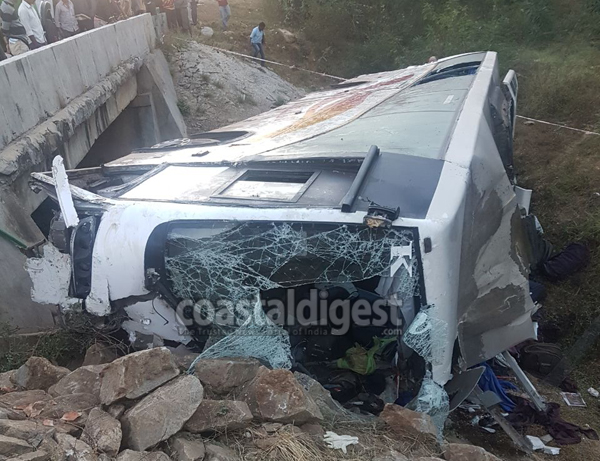
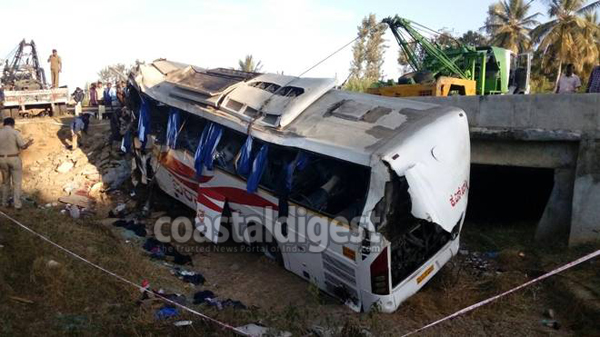
8 dead, a dozen injured as Dharmastala bound bus falls off bridge in Hassan

coastaldigest.com news network
January 13, 2018

Hassan, Jan 13: At least eight persons including two women died and around a dozen passengers suffered injuries when a KSRTC Airavata Bus fell off a bridge near Karekere on National Highway 75 in Hassan taluk around 3.30 am on Saturday. The bus was heading to Dharmastala from Bengaluru.

The police and ambulance reached the spot after nearby residents alerted them.

Sources said that seven people died on the spot while an injured passenger died at a hospital.

Five of the victims have been identified as Diana (22) from Mangaluru, Gangadhar N. (30) from Bengaluru and Bijo (25) from Belthangadi, besides the bus driver Lakshman and conductor Shivappa Chalavadi.

Two passengers who have been seriously injured are being treated in a private hospital in Hassan.

The reason for the accident is not known, though the police suspects that it could have been caused due to the driver’s negligence. The incident happened in Shantigrama Police Station limits.

Comments

Manzoor Ahammad Ali
 - 
Saturday, 13 Jan 2018

We belong to Allah and to Him we shall return.

Rahman
 - 
Saturday, 13 Jan 2018

Inna Lillahi wa inna ilayhi raji'un

Mohan
 - 
Saturday, 13 Jan 2018

Shocking accident. RIP

Kumar
 - 
Saturday, 13 Jan 2018

Horrible. Rest in peace

Ganesh
 - 
Saturday, 13 Jan 2018

Blame and full responsibility always on driver head

Add new comment

  • Coastaldigest.com reserves the right to delete or block any comments.
  • Coastaldigset.com is not responsible for its readers’ comments.
  • Comments that are abusive, incendiary or irrelevant are strictly prohibited.
  • Please use a genuine email ID and provide your name to avoid reject.
Media Release
November 24,2025

novel2.jpg

Sharjah, UAE: Ayisha Basheer Esra, a talented young writer hailing from Aramboor in Dakshina Kannada’s Sullia taluk, marked a significant milestone in her burgeoning literary career with the launch of her debut novel, The Betrayal of the Kingdom, at the Sharjah International Book Fair. The prestigious event, recognized as the world’s largest book fair, provided a fitting stage for the unveiling of Esra’s work.

The official release ceremony was conducted by Sheikh Abdullah bin Mohammed Al Qasimi, Director of the Religious Affairs Office of the Sharjah Government and a distinguished member of the royal family, underscoring the significance of Esra’s achievement. Mrs. Lini Shivaprasad, Principal of GEMS Millennium School, Sharjah, had the honor of receiving the first copy of the novel.

The event was graced by the presence of numerous distinguished guests, reflecting the widespread recognition of Esra’s literary talent and the anticipation surrounding her debut novel. Among the notable attendees were Syed Panakkad Munawwarali Shihab Tangal, Dr. Mariam Al Shenasi, the UAE’s renowned writer and Head of Dar Al Yasmin Publications, Dr. K. K. N. Kurup, Retired Vice Chancellor of Calicut University and Historian, Sharjah Businessman Shamsuddin Bin Mohideen, Nizar Talangara, President of the Sharjah Indian Association, V. T Salim, Director of Silver Home Real Estate, Munir Al Wafa, MD of Lipi Publication Akbar, and other esteemed individuals.

At the remarkably young age of eight, Esra has already established herself as a prolific writer, authoring and publishing collections of short stories in addition to her newly released full-length novel. Her dedication to writing and her exceptional talent have positioned her as one of the youngest authors to achieve such literary success. 

Esra is the daughter of Basheer and Haseena, residents of Aramboor, Sullia, and currently a student at Sharjah’s GEMS Millennium School. Her early accomplishments serve as an inspiration to aspiring young writers and a testament to the power of nurturing creativity from a young age.

novel1.jpg

Comments

Add new comment

  • Coastaldigest.com reserves the right to delete or block any comments.
  • Coastaldigset.com is not responsible for its readers’ comments.
  • Comments that are abusive, incendiary or irrelevant are strictly prohibited.
  • Please use a genuine email ID and provide your name to avoid reject.
News Network
November 26,2025

students.jpg

Bengaluru, Nov 26: Karnataka is taking its first concrete steps towards lifting a three-decade-old ban on student elections in colleges and universities. Deputy Chief Minister D.K. Shivakumar announced Wednesday that the state government will form a small committee to study the reintroduction of campus polls, a practice halted in 1989 following incidents of violence.

Speaking at a 'Constitution Day' event organised by the Karnataka Congress, Mr. Shivakumar underscored the move's aim: nurturing new political leadership from the grassroots.

"Recently, (Leader of the Opposition in Lok Sabha) Rahul Gandhi wrote a letter to me and Chief Minister (Siddaramaiah) asking us to think about restarting student elections," Shivakumar stated. "I'm announcing today that we'll form a small committee and seek a report on this."

Student elections were banned in Karnataka in 1989, largely due to concerns over violence and the infiltration of political party affiliates into campus life. The ban effectively extinguished vibrant student bodies and the pipeline of young leaders they often produced.

Mr. Shivakumar, who also serves as the Karnataka Congress president, said that former student leaders will be consulted to "study the pros and cons" of the re-introduction.

Acknowledging the history of the ban, he added, "There were many criminal activities taking place back then. We’ll see how we can conduct (student) elections by regulating such criminal activities."

The Deputy CM reminisced about his own journey, which began on campus. He recalled his political activism at Sri Jagadguru Renukacharya College leading to his first Assembly ticket in 1985 at the age of 23. "That's how student leadership was at the time. Such leadership has gone today. College elections have stopped," he lamented, adding that for many, college elections were "like a big movement" where leaders were forged.

The move, driven by the Congress high command's push to cultivate young talent, will face scrutiny from academics and university authorities who have, in the past, expressed concern that the return of polls could disrupt the peaceful academic environment and turn campuses into political battlegrounds.

Comments

Add new comment

  • Coastaldigest.com reserves the right to delete or block any comments.
  • Coastaldigset.com is not responsible for its readers’ comments.
  • Comments that are abusive, incendiary or irrelevant are strictly prohibited.
  • Please use a genuine email ID and provide your name to avoid reject.
News Network
December 6,2025

pilot.jpg

New Delhi: IndiGo, India’s largest airline, faced major operational turbulence this week after failing to prepare for new pilot-fatigue regulations issued by the Directorate General of Civil Aviation (DGCA). The stricter rules—designed to improve flight safety—took effect in phases through 2024, with the latest implementation on November 1. IndiGo has acknowledged that inadequate roster planning led to widespread cancellations and delays.

Below are the key DGCA rules that affected IndiGo’s operations:

1. Longer Mandatory Weekly Rest

Weekly rest for pilots has been increased from 36 hours to 48 hours.

The government says the extended break is essential to curb cumulative fatigue. This rule remains in force despite the current crisis.

2. Cap on Night Landings

Pilots can now perform only two night landings per week—a steep reduction from the earlier limit of six.

Night hours, defined as midnight to early morning, are considered the least alert period for pilots.

Given the disruptions, this rule has been temporarily relaxed for IndiGo until February 10.

3. Reduced Maximum Night Flight Duty

Flight duty that stretches into the night is now capped at 10 hours.

This measure has also been kept on hold for IndiGo until February 10 to stabilize operations.

4. Weekly Rest Cannot Be Replaced With Personal Leave

Airlines can no longer count a pilot’s personal leave as part of the mandatory 48-hour rest.

Pilots say this closes a loophole that previously reduced actual rest time.

Currently, all airlines are exempt from this rule to normalise travel.

5. Mandatory Fatigue Monitoring

Airlines must submit quarterly fatigue reports along with corrective actions to DGCA.

This system aims to create a transparent fatigue-tracking framework across the industry.

The DGCA has stressed that these rules were crafted to strengthen flight safety and align India with global fatigue-management standards. The temporary relaxations are expected to remain until February 2025, giving IndiGo time to stabilise its schedules and restore normal air travel.


Comments

Add new comment

  • Coastaldigest.com reserves the right to delete or block any comments.
  • Coastaldigset.com is not responsible for its readers’ comments.
  • Comments that are abusive, incendiary or irrelevant are strictly prohibited.
  • Please use a genuine email ID and provide your name to avoid reject.