



A tribute to Mirza Ghalib, the legendary poet

coastaldigest.com web desk 
December 27, 2017

Poet and philosopher Mirza Ghalib, who contributed greatly towards Urdu and Persian literature, was paid tributes by the Google with its doodle on his 220th birth anniversary on December 27, 2017. The Google Doodle fittingly shows Ghalib with his pen and paper, knitting his imagination, with a backdrop of buildings of Mughal architecture.

In its blog post, Google said, “His (Ghalib) verse is characterised by a lingering sadness borne of a tumultuous and often tragic life — from being orphaned at an early age, to losing all of his seven children in their infancy, to the political upheaval that surrounded the fall of Mughal rule in India. He struggled financially, never holding a regular paying job but instead depending on patronage from royalty and more affluent friends.”

“But despite these hardships, Ghalib navigated his circumstances with wit, intellect, and an all-encompassing love for life. His contributions to Urdu poetry and prose were not fully appreciated in his lifetime, but his legacy has come to be widely celebrated, most particularly for his mastery of the Urdu ghazal (amatory poem),” the post added.

Born on December 27, 1797 in Agra, when Mughal Empire was counting its last days, Mirza Ghalib began his literary works at the age of 11. Although his first language was Urdu, Turkish and Persian were spoken at home too. After getting married by the age of 13, he settled in Delhi. 

In one of his letters, Ghalib describes his marriage as the second imprisonment after the initial confinement that was life itself. The idea that life is one continuous painful struggle which can end only when life itself ends, is a recurring theme in his poetry.

His poem and Ghazals have been translated and recited in multiple languages across the globe. In 1850, he was honoured with the title of Dabir-ul-Mulk by Mughal emperor Bahadur Shah Zafar II. During the last years of the Mughal Empire, Mirza Ghalib was not only an important member of the Mughal court, but also the poet tutor to the emperor's eldest son, Prince Fakhr-ud Din Mirza. The emperor also appointed him as the royal historian of the Mughal court.

Following the decline of the Mughal Empire, Mirza Ghalib struggled to make a living. Much of his fame came to him posthumously and in his lifetime, despite his best attempts, he couldn't get the British to restore his full pension.

Mirza Ghalib died in Delhi on 15 February 1869 and the house where he lived, in Old Delhi, has been turned into "Ghalib Memorial". Known as "Ghalib ki Haveli", it permanently houses Ghalib's exhibitions.

Imprints on heart and mind

One of the recurring themes in Mirza Ghalib's poems is the idea that life is a continuous painful struggle which ends only with life itself. His poems perfectly capture the pathos of love and continue to be relevant even after all these years.  Here are some of the famous sher by the legendary poet that manage to pierce the heart:

aah ko chaahiye ik umr asar hone tak
kaun jeeta hai teri zulf ke sar hone tak

(Translation: A lifetime passes before a sigh shows its effect, who would wait so long to see you fixing the tangles in your hair)

un ke dekhe se jo aa jaati hai munh par raunaq
vo samajhte hain ki beemar ka haal achha hai

(Translation: My face lights up when I see her and she feels that the sick me is now okay)

hazaron khwahishen aisi ki har khwahish pe dam nikle,
bahut nikle mire armaan lekin phir bhi kam nikle

(Translation: I have a thousand desires, all desires worth dying for,
Though many of my desires were fulfilled, many remained unfulfilled)

hum ko maalum hai jannat ki haqiqat lekin
dil ke khush rakhne ko 'ghalib' ye khayal achha hai

(Translation: We know what's the truth, but to please yourself, this thought is good)

hum toh fanaah ho gaye uskii aankhen dekh kar, Ghalib,
na jaanein woh aaina kaise dekhte hongey

(Translation: I just lost my mind after seeing her eyes, Ghalib,
I wonder how she sees herself in the mirror)

ye na thi hamari qismat ki visal-e-yaar hota
agar aur jeete rahte yahi intezar hota

(Translation: That my love be consummated, fate did not ordain
Living longer had I waited, would have been in vain)

Kaid-e-hayat O band-e-gham asalm men donon ek hain
Mauth se pahle aadmi gham se najat paye kyon?

(Translation: The prison of life and the bondage of grief are one and the same/ Before the onset of death, why should man expect to be free of grief?)

Comments

Sameer
 - 
Tuesday, 16 Jan 2018

Good article. Translation of poem is poor.

Muhammed Ali Uchil
 - 
Wednesday, 27 Dec 2017

Super article, a fiiting tribute to this great poet

Add new comment

  • Coastaldigest.com reserves the right to delete or block any comments.
  • Coastaldigset.com is not responsible for its readers’ comments.
  • Comments that are abusive, incendiary or irrelevant are strictly prohibited.
  • Please use a genuine email ID and provide your name to avoid reject.
News Network
January 19,2026

New Delhi: Setting speculation to the rest, the CPI(M) has made it clear that it is open to have an electoral understanding with the Congress “to defeat” the Trinamool Congress and the BJP in West Bengal Assembly election even as it is all set to take on the grand old party in Kerala accusing it of “found wanting” in fighting the Hindutva forces.

The CPI(M) also said that it will contest the Tamil Nadu election “with DMK and its allies to defeat the BJP and its allies”, amid a section in the Congress triggering confusion about its participation in the M K Stalin-led coalition over demand over power-sharing and more seats. It is also willing to join hands with Congress and others in Assam and Puducherry to defeat the BJP.

The decisions came at a three-day meeting of the CPI(M) Central Committee in Thiruvananthapuram, which ended on Sunday after reviewing the poll preparations in the poll-bound states.

The CPI(M)'s decision came even as a section led by West Bengal Congress president Subhankar Sarkar is averse to tying up with the Left Front, claiming that their party is not benefitted by the electoral understanding. Both Congress and CPI(M)-led Left Front had electoral understanding in 2016 and 2021 Assembly elections and 2024 Lok Sabha polls.

Congress and the Left Front fought together for the first time in 2016 when Congress won 44 seats and the CPI(M) got 26. In 2021, the Left Front and the Congress drew a blank. In the 2024 Lok Sabha polls, Congress managed to win one seat while the Left did not win any. In the 2019 Lok Sabha polls, both fought against each other with Congress winning two and the Left none.

“In Bengal, the party will work for the defeat of both the TMC and the BJP, which are trying to polarise the society. We will try to rally all the forces that are ready to work against them,” the CPI(M) said in a statement without naming Congress by name. Senior leaders said there is no change in its strategy of pooling all non-BJP, non-TMC votes.

However, the party was critical of the Congress in Kerala where both will fight against each other.

The CPI(M) said it would "expose the BJP-led Union government’s denial of rightful dues to Kerala, the fiscal constraints imposed and the overall attack on federalism" as also "expose the failure of the Congress to effectively counter this attack on federalism, as the largest opposition party in the Parliament".

"The Congress, especially in Kerala, was found wanting in the fight against communal RSS-BJP, ideologically and this will also be exposed before the people," it added.

In Assam, it said, the CPI(M) will work for the mobilisation of all the anti-BJP parties and forces and defeat the rabidly communal and divisive BJP government. The Left parties are cooperating with Congress in the north-eastern state. In Puducherry, it said it will work for the defeat of the BJP alliance government.

Comments

Add new comment

  • Coastaldigest.com reserves the right to delete or block any comments.
  • Coastaldigset.com is not responsible for its readers’ comments.
  • Comments that are abusive, incendiary or irrelevant are strictly prohibited.
  • Please use a genuine email ID and provide your name to avoid reject.
News Network
January 20,2026

iran.jpg

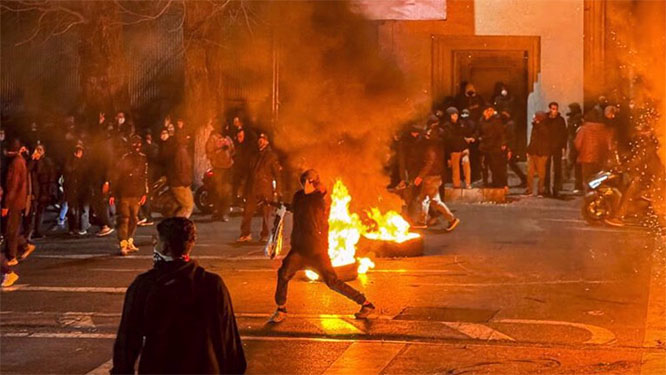
Iranian security and intelligence forces have captured more than 470 individuals in three provinces, identified as key figures behind the recent wave of violent unrest and terrorist activities linked to foreign-backed networks.

The Intelligence Ministry's provincial office in Khorasan Razavi announced on Monday the arrest of 192 armed terrorists, identified as the main agents behind recent riots in the region. 

According to an official statement, the detainees were involved in the killing of several security personnel and civilians, setting fire to mosques, public service facilities, and buses, as well as attacks on military and law enforcement centers.

The seized items from the group include several bulletproof vests, Kalashnikov rifles, hunting weapons, Winchester rifles, and various cold weapons such as daggers, swords, brass knuckles, tactical knives, crossbows, and chains.

Evidence indicates that some of the individuals were tied to hostile movements and terrorist organizations, with links overseas. Others were identified as members of violent criminal gangs, actively taking part in the unrest alongside their associates.

Simultaneously, in the western province of Lorestan, the IRGC announced the arrest of 134 individuals as the main leaders and influential field agents of a US-Israeli terrorist network.

The IRGC statement stated that these individuals formed terrorist cells during the recent unrest, committing "Daesh-like" acts.

They wounded security forces with firearms and cold weapons, and burned and destroyed public and private properties, including mosques, shops, banks, and private and public vehicles.

In the northwestern province of Zanjan, the police reported detaining 150 people identified as principal leaders and agents behind recent riots.

Authorities noted that these individuals were responsible for destroying public and private property and intentionally setting fire to vehicles in the province's squares.

Their crimes include shedding the blood of innocent people, destroying public and private property, attempting to enter military sites, disrupting public order, and spreading terror among citizens.

A variety of cold weapons were reportedly seized from the detainees.

What began late last month as peaceful protests over economic hardship across Iran turned violent after public statements by US and Israeli regime figures encouraged vandalism and disorder.

During the unrest, foreign-backed mercenaries rampaged through cities, killing security forces and civilians and damaging public property.

Comments

Add new comment

  • Coastaldigest.com reserves the right to delete or block any comments.
  • Coastaldigset.com is not responsible for its readers’ comments.
  • Comments that are abusive, incendiary or irrelevant are strictly prohibited.
  • Please use a genuine email ID and provide your name to avoid reject.
News Network
January 20,2026

Mangaluru: In a major step towards strengthening rural innovation, the Office of the Principal Scientific Adviser (PSA) to the Government of India is supporting the establishment of RuTAGe Smart Village Centres (RSVCs) across the country through collaborations with academic institutions, civil society organisations and philanthropic partners.

As part of this national initiative, Nitte (Deemed to be University) will set up the first RSVCs in the region at Nitte GP in Udupi district and at the Nitte Health Centre, Sevanjali Trust, Farangipete, in Dakshina Kannada district. The centres will be inaugurated on January 21. In South India, the programme is being implemented by the Section Infin-8 Foundation (SI-8).

Speaking to reporters on Monday, SI-8 founder-director Vishwas US said experts from Nitte University and SI-8 would work closely with farmers, students, youth and local entrepreneurs to adapt and deploy technologies tailored to local needs.

Project head Prof Iddya Karunasagar, representing Nitte DU, said the RSVCs at Nitte and Farangipete would serve as demonstration hubs for a wide range of agriculture, energy, skill-development and assistive technologies. These include solar dryers for fruits, vegetables and crops; soil-testing solutions; power weeders and women-friendly farm tools; wind-powered devices for rural artisans; grain storage systems; grass-cutting and tree-climbing equipment; and liquid fertiliser production using cowshed waste.

SI-8 CEO Aravind C Kumar said the centres would also provide access to digital and knowledge-based platforms such as ISRO applications, government scheme portals, market linkage tools and gamified learning resources, along with assistive technologies for persons with visual impairments.

Highlighting the broader impact of the initiative, Principal Scientific Adviser Prof Ajay Kumar Sood said it demonstrated how applied research could bridge the rural–urban divide and help create self-reliant, technology-enabled villages.

The initiative has been made possible through philanthropic support from Dr NC Murthy of ACM Business Solutions, LLC, USA. Dr Sapna Poti, Director (Strategic Alliances) at the Office of the Principal Scientific Adviser, said the long-term objective is to build self-sufficient, technology-driven communities capable of generating sustainable livelihoods on their own.

Comments

Add new comment

  • Coastaldigest.com reserves the right to delete or block any comments.
  • Coastaldigset.com is not responsible for its readers’ comments.
  • Comments that are abusive, incendiary or irrelevant are strictly prohibited.
  • Please use a genuine email ID and provide your name to avoid reject.