A tribute to Mirza Ghalib, the legendary poet

coastaldigest.com web desk 
December 27, 2017

Poet and philosopher Mirza Ghalib, who contributed greatly towards Urdu and Persian literature, was paid tributes by the Google with its doodle on his 220th birth anniversary on December 27, 2017. The Google Doodle fittingly shows Ghalib with his pen and paper, knitting his imagination, with a backdrop of buildings of Mughal architecture.

In its blog post, Google said, “His (Ghalib) verse is characterised by a lingering sadness borne of a tumultuous and often tragic life — from being orphaned at an early age, to losing all of his seven children in their infancy, to the political upheaval that surrounded the fall of Mughal rule in India. He struggled financially, never holding a regular paying job but instead depending on patronage from royalty and more affluent friends.”

“But despite these hardships, Ghalib navigated his circumstances with wit, intellect, and an all-encompassing love for life. His contributions to Urdu poetry and prose were not fully appreciated in his lifetime, but his legacy has come to be widely celebrated, most particularly for his mastery of the Urdu ghazal (amatory poem),” the post added.

Born on December 27, 1797 in Agra, when Mughal Empire was counting its last days, Mirza Ghalib began his literary works at the age of 11. Although his first language was Urdu, Turkish and Persian were spoken at home too. After getting married by the age of 13, he settled in Delhi. 

In one of his letters, Ghalib describes his marriage as the second imprisonment after the initial confinement that was life itself. The idea that life is one continuous painful struggle which can end only when life itself ends, is a recurring theme in his poetry.

His poem and Ghazals have been translated and recited in multiple languages across the globe. In 1850, he was honoured with the title of Dabir-ul-Mulk by Mughal emperor Bahadur Shah Zafar II. During the last years of the Mughal Empire, Mirza Ghalib was not only an important member of the Mughal court, but also the poet tutor to the emperor's eldest son, Prince Fakhr-ud Din Mirza. The emperor also appointed him as the royal historian of the Mughal court.

Following the decline of the Mughal Empire, Mirza Ghalib struggled to make a living. Much of his fame came to him posthumously and in his lifetime, despite his best attempts, he couldn't get the British to restore his full pension.

Mirza Ghalib died in Delhi on 15 February 1869 and the house where he lived, in Old Delhi, has been turned into "Ghalib Memorial". Known as "Ghalib ki Haveli", it permanently houses Ghalib's exhibitions.

Imprints on heart and mind

One of the recurring themes in Mirza Ghalib's poems is the idea that life is a continuous painful struggle which ends only with life itself. His poems perfectly capture the pathos of love and continue to be relevant even after all these years.  Here are some of the famous sher by the legendary poet that manage to pierce the heart:

aah ko chaahiye ik umr asar hone tak
kaun jeeta hai teri zulf ke sar hone tak

(Translation: A lifetime passes before a sigh shows its effect, who would wait so long to see you fixing the tangles in your hair)

un ke dekhe se jo aa jaati hai munh par raunaq
vo samajhte hain ki beemar ka haal achha hai

(Translation: My face lights up when I see her and she feels that the sick me is now okay)

hazaron khwahishen aisi ki har khwahish pe dam nikle,
bahut nikle mire armaan lekin phir bhi kam nikle

(Translation: I have a thousand desires, all desires worth dying for,
Though many of my desires were fulfilled, many remained unfulfilled)

hum ko maalum hai jannat ki haqiqat lekin
dil ke khush rakhne ko 'ghalib' ye khayal achha hai

(Translation: We know what's the truth, but to please yourself, this thought is good)

hum toh fanaah ho gaye uskii aankhen dekh kar, Ghalib,
na jaanein woh aaina kaise dekhte hongey

(Translation: I just lost my mind after seeing her eyes, Ghalib,
I wonder how she sees herself in the mirror)

ye na thi hamari qismat ki visal-e-yaar hota
agar aur jeete rahte yahi intezar hota

(Translation: That my love be consummated, fate did not ordain
Living longer had I waited, would have been in vain)

Kaid-e-hayat O band-e-gham asalm men donon ek hain
Mauth se pahle aadmi gham se najat paye kyon?

(Translation: The prison of life and the bondage of grief are one and the same/ Before the onset of death, why should man expect to be free of grief?)


Comments

Sameer
 - 
Tuesday, 16 Jan 2018

Good article. Translation of poem is poor.

Muhammed Ali Uchil
 - 
Wednesday, 27 Dec 2017

Super article, a fiiting tribute to this great poet

Add new comment

  • Coastaldigest.com reserves the right to delete or block any comments.
  • Coastaldigset.com is not responsible for its readers’ comments.
  • Comments that are abusive, incendiary or irrelevant are strictly prohibited.
  • Please use a genuine email ID and provide your name to avoid reject.
News Network
December 4,2025

indigocrisis.jpg

Angry outbursts, long queues, and desperate appeals filled airports across India today as IndiGo grappled with a severe operational breakdown. Hundreds of flights have been cancelled or delayed, leaving thousands of passengers stranded through the night and forcing many to spend long hours at helpdesks.

Social media was flooded with videos of fliers pleading for assistance, accusing the airline of misleading updates, and demanding accommodation after being stuck for 10 to 12 hours at airports such as Hyderabad and Bengaluru.

What Triggered the Meltdown?

IndiGo has attributed the widespread disruption to “a multitude of unforeseen operational challenges.” These include:

•    Minor technology glitches
•    Winter-season schedule adjustments
•    Bad weather
•    Congestion in the aviation network
•    New crew rostering rules (Flight Duty Time Limitations or FDTL)

Among these, the most disruptive has been the implementation of the updated FDTL norms introduced by the Directorate General of Civil Aviation (DGCA) in January 2024.

These rules were designed to reduce pilot fatigue and improve passenger safety. Key changes include:

•    Longer weekly rest periods for flight crew
•    A revised definition of “night,” extending it by an extra hour
•    Tighter caps on flight duty timing and night landings
•    Cutting night shifts for pilots and crew from six per roster cycle to just two

Once these norms became fully enforceable, airlines were required to overhaul rosters well in advance. For IndiGo, this triggered a sudden shortage of crew available for duty, leading to cascading delays and cancellations.

Why IndiGo Was Hit the Hardest

IndiGo is India’s largest airline by a wide margin, operating over 2,200 flights daily. That’s roughly double the number operated by Air India.

When an airline of this size experiences even a 10–20% disruption, it translates to 200–400 flights being delayed or grounded — producing massive spillover effects across the country.

IndiGo also relies heavily on high-frequency overnight operations, a model typical of low-cost carriers that aim to maximise aircraft utilisation and reduce downtime. The stricter FDTL norms clash with these overnight-heavy schedules, forcing the airline to pull back services.

Aviation bodies have also criticised IndiGo’s preparedness. The Airline Pilots' Association of India (ALPA) said airlines were given a two-year window to plan for the new rules but “started preparing rather late.” IndiGo, it said, failed to rebuild crew rosters 15 days in advance as required.

The Federation of Indian Pilots (FIP) went further, calling the crisis the result of IndiGo’s “prolonged and unorthodox lean manpower strategy,” and alleging that the airline adopted a hiring freeze even as it knew the new rules would require more careful staffing.

How Many Flights Are Affected?

In the past 48 hours, over 300 flights have been cancelled. At least 100 more are expected to be cancelled today.

City-wise impact:

•    Hyderabad: 33 expected cancellations; several fliers stranded overnight
•    Bengaluru: over 70 expected cancellations
•    Delhi, Mumbai, Chennai, Kolkata: widespread delays and missed connections

Passengers shared distressing accounts online.

One customer at Hyderabad airport said they waited from 6 PM to 9 AM with “no action taken” regarding their delayed Pune flight. Another said IndiGo repeatedly told them the crew was “arriving soon,” only for the delay to stretch over 12 hours.

IndiGo has apologised for the disruption and promised that operations will stabilise within 48 hours, adding that “calibrated adjustments” are being made to contain the chaos.

What Should Passengers Do Now?

For those flying in the next few days, especially with IndiGo, here are key precautions:

1. Keep Checking Flight Status
Monitor your flight closely before leaving for the airport, as delays may be announced last-minute.

2. Arrive Early
Expect long queues at counters and security due to crowding and rescheduling.

3. Carry Essentials
Pack snacks, water, basic medicines, chargers, and items for children or senior citizens. Extended waiting times should be anticipated.

4. Use Flexible Booking Options
If you booked tickets with a free-date-change or cancellation option, consider using them.
If you haven’t booked yet, prefer refundable or flexible fares, or even consider alternate airlines.

5. Follow IndiGo’s Updates
Keep an eye on IndiGo’s official social media channels and contact customer support for rebooking and refund queries.

What Needs to Change?

Pilot groups have raised concerns not just about staffing but also the planning practices behind it.
The Federation of Indian Pilots accused IndiGo of:

•    Imposing an unexplained hiring freeze despite knowing the FDTL changes were coming
•    Entering non-poaching agreements that limited talent movement
•    Keeping pilot pay frozen
•    Underestimating the need to restructure operations in advance

They have urged DGCA to approve seasonal schedules only after airlines prove they have adequate pilot strength under the new norms.

ALPA also warned that some airlines might be using the delays as an “immature pressure tactic” to push DGCA for relaxations in the new rules — which, if granted, could compromise the very safety standards the norms were meant to protect.

Both pilot bodies stressed that no exemption should dilute safety, and any deviations should be based solely on scientific risk assessment.

Is a Solution in Sight?

While IndiGo says normalcy will return within two days, aviation experts believe that fully stabilising operations could take longer, depending on how quickly the airline can:
•    Re-align rosters
•    Mobilise rested crew
•    Boost staffing
•    Adjust its winter schedule to match regulatory requirements
Passengers are advised to remain prepared for continued delays over the next few days as the airline works through its backlog. 

Comments

Add new comment

  • Coastaldigest.com reserves the right to delete or block any comments.
  • Coastaldigset.com is not responsible for its readers’ comments.
  • Comments that are abusive, incendiary or irrelevant are strictly prohibited.
  • Please use a genuine email ID and provide your name to avoid reject.
News Network
November 21,2025

malpe.jpg

Udupi: The Malpe Police have arrested two men from Uttar Pradesh for allegedly sharing classified information related to Indian Navy vessels with individuals in Pakistan, posing a serious threat to national security.

According to a complaint filed by the CEO of Udupi Cochin Shipyard, Malpe—an institution under the Union Ministry of Ports, Shipping and Waterways—the prime accused, Rohit (29), was working as an insulator through subcontractor M/S Shushma Marine Pvt Ltd. He had earlier served at Cochin Shipyard Limited in Kochi, Kerala, where naval ships are under construction.

Udupi SP Hariram Shankar said the accused had unlawfully shared, via WhatsApp, confidential identification numbers of Navy-related ships and other classified details while working in Kerala, allegedly for illegal gains.

After joining the Malpe shipyard unit, Rohit reportedly continued collecting sensitive information through a friend in Kochi and circulated it to unauthorised individuals, violating national security protocols and potentially endangering India’s sovereignty, unity, and integrity.

Based on the complaint, Malpe Police registered a case under Section 152 of the Bharatiya Nyaya Sanhita (BNS) and Sections 3 and 5 of the Official Secrets Act, 1923.

A police team led by Karkala Subdivision Assistant Superintendent of Police Harsha Priyamvada—along with PSI Anil Kumar D, ASI Harish, and PC Ravi Jadhav—conducted the investigation and arrested the two accused, identified as Rohit (29) and Santri (37), both residents of Sultanpur district, Uttar Pradesh.

The duo was produced before the court, which remanded them in judicial custody till December 3. Further investigation is in progress.

Comments

Add new comment

  • Coastaldigest.com reserves the right to delete or block any comments.
  • Coastaldigset.com is not responsible for its readers’ comments.
  • Comments that are abusive, incendiary or irrelevant are strictly prohibited.
  • Please use a genuine email ID and provide your name to avoid reject.
News Network
November 28,2025

ministerPM.jpg

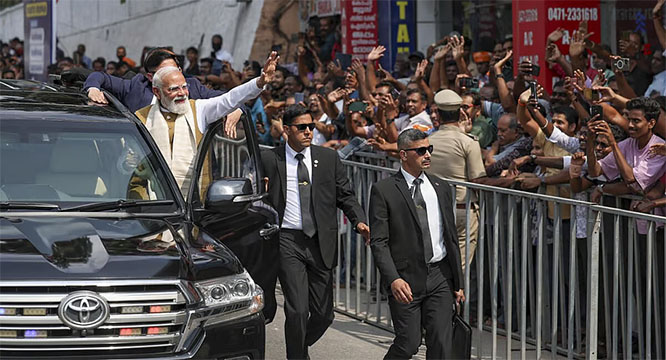
Mangaluru, Nov 28: Karnataka Health Minister and Dakshina Kannada district in-charge minister Dinesh Gundu Rao on Friday handed over Chief Minister Siddaramaiah’s letter to Prime Minister Narendra Modi, highlighting the severe distress faced by farmers due to crashing crop prices.

PM Modi arrived at the Mangaluru International Airport en route to Udupi, where Gundu Rao welcomed him and submitted the letter. The chief minister’s message stressed that farmers are suffering heavy losses because maize and green gram are being bought far below the Minimum Support Price (MSP). The state urged the Centre to immediately begin procurement at MSP.

According to the letter, Karnataka has a bumper harvest this year—over 54.74 lakh metric tons of maize and 1.98 lakh metric tons of green gram—yet farmers are unable to secure fair prices. Against the MSP of ₹2,400/MT for maize and ₹8,768/MT for green gram, market rates have plunged to ₹1,600–₹1,800 and ₹5,400 respectively.

The chief minister has requested the Centre to:

• Direct NAFED, FCI and NCCF to start MSP procurement immediately.
• Ensure ethanol units purchase maize directly from farmers or FPOs.
• Increase Karnataka’s ethanol allocation, citing high production capacity.
• Stop maize imports, which have depressed domestic prices.
• Relax quality norms for green gram, allowing up to 10% discoloration due to rains.

The letter stresses that MSP is crucial for farmer dignity and income stability and calls for swift central intervention to prevent a deepening crisis.

Comments

Add new comment

  • Coastaldigest.com reserves the right to delete or block any comments.
  • Coastaldigset.com is not responsible for its readers’ comments.
  • Comments that are abusive, incendiary or irrelevant are strictly prohibited.
  • Please use a genuine email ID and provide your name to avoid reject.