CRPF jawans break Ramadan fast to donate blood

Agencies
June 14, 2018

Srinagar, Jun 14: Two CRPF jawans went beyond their call of duty and broke their Ramadan fast to donate blood to a woman suffering from cancer as part of the forces' 'madadgaar' initiative for locals of the Kashmir valley.

Officials said the CRPF 'madadgaar' helpline received a call a few days back from Kishtwar resident Anil Singh seeking help to obtain blood units for his sister Pooja Devi, who is suffering from leukaemia.

The requirement of the Singh family was six units and they informed that while they have arranged for two bottles of blood from their family members, they still are looking for four units, a senior official said.

Four personnel of the Central Reserve Police Force (CRPF) posted in Srinagar, Sub-inspector Sanjay Paswan and Constables Ramnivas, Mudasir Rasool Bhat and Mohammed Aslam Mir volunteered for the blood donation.

Bhat and Mir, who are observing Ramadan fast, broke their fast and donated blood, he said.

All the four personnel went to the Sher-i-Kashmir Institute of Medical Sciences (SKIMS) yesterday where the woman is admitted for treatment, he said.

The CRPF, that is deployed for security duties in Jammu and Kashmir, had launched the 24×7 helpline–Madadgaar (14411)– in June last year to help any valley resident who is in distress.

The helpline is manned by the CRPF personnel.

About two weeks ago, a similar call was made to the helpline from Ashiq Hussain of Doda whose hydrocephalus (a condition in which there is an accumulation of cerebrospinal fluid in the brain) suffering newborn baby required immediate surgery.

The CRPF got the surgery conducted free of cost at a government hospital, the official said.

Comments

Abd
 - 
Friday, 15 Jun 2018

mera bharat mahan 


Add new comment

  • Coastaldigest.com reserves the right to delete or block any comments.
  • Coastaldigset.com is not responsible for its readers’ comments.
  • Comments that are abusive, incendiary or irrelevant are strictly prohibited.
  • Please use a genuine email ID and provide your name to avoid reject.
News Network
December 22,2025

The Bharatiya Janata Party (BJP) received ₹6,654.93 crore in donations during the 2024-25 financial year — a Lok Sabha election year — registering a 68 per cent increase over the previous fiscal.

In its annual contribution report submitted to the Election Commission on December 8, two days ahead of the deadline, the BJP disclosed all donations exceeding ₹20,000. The report, now available on the Commission’s website, covers contributions received between April 1, 2024 and March 30, 2025 — a period marked by the general election and Assembly polls in Arunachal Pradesh, Sikkim, Andhra Pradesh, Odisha, Jammu and Kashmir, Haryana, Jharkhand, Maharashtra and Delhi.

The BJP, the world’s largest political party by membership, had reported donations of ₹3,967 crore in 2023-24. The latest figures represent the party’s highest donation receipts in the last five years.

Electoral trusts accounted for around 40 per cent of the BJP’s total donations. The Prudent Electoral Trust contributed ₹2,180 crore, followed by the Progressive Electoral Trust with ₹757 crore and the New Democratic Electoral Trust with ₹150 crore. Contributions from other electoral trusts together amounted to ₹3,112.5 crore. The remaining funds came from corporate donors and individuals. Electoral trusts are entities set up by companies to channel donations to political parties.

Among major corporate contributors, Serum Institute of India donated ₹100 crore, Rungta Sons Private Limited ₹95 crore, Vedanta ₹67 crore, and Macrotech Developers (formerly Lodha Developers) ₹65 crore. Three Bajaj Group companies together contributed ₹65 crore, while Derive Investments donated ₹50 crore.

Other notable donors included Malabar Gold (₹10 crore), Kalyan Jewellers (₹15.1 crore), Hero Group (₹23.65 crore), Dilip Buildcon Group (₹29 crore), ITC Limited (₹35 crore), Wave Industries (₹5.25 crore) and Zerodha’s investment firm, promoted by Nikhil Kamath, which contributed ₹1.5 crore.

Several BJP leaders also made individual donations. Assam Chief Minister Himanta Biswa Sarma donated ₹3 lakh, Assam minister Pijush Hazarika ₹2.75 lakh, Union Education Minister Dharmendra Pradhan ₹1 lakh, Odisha Chief Minister Mohan Charan Majhi ₹5 lakh, Indore Mayor Pushyamitra Bhargava ₹1 lakh, and Akash Vijayvargiya, son of senior BJP leader Kailash Vijayvargiya, also donated ₹1 lakh, among others.

In contrast, most opposition parties reported a sharp decline in donations. The Congress received ₹522.13 crore in 2024-25, a fall of about 43 per cent from ₹1,129 crore in the previous year. The Trinamool Congress saw donations drop to ₹184.08 crore from ₹618.8 crore, while the Bharat Rashtra Samithi reported just ₹15.09 crore, down from ₹580 crore.

The Aam Aadmi Party, however, recorded an increase, collecting ₹39.2 crore compared to ₹22.1 crore last year. The Telugu Desam Party received ₹85.2 crore in donations, down from ₹274 crore, but also earned ₹102 crore through fees and subscriptions. The Biju Janata Dal reported ₹60 crore in donations, compared to ₹246 crore in the previous fiscal.

The 2024-25 financial year is also the first without electoral bonds, after the Supreme Court struck down the scheme as unconstitutional in February 2024. Since its introduction in 2018, the electoral bond scheme had enabled political parties to receive over ₹16,000 crore in anonymous donations, with the BJP receiving the largest share. 

Comments

Add new comment

  • Coastaldigest.com reserves the right to delete or block any comments.
  • Coastaldigset.com is not responsible for its readers’ comments.
  • Comments that are abusive, incendiary or irrelevant are strictly prohibited.
  • Please use a genuine email ID and provide your name to avoid reject.
News Network
December 22,2025

saudisnow.jpg

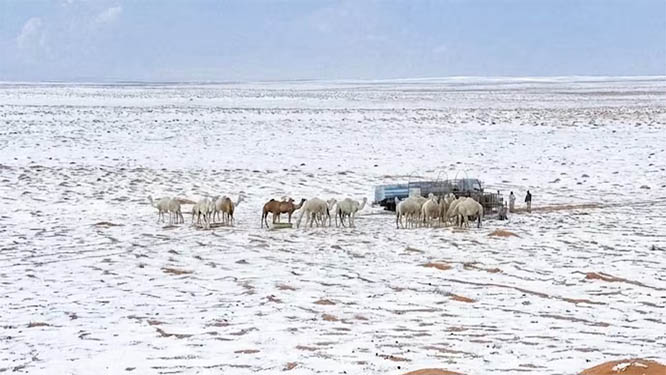
Saudi Arabia has witnessed rare snowfall in several parts of the country, including the northern regions, where such an event has been reported for the first time in 30 years, leaving residents in awe. 

The white blanket of snow covered vast desert areas, from the Tuwaiq mountain range in the west to regions near Riyadh. The rare event has sparked excitement and disbelief among residents, who have shared videos and photos of the Gulf nation blanketed in white.

A video shared on X captured an unusual scene: a group of camels standing in a desert area covered in snow, with dark clouds looming overhead.

Snowfall transformed parts of the country into an unexpected winter playground. Another video showed adults enjoying the snow by skiing, celebrating, and capturing a scene rarely seen in the Kingdom.

Local TV channels have described the snowfall as historic, while many residents have expressed concerns over the cold conditions and icy roads. The National Meteorology Center (NCM) had earlier warned of a sharp drop in temperatures and urged the public to take safety precautions.

Additionally, the Trojena Highlands and parts of the Tabuk region experienced unusually low temperatures due to snow last week. Jabal Al-Lawz in Tabuk reported heavy snowfall on Wednesday, accompanied by thick fog and strong winds, according to the Saudi Gazette.

The NCM has forecast a high chance of snow in the Qassim region and northern parts of Riyadh on Thursday, as an intense weather system continues to affect large areas of the kingdom. Authorities have cautioned the public to exercise extreme care during the severe weather.

While snow in Saudi Arabia is rare, it is not unprecedented. Last February, the Trojena Mountains saw snowfall and sub-zero temperatures, and parts of Al-Jawf reportedly experienced snow for the first time.

Comments

Add new comment

  • Coastaldigest.com reserves the right to delete or block any comments.
  • Coastaldigset.com is not responsible for its readers’ comments.
  • Comments that are abusive, incendiary or irrelevant are strictly prohibited.
  • Please use a genuine email ID and provide your name to avoid reject.
News Network
December 16,2025

Mangaluru, Dec 16: The Mangaluru City police have significantly escalated their campaign against drug trafficking, arresting 25 individuals and booking 12 cases under the Narcotic Drugs and Psychotropic Substances (NDPS) Act between November 30 and December 13. The crackdown resulted in the seizure of a substantial quantity of illicit substances, including 685.6 grams of MDMA and 1.5 kg of ganja.

The success of this recent drive has been significantly boosted by the city’s innovative, QR code-based anonymous reporting system.

"The anonymous reporting system has received an encouraging response. Several recent arrests were made based on inputs received through this system, helping police tighten the noose around drug peddlers," said the City Police Commissioner.

The latest arrests contribute to a robust year-to-date record, underscoring the police's relentless commitment to combating the drug menace.

Up to December 14 this year, the police have registered a total of 107 cases of drug peddling, leading to the arrest of 219 peddlers. Furthermore, they have booked 562 cases of drug consumption, resulting in the arrest of 671 individuals.

The scale of the seizure for the year reflects the magnitude of the problem being tackled: police have seized 320.6 kg of ganja worth ₹88.7 lakh and 1.4 kg of MDMA valued at ₹1.2 crore. Other significant seizures include hydro-weed ganja worth ₹94.7 lakh and cocaine worth ₹1.9 lakh, among others.

The Commissioner emphasized a policy of rigorous enforcement: "We ensure that peddlers are caught red-handed so that they cannot later dispute the case or claim innocence."

To counter the rising trend of substance abuse among youth, the Mangaluru City police have rolled out uniform guidelines for random drug testing across educational institutions.

As part of the drive, tests were conducted in approximately 100 institutions, screening an estimated 5,500 to 6,000 students in the first phase. 20 students tested positive for drug consumption during the initial screening.

Students who tested positive have been provided counselling and are scheduled for re-testing in the second quarter. The testing will also be expanded to students not covered in the first phase. In a move to ensure strict implementation, police personnel were deployed in mufti in some institutions. Reiterating a zero-tolerance stance, the Commissioner confirmed that random testing will continue, and colleges have also been instructed to conduct drug tests at the time of admission to deter substance abuse from an early stage.

Comments

Add new comment

  • Coastaldigest.com reserves the right to delete or block any comments.
  • Coastaldigset.com is not responsible for its readers’ comments.
  • Comments that are abusive, incendiary or irrelevant are strictly prohibited.
  • Please use a genuine email ID and provide your name to avoid reject.