



Firecrackers, beef, child abduction rumours: India's lynching spectrum widens

Agencies
July 13, 2018

New Delhi, Jul 13: Jatin Das, a labourer, was beaten to death by an angry crowd at a wedding venue in Assam three days ago for allegedly demanding that revellers stop bursting firecrackers, laying bare once again the veneer of tolerance that gives way only too easily to extreme rage and aggression.

The 35-year-old labourer's tragic death this week is only the latest in a series of lynchings that have shocked India, and forced experts to introspect on collective anger that kills and the why and how of public violence.

According to reports, at least 20 people were killed in 14 separate incidents between May and July 2018 in various parts of India.

Though the National Crimes Records Bureau (NCRB) does not specifically track lynchings, the incidence of mob killings and vigilantism has been on the rise.

The killing of Das, who wanted the fireworks be stopped because he had been hit by a splinter, is one end of the lynching spectrum. If his ask triggered irrational fury, the other cases are fuelled by righteousness with mobs believing they were doing the good thing.

Some of the victims were believed to be beef eaters or indulging in cow slaughter, others were thought to be kidney smugglers, and in many cases the victims were suspected to be child abductors.

The reasons for this vigilante justice were varied but the root cause was often the same -- suspicion based on rumours fanned by messages on social media platforms like WhatsApp.

According to Mumbai-based psychologist Harish Shetty. India is caught in a "state of post-disaster syndrome", contributing significantly towards the making of an angst driven "fickle" population which can be easily instigated.

"One needs to understand that something or the other is always happening in this country...children are being stolen... suicides and murders are happening. All of this leaves people in a state of hyper-arousal and a small trigger can channel their frustration," he said.

In Dhule in Maharashtra, where five people were killed on July 1, violence in the predominantly adivasi region was triggered following rumours of child kidnappers on WhatsApp.

"Rumours of child kidnappers were doing rounds on Whatsapp, and people became suspicious of the victims who belonged to the nomadic Gosavi community due to their alien attire and language," Superintendent of Police M Ramkumar told .

A police team of "eight people", heavily outnumbered by the mob, reached the spot within 40 minutes, only to find that the victims had already succumbed to the attacks.

The deaths bring to light the horrors of mob fury when a group of people, sometimes 50 and sometimes as many as 3,500 like in Dhule, decide to take law in their hands and kill somebody. Last month, the deaths of 29-year-old Nilotpal Das and 30-year-old Abhijeet Nath in Assam's Karbi Anglong district shook the country. The two were beaten to death by over 500 angry people, again on the suspicion of being child abductors.

"It is an uncivilised notion of justice," said city-based lawyer Kirti Singh.

Equating the act of lynching with a kangaroo court where "the mob seems to be doing what it thinks is right", she said people build up the fury on "fake news".

She rued the absolute lack of political will to put an end to these "rumours" and blamed the absence of a policy of "zero-tolerance" towards the heinous crime for the lives lost.

"Lynching is illegal. It is brutal murder. The ruling dispensation needs to tell people they cannot take the law in their hands. There should be widespread condemnation of such actions. They should set an example by talking extensively about its horrors," the lawyer said.

Singh also stressed on the need for police to act immediately and efficiently to stop incidents of violence from escalating, particularly by getting more forces.

Agreeing with her, Shetty said, "The police needs to be 10 steps ahead of the rumours."

Putting a check on the anti-social elements spreading fake news, effectively communicating with the general public and making them aware about marginalised communities are some of key steps the police must keep in mind, Shetty said.

Cyber law expert Pawan Duggal suggested "data localisation" to supervise the disemmination of content on Whatsapp and similar platforms.

According to him, having servers of Whatsapp and Twitter in India will help bring the data that needs to be controlled within the physical boundary of India, thereby bringing it within the purview of Indian law.

"This could have a substantial impact on reducing the dissemination of fake news," Duggal said.

In 2015, the lynching of Mohammed Akhlaq following rumours that he was storing beef in his home in Dadri village shocked the nation and prompted a nationwide debate. Three years later, the cases continue to pile up but the outrage seems to have dulled, prompting the question -- is lynching the new normal?

Comments

saad Khan
 - 
Saturday, 14 Jul 2018

One Word  "ACHA DIN"

Add new comment

  • Coastaldigest.com reserves the right to delete or block any comments.
  • Coastaldigset.com is not responsible for its readers’ comments.
  • Comments that are abusive, incendiary or irrelevant are strictly prohibited.
  • Please use a genuine email ID and provide your name to avoid reject.
News Network
December 13,2025

New Delhi: School-going children are picking up drug and smoking habits and engaging in consumption of alcohol, with the average age of introduction to such harmful substances found to be around 13 years, suggesting a need for earlier interventions as early as primary school, a multi-city survey by AIIMS-Delhi said.

The findings also showed substance use increased in higher grades, with grade XI/XII students two times more likely to report use of substances when compared with grade VIII students. This emphasised the importance of continued prevention and intervention through middle and high school.

The study led by Dr Anju Dhawan of AIIMS's National Drug Dependence Treatment Centre, published in the National Medical Journal of India this month, looks at adolescent substance use across diverse regions.

The survey included 5,920 students from classes 8, 9, 11 and 12 in urban government, private and rural schools across 10 cities -- Bengaluru, Chandigarh, Delhi, Dibrugarh, Hyderabad, Imphal, Jammu, Lucknow, Mumbai, and Ranchi. The data were collected between May 2018 and June 2019.

The average age of initiation for any substance was 12.9 (2.8) years. It was lowest for inhalants (11.3 years) followed by heroin (12.3 years) and opioid pharmaceuticals (without prescription; 12.5 years).

Overall, 15.1 per cent of participants reported lifetime use, 10.3 per cent reported past year use, and 7.2 per cent reported use in the past month of any substance, the study found.

The most common substances used in the past year, after tobacco (4 per cent) and alcohol (3.8 per cent), were opioids (2.8 per cent), followed by cannabis (2 per cent) and inhalants (1.9 per cent). Use of non-prescribed pharmaceutical opioids was most common among opioid users (90.2 per cent).

On being asked, 'Do you think this substance is easily available for a person of your age' separately for each substance category, nearly half the students (46.3 per cent) endorsed that tobacco products and more than one-third of the students (36.5 per cent) agreed that a person of their age can easily procure alcohol products.

Similarly, for Bhang (21.9 per cent), ganja/charas (16.1 per cent), inhalants (15.2 per cent), sedatives (13.7 per cent), opium and heroin (10 per cent each), the students endorsed that these can be easily procured.

About 95 per cent of the children, irrespective of their grade, agreed with the statement that 'drug use is harmful'.

The rates of substance use (any) among boys were significantly higher than those of girls for substance use (ever), use in the past year and use in the past 30 days. Compared to grade VIII students, grade IX students were more likely, and grade XI/XII students were twice as likely to have used any substance (ever).

The likelihood of past-year use of any substance was also higher for grade IX students and for grade XI/XII students as compared to grade VIII students.

About 40 per cent of students mentioned that they had a family member who used tobacco or alcohol each. The use of cannabis (any product) and opioid (any product) by a family member was reported by 8.2 per cent and 3.9 per cent of students, respectively, while the use of other substances, such as inhalants/sedatives by family was 2-3 per cent, the study found.

A relatively smaller percentage of students reported use of tobacco or alcohol among peers as compared to among family members, while a higher percentage reported inhalants, sedatives, cannabis or opioid use among peers.

Children using substances (past year) compared to non-users reported significantly higher any substance use by their family members and peers.

There were 25.7 per cent students who replied 'yes' to the question 'conflicts/fights often occur in your family'. Most students also replied affirmatively to 'family members are aware of how their time is being spent' and 'damily members are aware of with whom they spend their time'.

Comments

Add new comment

  • Coastaldigest.com reserves the right to delete or block any comments.
  • Coastaldigset.com is not responsible for its readers’ comments.
  • Comments that are abusive, incendiary or irrelevant are strictly prohibited.
  • Please use a genuine email ID and provide your name to avoid reject.
News Network
December 6,2025

indigoticket.jpg

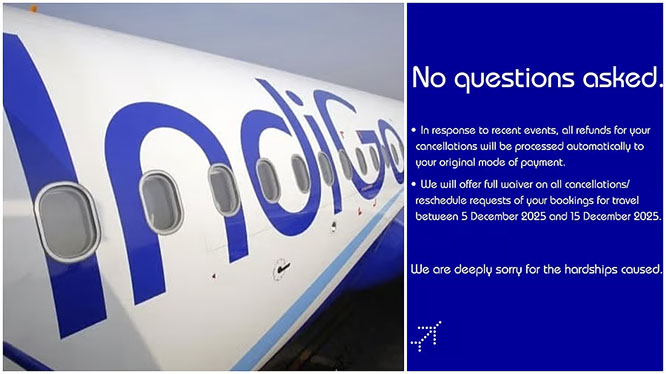
With IndiGo flight disruptions impacting thousands of passengers, the airline on Saturday said that it will offer full waiver on all cancellations/reschedule requests for travel bookings between December 5, 2025 and December 15, 2025.

Earlier in the day, the civil aviation ministry had directed the airline to complete the ticket refund process for the cancelled flights by Sunday evening, as well as ensure baggage separated from the travellers are delivered in the next two days.

In a post on X, titled 'No questions asked', IndiGo wrote, "In response to recent events, all refunds for your cancellations will be processed automatically to your original mode of payment."

"We are deeply sorry for the hardships caused," it further added.

Several passengers, however, complained of not getting full refund as promised by the airline.

Netizens have shared screenchots of getting charged for airline cancellation fee and convenience fee.

"Please tell me why u have did this airline cancellation charges when u say full amount will be refunded (sic)," a user wrote sharing a screenshot of the refund page.

"Well, but you have still debited the convenience charges," wrote another.

Passengers have also raised concerns about the "cancel" option being disabled on the IndiGo app. "First enable the 'Cancel' button on your App & offer full refund on tickets cancelled by customers between the said dates," wrote a user.

A day after the country's largest airline, IndiGo, cancelled more than 1,000 flights and caused disruptions for the fifth day on Saturday, the ministry said that any delay or non-compliance in refund processing will invite immediate regulatory action.

The refund process for all cancelled or disrupted flights must be completed by 8 pm on Sunday, the ministry said in a statement.

"Airlines have also been instructed not to levy any rescheduling charges for passengers whose travel plans were affected by cancellations," it said.

On Saturday, more than 400 flights were cancelled at various airports.

IndiGo has also been instructed to set up dedicated passenger support and refund facilitation cells.

Comments

Add new comment

  • Coastaldigest.com reserves the right to delete or block any comments.
  • Coastaldigset.com is not responsible for its readers’ comments.
  • Comments that are abusive, incendiary or irrelevant are strictly prohibited.
  • Please use a genuine email ID and provide your name to avoid reject.
News Network
December 19,2025

Mangaluru: Public transport in Mangaluru is set for a state-led transformation as the government moves to deploy 100 new electric govt buses to replace unreliable private services. The initiative aims to provide a dependable alternative to private operators who have been frequently "cutting trips," leaving thousands of commuters stranded.

The announcement was made by Deputy Commissioner and MCC Administrator Darshan HV during a public phone-in session. The move specifically targets routes where private bus service has become erratic, ensuring that citizens no longer have to rely on a fluctuating private sector for their daily commute.

Restoring the Govt Presence

The transport crisis was brought to the forefront by Ramayya, a resident of Bajal, who highlighted a growing trend of private buses skipping morning and night trips. With the previous KSRTC (govt) services discontinued, residents have been left without a fallback option.

To fix this, the DC confirmed that the PM-eBus Sewa Scheme will bring 100 government-owned electric buses to the city:

•    Phased Deployment: The first 50 of the new 100 government buses are scheduled to arrive by March 2026.

•    State Infrastructure: Two new government depots, including one at Mudipu, are being prepared for operations.

•    Recruitment: The state has already begun training a new batch of government bus drivers to ensure the fleet is operational the moment it arrives.

Comments

Add new comment

  • Coastaldigest.com reserves the right to delete or block any comments.
  • Coastaldigset.com is not responsible for its readers’ comments.
  • Comments that are abusive, incendiary or irrelevant are strictly prohibited.
  • Please use a genuine email ID and provide your name to avoid reject.