


From Allahabad to Prayagraj; Whats in the name?

Ram Puniyani
October 27, 2018

Adityanath Yogi, Chief Minister of UP seems to be on the name changing spree. In his latest move he has changed the name of famous city of UP, Allahabad to Prayagraj. Prayag is the meeting point of rivers and since this city is the meeting point of Ganga, Yamuna and probably of invisible Sarswati, this name might have been chosen by him in his attempts to remove the Islamic touch to the names of our cities. As such many a versions of the origin of the name of this city are circulating. One such says that it was Ila-vas. Ila being the mother of mythological Pururva. Another such says it was in the name of Alha of Alha-Udal (part of popular folk lore) fame. More concrete records tell us that Akbar had named it Illaha-bad or Illahi-bas. Illaha is a generic term of Gods. He regarded this city as holy city of Hindus and Illah-bas in Persian means ‘abode of Gods’. This is clear from the records and from the coins of that time and reflects the inclusive spirit of Akbar. Earlier Yogi had made many changes in the names like that of Mughal sarai to Pundit Deendayal Upadhayay Junction, Agra airport in the same leader, Urdu Bazar to Hindi Bazar, Ali Nagar to Arya nagar etc. He regards all Muslim sounding names as being alien.

In an interview Yogi said he has to change many more names. On his agenda is to change the name Taj Mahal to Ram Mahal, Azamgarhg to Aryamgarh and to cap it all as per him the name India in our constitution should be changed to Hindustan. As per him these places were renamed after invasion of Muslim kings, so there is a need to re-change them. In UP Mayawati had already begun this name changing game which was to some extent reversed by his successor Akhilesh Yadav. Now in a more persistent way Yogi is identifying the Muslim sounding names and changing them one by one.

Adityanath Yogi is the Mahant of famous Gorakhnath Math. His predecessor of Math was in also politics, and Yogi has been a major player on the political chess board in UP. He comes from the Hindu Mahasabha stream of politics. His dominance has been very visible as his slogan, UP mein rahna hay to Yogi Yogi Kahna hoga (If you want to stay in UP, you have to Chant Yogi-Yogi) had been prevalent in parts of UP. His Hindu Yuva Vahaini has been in the news off and on; not for right reasons. He belongs to the group of large number of Holy men, Sakski Maharaj, Sadhvi Uma Bharati, Sadhvi Nirnajan Jyoti etc. who have been part of Hindu nationalist agenda. As such Holy men are supposed to have renounced the World to focus on spiritual pursuits, but this lot seems to be more active in Worldly pursuits.

The phenomenon of these holy men-women being in politics seems to be there in many post-colonial states. In these countries there has been absence of radical land reforms and there is persistence of hold of landlord-clergy which seems to be the reason for the God people to be in political arena. In these places God men and women has been part of the politics, which opposes the democratic values as being Western or alien, being against the spirit of ‘our’ land. They in a way harp on the pre Industrial values of birth based hierarchies. Surveying these countries one can see the rise of Ayatollah Khomeini in Iran, succeeded by many Ayatollahs. In Pakistan the Mullahs have been working closely with the military and landlord elements to undermine the democratic possibilities in society. In Pakistan the most prominent name which emerged was that of Maulana Maududi, who worked closely with Zia Ul Haq in Islamization of Pakistan. In neighboring Mynamar, the monks like Ashin Wirathu, also called ‘Burma’s bin laden’, are part of the politics to oppose the democratic society, to target the religious minorities there.

Back to India we have seen the crop of these Holy men, dominating the political scene in various ways. Most of these Godmen-women have been part of Hindu nationalist movement and are very vicious as far as hate speech is concerned. One recalls that Sadhvi Niranjan Jyoti had used the word haram Jade, Sakshi Maharaj was booked for blaming Muslims for population growth. Yogi himself has many cases pending against as far as hate speech is concerned. The worst of these was when he advised the rape of dead Muslim women.

Yogi has intensified the communal agenda to no end. UP state is organizing Hindu religious festivals. One recalls that the on occasion of Divali, the Helicopter carrying Lord Ram and Sita landed and the Gods were received by Yogi. UP State also organized the lighting of lamps in big numbers. Recently he had again been in news for the declaration that state Government will spend 5000 crores for the Kumbh mela. All this is taking place at a time when the state is suffering sever crunch in regards to health care and other infrastructure related issues. Young children, infants have died in hospital for lack of facilities; times and over again. The cities where name change has been brought about languishes with bad infrastrures and state constantly lags behind in Human growth indices, what to talk of the abysmal condition of human rights in the state. The condition of minorities is worsening as state sponsored moves to trample on their livelihood in the form of closing many the meat shops, which was done right at the beginning of his rule in UP, among other steps which is order of the day.

Yogi also bluntly stated that secularism is a big lie. His actions are showing as to how he is forcing the march of the state in the direction of Hindu nation, without any qualms for secular values as enshrined in our Constitution!

Comments

Well Wisher
 - 
Wednesday, 31 Oct 2018

I prefer Goondaraj instead

Add new comment

  • Coastaldigest.com reserves the right to delete or block any comments.
  • Coastaldigset.com is not responsible for its readers’ comments.
  • Comments that are abusive, incendiary or irrelevant are strictly prohibited.
  • Please use a genuine email ID and provide your name to avoid reject.
News Network
December 3,2025

indigo.jpg

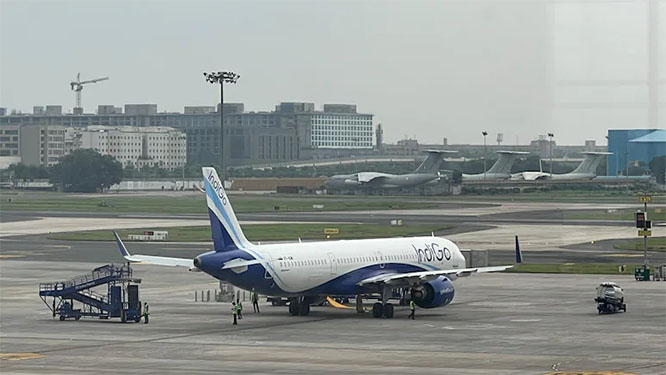
IndiGo, India’s largest airline, is battling one of its worst operational disruptions in recent years, with hundreds of delays and cancellations throwing domestic travel into chaos.

Government data on Tuesday showed its on-time performance plunging to 35%, an unusual dip for a carrier long associated with punctuality.

By Wednesday afternoon, airports in Delhi, Mumbai, Bengaluru and Hyderabad had collectively reported close to 200 cancellations, stranding travellers across the country.

Crew Shortage After New Duty Norms

A major trigger behind the meltdown is a severe crew shortage, especially among pilots, following the rollout of revised Flight Duty Time Limitation (FDTL) norms last month.

The rules mandate longer rest hours and more humane rosters — a shift IndiGo has struggled to incorporate across its vast network.

Sources said several flights were grounded due to lack of cabin crew, while some delays stretched upwards of eight hours.

With IndiGo controlling over 60% of India’s domestic aviation market, the ripple effect has impacted airports nationwide.

IndiGo Issues Apology, Lists “Compounding Factors”

In a statement, IndiGo acknowledged the large-scale disruption:

“We sincerely apologise to customers. A series of unforeseen operational challenges — technology glitches, winter schedule changes, adverse weather, system congestion and updated FDTL norms — created a compounding impact that could not have been anticipated.”

To stabilise operations, the airline has begun calibrated schedule adjustments for the next 48 hours, aiming to restore punctuality. Affected passengers are being offered refunds or alternate travel arrangements, IndiGo said.

What the FDTL Rules Require

The FDTL norms, designed to reduce pilot fatigue, cap duty and flying hours as follows:
•    Maximum 8 hours of flying per day
•    35 hours per week
•    125 hours per month
•    1,000 hours per year

Crew must also receive rest equalling twice the flight duration, with a minimum 10-hour rest period in any 24-hour window.

The DGCA introduced these limits to enhance flight safety.

Hyderabad: 33 Flights Cancelled, Long Queues Reported

Hyderabad’s Rajiv Gandhi International Airport saw heavy early-morning crowds as 33 IndiGo flights (arrivals and departures) were cancelled.

The airport clarified on X that operations were normal, advising passengers to contact IndiGo directly for latest flight status.

Cancellations included flights to and from Visakhapatnam, Goa, Ahmedabad, Delhi, Bengaluru, Chennai, Madurai, Hubli, Bhopal and Bhubaneswar.

Bengaluru: 42 Flights Disrupted

Bengaluru’s Kempegowda International Airport recorded 42 cancellations — 22 arrivals and 20 departures — affecting routes to Delhi, Mumbai, Chennai, Hyderabad, Goa, Kolkata and Lucknow.

Passengers Vent on Social Media

Irate travellers took to X to share their experiences. One passenger stranded in Hyderabad wrote: “I have been here since 3 a.m. and missed an important meeting.”

Another said: “My flight was pushed from 1:55 PM to 2:55 PM and now 4:35 PM. I was informed only three minutes before entering the airport.”

Delhi Airport Hit by Tech Glitch

At Delhi Airport, the disruption deepened due to a slowdown in the Amadeus system — used for reservations, check-ins and departure control.

The technical issue led to longer queues and sluggish processing, adding to delays already worsened by staff shortages.

Comments

Add new comment

  • Coastaldigest.com reserves the right to delete or block any comments.
  • Coastaldigset.com is not responsible for its readers’ comments.
  • Comments that are abusive, incendiary or irrelevant are strictly prohibited.
  • Please use a genuine email ID and provide your name to avoid reject.
News Network
November 24,2025

Mangaluru, Nov 24: The original departure time of 11.10 pm was a distant memory for scores of Dammam-bound passengers at Mangaluru International Airport last Friday night, as their Air India Express flight was abruptly cancelled at the eleventh hour, sparking hours of frustration and chaos.

The flight, IX 885, initially scheduled to depart at 11.10 pm on November 22, was subject to two back-to-back reschedules—first pushed to 11.45 pm and then significantly postponed to 1.40 am—before the final, crushing announcement of cancellation was made. For the travellers, many of whom are likely expatriate workers with tight schedules, the last-minute change marked the beginning of a distressing ordeal.

"There was no drinking water, no food, and absolutely no proper guidance. We were left stranded like refugees," complained a stranded passenger.

According to multiple passenger accounts, the airline's ground staff failed to provide adequate support or essential amenities following the cancellation. Complaints poured in about the total absence of drinking water, food provisions, and any reliable guidance from the carrier's representatives. Travellers alleged they were left stranded for a considerable period, with no immediate arrangements or clear communication offered regarding accommodation or alternative travel to send them back home.

The incident has highlighted serious concerns over the carrier's contingency planning and customer service protocols during flight disruptions at one of India's key international gateways. The airline is yet to issue a comprehensive statement addressing the alleged lapse in passenger care.
 

Comments

Add new comment

  • Coastaldigest.com reserves the right to delete or block any comments.
  • Coastaldigset.com is not responsible for its readers’ comments.
  • Comments that are abusive, incendiary or irrelevant are strictly prohibited.
  • Please use a genuine email ID and provide your name to avoid reject.
News Network
November 21,2025

Bengaluru, Nov 21: The Karnataka government is facing pressure to overhaul its employment system after a high-level Cabinet sub-committee recommended the complete phase-out of job outsourcing in government offices, boards, and corporations by March 2028. The move is aimed at tackling a systemic issue that has led to the potential violation of constitutional reservation policies and the exploitation of workers.

The Call for Systemic Change

With over three lakh vacant posts currently being filled through private agencies on an outsource, insource, or daily wage basis, the sub-committee highlighted a significant lapse. "As a result, reservations are not being followed as per the Constitution and state laws. It’s an urgent need to take serious steps to change the system. It has been recommended to completely stop the system of outsourcing by March 2028," the panel stated in a document.

The practice of outsourcing involves private companies hiring workers to perform duties for a government agency. Critics argue this model results in lesser salaries, a lack of social security benefits (otherwise available to permanent government employees), and a failure to adhere to the provisions of Articles 14 and 15 of the Constitution, which guarantee equality before the law and prohibit discrimination.

The 'Bidar Model' as a Stop-Gap Solution

To regulate the current mode of employment and reduce worker exploitation until the 2028 deadline, the government plans to establish workers’ services multi-purpose cooperative societies across all districts, following the successful "Bidar Model."

The Bidar District Services of Labour Multi-purpose Cooperative Society Ltd., which operates under the District Commissioner, is cited as a successful example of providing a measure of social security to outsourced staff. Labour Department officials argue this society ensures workers receive their due wages and statutory facilities like ESI (Employees' State Insurance) and PF (Provident Fund), in exchange for a 1% service fee collected from the employees.

legislative push and Priority Insourcing

The recommendations, led by the sub-committee headed by Law and Parliamentary Affairs Minister H K Patil, are set to be discussed at the next Cabinet meeting. The committee has proposed the introduction of the Karnataka Outsourced Employees (Regulation, Placement and Welfare) Bill 2025.

In a move addressing immediate concerns, Labour Minister Santosh Lad, a member of the sub-committee, has reportedly assured that steps will be taken over the next 2-3 years to insource workers in "life-threatening services" on a priority basis. This includes essential personnel like pourakarmikas (sanitation workers), drivers, electrical staff in the Energy Department, and Health Department staff handling contagious diseases. The transition aims to grant these workers the long-term security and benefits they currently lack under the outsourcing system. 

Comments

Add new comment

  • Coastaldigest.com reserves the right to delete or block any comments.
  • Coastaldigset.com is not responsible for its readers’ comments.
  • Comments that are abusive, incendiary or irrelevant are strictly prohibited.
  • Please use a genuine email ID and provide your name to avoid reject.