President urges people to vote during LS polls

Agencies
January 25, 2019

New Delhi, Jan 25: With Lok Sabha elections round the corner, President Ram Nath Kovind on Friday gave a clarion call to people to perform the "sacred act" of voting, emphasising this year's polls should be seen as a "once-in-a-century moment" that will shape the India of the remainder of the 21st century.
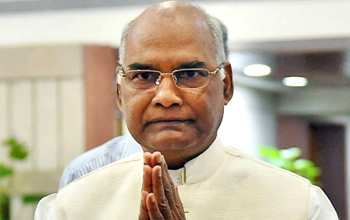
Observing that an election is not just a political exercise, Kovind said it is a collective call to wisdom and a collective call to action, adding the ideas and idealism of our democracy will come into force to elect the 17th Lok Sabha.

In his customary address to the nation on the eve of the 70th Republic Day, the President said development of the country cannot be completed without a salute to the "spirit of inclusiveness and pluralism which rests on a "tripod of diversity, democracy and development".

"This country belongs to each of us and to all of us – every group and every community, every region and every identity. It belongs to every citizen and every individual. India's pluralism is its greatest strength and its greatest example to the world.

"The 'Indian model' rests on a tripod of diversity, democracy and development. We cannot choose one above the other; we must have all three and we will have all three," he said in the address that was telecast and broadcast across the country.

Referring to the general elections that are due before June, the President said it will be the first when voters born in the 21st century will contribute to electing a new Lok Sabha.

The election represents the diverse and singular urges of the people and the Republic of India, he said.

"This makes the very act of voting a sacred act. Please perform this act. Who the voter chooses to vote for is up to him or her, I would only request all eligible voters to go out and vote.

"Our country is at a key juncture. In some respects this is as critical and formative a period as the late 1940s and early 1950s. Decisions and actions of today will shape the India of the remainder of the 21st century. As such, this is not just a once-in-a-generation moment – it is a once-in-a-century moment," he said.

The President said this election, in which the ideas and idealism of democracy will come into full force, is only a milestone in the journey towards fulfilling the aspirations of the people and building a developed India.

While appreciating the role of successive generations in nation building, the President reminded the people that "our voyage is far from complete."

"There are still waters to cover, still gaps to fill and still tears to wipe."

"We have to recalibrate our yardstick of achievement and success – from quantity to quality; from a literate society to a knowledge society; from a nation that has room for all segments and all communities to a family that invokes, encourages and celebrates the uniqueness and potential in each person – each daughter and each son," he said.

He said the ideals of Mahatma Gandhi of all people living in perfect harmony are a constant reminder while building the nation.

In an apparent reference to the 10 per cent quota for economically weaker sections in the general category, he said "the recent constitutional amendment to provide special facilities for talented children from poorer families is another step to an India of our dreams – and of Gandhiji's dreams."

The President also advocated the need for engaging in conversation with groups who have been historically disadvantaged.

"Partnerships are enhanced by open communication, honest conversation and unstinted compassion...This is also true with sections or groups that have been historically disadvantaged and whose grievances must continue to be heard and addressed. It is important to create avenues for such conversations, even if they are inconvenient.

"In a society experiencing rapid change, we must be prepared for such conversations. And similarly, we must be alive to the need for compassion – to those less privileged than us and to the differently-abled, for example," he said.

The President stressed that the vision of India's Republic was to reach democratic goals by democratic means, pluralistic goals by pluralistic means, enlightened goals by enlightened means, inclusive goals by inclusive means, compassionate goals by compassionate means – and constitutional goals by constitutional means.

"May those principles always illuminate our path! After all, 'We, the People …' gave ourselves this Constitution and 'We, the People …' are the custodians and upholders of its principles," he said.

He said the best indicator of social change in India is changing towards gender equity and towards providing equal opportunities, under conditions of equality, to every girl child and every woman.

"...Young women in our country are moving ahead in every field - from academics to the creative arts, from sports to the armed forces. There is no stopping and no hesitation in this process. It is the route to India’s future," he added.

Kovind said this year also marks 150th birthday anniversary of Gandhi ji which will be followed by the 70th anniversary of the adoption of the Constitution. "In his (Bhimrao Ambedkar), honour and in our Constitution's honour, the nation will celebrate Constitution Day this year in an appropriate manner," he said.

The President said the country was at the doorstep of eliminating extreme poverty for the first time in memory and several people friendly programmes including equitable healthcare have begun to be rolled out.

Road, water, rail and air connectivity has improved. "India has been united and integrated – now it is being networked," he said.

Comments

Wellwisher
 - 
Saturday, 26 Jan 2019

Happy Republic Day


Long Live India


No  doubt this time polling turnout wI'll come with new record.Peace lovIng patriot Indians will reject criminal force and their political leader's. 


Add new comment

  • Coastaldigest.com reserves the right to delete or block any comments.
  • Coastaldigset.com is not responsible for its readers’ comments.
  • Comments that are abusive, incendiary or irrelevant are strictly prohibited.
  • Please use a genuine email ID and provide your name to avoid reject.
News Network
December 16,2025

jordan.jpg

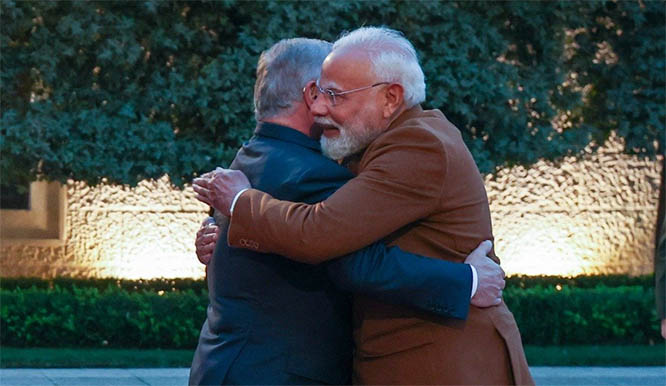
Prime Minister Narendra Modi on Monday held talks with Jordan’s King Abdullah II in Amman, during which the two leaders discussed ways to further strengthen bilateral relations, with the Prime Minister outlining an eight-point vision covering key areas of cooperation.

Describing the meeting as “productive”, PM Modi said he shared a roadmap focused on trade and economy, fertilisers and agriculture, information technology, healthcare, infrastructure, critical and strategic minerals, civil nuclear cooperation, and people-to-people ties.

In a post on social media platform X, the Prime Minister praised King Abdullah II’s personal commitment to advancing India–Jordan relations, particularly as both countries mark the 75th anniversary of the establishment of diplomatic ties this year.

“Held productive discussions with His Majesty King Abdullah II in Amman. His personal commitment towards vibrant India-Jordan relations is noteworthy. This year, we are celebrating the 75th anniversary of our bilateral diplomatic relations,” PM Modi said.

The meeting took place at the Al Husseiniya Palace, where the two leaders also exchanged views on regional and global issues of mutual interest. According to the Ministry of External Affairs (MEA), both sides agreed to further deepen cooperation in areas including trade and investment, defence and security, counter-terrorism and de-radicalisation, fertilisers and agriculture, infrastructure, renewable energy, tourism, and heritage.

The MEA said both leaders reaffirmed their united stand against terrorism.

PM Modi arrived in Amman earlier on Monday and was received by Jordanian Prime Minister Jafar Hassan, who accorded him a formal welcome. Following the talks, King Abdullah II hosted a banquet dinner in honour of the Prime Minister, reflecting the warmth of bilateral ties.

Jordan is the first leg of PM Modi’s three-nation tour. From Amman, the Prime Minister will travel to Ethiopia at the invitation of Prime Minister Abiy Ahmed Ali, marking his first official visit to the African nation. The tour will conclude with a visit to Oman.

Comments

Add new comment

  • Coastaldigest.com reserves the right to delete or block any comments.
  • Coastaldigset.com is not responsible for its readers’ comments.
  • Comments that are abusive, incendiary or irrelevant are strictly prohibited.
  • Please use a genuine email ID and provide your name to avoid reject.
News Network
December 6,2025

pilot.jpg

New Delhi: IndiGo, India’s largest airline, faced major operational turbulence this week after failing to prepare for new pilot-fatigue regulations issued by the Directorate General of Civil Aviation (DGCA). The stricter rules—designed to improve flight safety—took effect in phases through 2024, with the latest implementation on November 1. IndiGo has acknowledged that inadequate roster planning led to widespread cancellations and delays.

Below are the key DGCA rules that affected IndiGo’s operations:

1. Longer Mandatory Weekly Rest

Weekly rest for pilots has been increased from 36 hours to 48 hours.

The government says the extended break is essential to curb cumulative fatigue. This rule remains in force despite the current crisis.

2. Cap on Night Landings

Pilots can now perform only two night landings per week—a steep reduction from the earlier limit of six.

Night hours, defined as midnight to early morning, are considered the least alert period for pilots.

Given the disruptions, this rule has been temporarily relaxed for IndiGo until February 10.

3. Reduced Maximum Night Flight Duty

Flight duty that stretches into the night is now capped at 10 hours.

This measure has also been kept on hold for IndiGo until February 10 to stabilize operations.

4. Weekly Rest Cannot Be Replaced With Personal Leave

Airlines can no longer count a pilot’s personal leave as part of the mandatory 48-hour rest.

Pilots say this closes a loophole that previously reduced actual rest time.

Currently, all airlines are exempt from this rule to normalise travel.

5. Mandatory Fatigue Monitoring

Airlines must submit quarterly fatigue reports along with corrective actions to DGCA.

This system aims to create a transparent fatigue-tracking framework across the industry.

The DGCA has stressed that these rules were crafted to strengthen flight safety and align India with global fatigue-management standards. The temporary relaxations are expected to remain until February 2025, giving IndiGo time to stabilise its schedules and restore normal air travel.

Comments

Add new comment

  • Coastaldigest.com reserves the right to delete or block any comments.
  • Coastaldigset.com is not responsible for its readers’ comments.
  • Comments that are abusive, incendiary or irrelevant are strictly prohibited.
  • Please use a genuine email ID and provide your name to avoid reject.
News Network
December 5,2025

indigoCEO.jpg

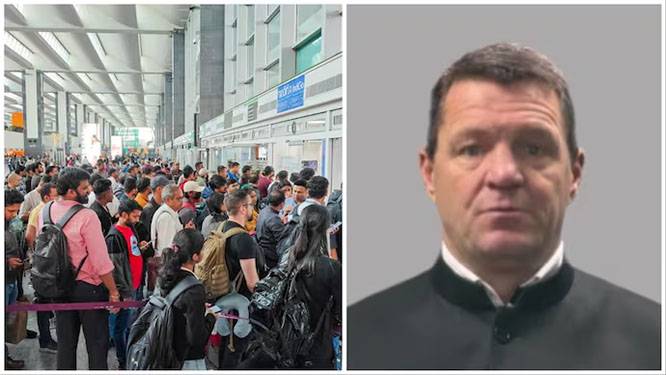
New Delhi, Dec 5: IndiGo CEO Pieter Elbers issued a public apology this evening after more than a thousand flights were cancelled today, making it the "most severely impacted day" in terms of cancellations. The biggest airline of the country cancelled "more than half" of its daily number of flights on Friday, said Elbers. He also said that even though the crisis will persist on Saturday, the airline anticipates fewer than 1,000 flight cancellations.

"Full normalisation is expected between December 10 and 15, though IndiGo cautions that recovery will take time due to the scale of operations," the IndiGo CEO said. 

IndiGo operates around 2,300 domestic and international flights daily.

Pieter Elbers, while apologising for the major inconvenience due to delays and cancellations, said the situation is a result of various causes.

The crisis at IndiGo stems from new regulations that boost pilots' weekly rest requirements by 12 hours to 48 and allow only two night-time landings per week, down from six. IndiGo has attributed the mass cancellations to "misjudgment and planning gaps".

Elbers also listed three lines of action that the airline will adopt to address the issue.

"Firstly, customer communication and addressing your needs, for this, messages have been sent on social media. And just now, a more detailed communication with information, refunds, cancellations and other customer support measures was sent," he said.

The airline has also stepped up its call centre capacity.

"Secondly, due to yesterday's situation, we had customers stranded mostly at the nation's largest airports. Our focus was for all of them to be able to travel today itself, which will be achieved. For this, we also ask customers whose flights are cancelled not to come to the airports as notifications are sent," the CEO said.

"Thirdly, cancellations were made for today to align our crew and planes to be where they need to start tomorrow morning afresh. Earlier measures of the last few days, regrettable, have proven not to be enough, but we have decided today to reboot all our systems and schedules, resulting in the highest numbers of cancellations so far, but imperative for progressive improvements starting from tomorrow," he added.

As airports witnessed chaotic scenes, the Directorate General of Civil Aviation (DGCA) stepped in to grant IndiGo a temporary exemption from stricter night duty rules for pilots. It also allowed substitution of leaves with a weekly rest period. 

Civil Aviation Minister Ram Mohan Naidu has said a high-level inquiry will be ordered and accountability will be fixed.

Comments

Add new comment

  • Coastaldigest.com reserves the right to delete or block any comments.
  • Coastaldigset.com is not responsible for its readers’ comments.
  • Comments that are abusive, incendiary or irrelevant are strictly prohibited.
  • Please use a genuine email ID and provide your name to avoid reject.