Mukesh Ambani loses Asia wealth crown to Jack Ma in $5.8 billion rout

News Network
March 10, 2020

Mar 10: Indian energy tycoon Mukesh Ambani is no longer Asia’s richest man, relinquishing the title to Jack Ma after oil prices collapsed along with global stocks.

The rout, exacerbated by mounting fears that the spread of the novel coronavirus will thrust the world into a recession, erased $5.8 billion from Ambani’s net worth on Monday and pushed him to No. 2 on the list of Asia’s richest people, according to the Bloomberg Billionaires Index. Ma, the Alibaba Group Holding Ltd. founder who relinquished the No. 1 ranking in mid-2018, is back on top with a $44.5 billion fortune, about $2.6 billion more than Ambani.

Oil plunged the most in 29 years on Monday as Saudi Arabia and Russia vowed to pump more in a struggle for market share. The slump comes just as the coronavirus is spurring the first decline in demand in more than a decade. That raises questions about whether Ambani’s flagship Reliance Industries Ltd. will be able to cut net debt to zero by early 2021, as he has pledged. The plan hinges on a proposal to sell a stake in the group’s oil and petrochemicals division to Saudi Arabian Oil Co., the world’s biggest crude producer.

While the coronavirus has curtailed some of tech giant Alibaba’s businesses, the damage has been mitigated by increased demand for its cloud computing services and mobile apps.

Reliance Industries, by comparison, has no such silver lining. The Indian conglomerate’s shares plunged 12% on Monday, the most since 2009, extending this year’s decline to 26%. Alibaba’s American depositary receipts have slipped 6.8% so far in 2020.

Ma reclaims crown after Reliance shares were pummeled in 2020.

Few of the world’s billionaires fared well in Monday’s collapse as the S&P 500 Index and Dow Jones Industrial Average each plunged more than 7.5%, the most since the 2008 financial crisis, threatening to end the longest bull market in history. But no one did worse than those whose fortunes are underpinned by oil. Wildcatter Harold Hamm’s fortune was cut almost in half to $2.4 billion and fellow oil magnate Jeff Hildebrand lost $3 billion, bumping both from Bloomberg’s 500-member wealth ranking.

In a pivot toward new businesses such as telecommunications, technology and retail, Ambani’s Reliance Industries has piled on billions of dollars of debt over the years.

It spent almost $50 billion -- most of it funded by borrowings -- to build Reliance Jio Infocomm Ltd., which became India’s No. 1 wireless carrier within about three years of its debut. As the mobile venture took off, Ambani also unveiled plans for an e-commerce empire to rival Amazon.com Inc. in India.

Addressing concerns over the liabilities, Ambani pledged in August to cut the group’s net debt to zero from about $21 billion as of last March. The Aramco deal is crucial to that plan for which Reliance Industries has valued its oil-to-chemicals division at $75 billion including debt, implying a $15 billion valuation for the 20% stake that’s for sale.

Signs of a potential delay to that deal unnerved some investors, hammering the stock since it touched a record high on Dec. 19.

Reliance Industries expected the Aramco transaction to be completed by March, but people familiar with the matter said in February that talks were still ongoing to bridge differences between the two parties over the deal’s structure.

Adding to the uncertainty, Indian Prime Minister Narendra Modi’s administration has petitioned a court to halt the proposed stake sale, threatening a key source of funds needed to pare net debt.

But Ambani, 62, may soon bounce back from the setback, said Harish H.V., managing partner at ECube Investment Advisors in Bengaluru, India.

“The game isn’t over,” he said. “Ambani has successfully built a robust business model which would keep him in the game. Moreover, his telecom business will start yielding results in coming years.”


Comments

SmR
 - 
Tuesday, 10 Mar 2020

The curses of the bank depositors savings which vanished with collapsing economy and fraudlent seems to have gradully affecting riches of Ambani's.


AU
 - 
Tuesday, 10 Mar 2020

in Holy Quran Allah says; but they plan and Allah plans, and Allah is the best planners..(Surah Al Anfal 8:30)

Add new comment

  • Coastaldigest.com reserves the right to delete or block any comments.
  • Coastaldigset.com is not responsible for its readers’ comments.
  • Comments that are abusive, incendiary or irrelevant are strictly prohibited.
  • Please use a genuine email ID and provide your name to avoid reject.
News Network
December 7,2025

SHRIMP.jpg

Mangaluru, Dec 7: A rare bamboo shrimp has been rediscovered on mainland India more than 70 years after it was last reported, confirming for the first time the presence of Atyopsis spinipes in the country. The find was made by researchers from the Centre for Climate Change Studies at Sathyabama Institute of Science and Technology, Chennai, during surveys in Karnataka and Odisha.

The team — shrimp expert Dr S Prakash, PhD scholar K Kunjulakshmi, and Mangaluru-based researcher Maclean Antony Santos — combined field surveys, ecological assessments and DNA analysis to identify the elusive species. Their findings, published in Zootaxa, resolve decades of taxonomic confusion stemming from a 1951 report that misidentified the species as Atyopsis moluccensis without strong evidence.

The shrimp has now been confirmed at two locations: the Mulki–Pavanje estuary near Mangaluru and the Kuakhai River in Bhubaneswar. Historical specimens from the Andaman Islands, previously labelled as A. moluccensis, were also found to be misidentified and actually belong to A. spinipes.

The rediscovery began after an aquarium hobbyist in Odisha spotted a shrimp in 2022, prompting systematic surveys across Udupi, Karwar and Mangaluru. Four female specimens were collected in Mulki and one in Odisha, all genetically matching.

Researchers warn the species may exist in very small, vulnerable populations as freshwater habitats face increasing pressure from pollution, sand mining and infrastructure development. All verified specimens have been deposited with the Zoological Survey of India for future reference.

Comments

Add new comment

  • Coastaldigest.com reserves the right to delete or block any comments.
  • Coastaldigset.com is not responsible for its readers’ comments.
  • Comments that are abusive, incendiary or irrelevant are strictly prohibited.
  • Please use a genuine email ID and provide your name to avoid reject.
News Network
December 16,2025

bengal.jpg

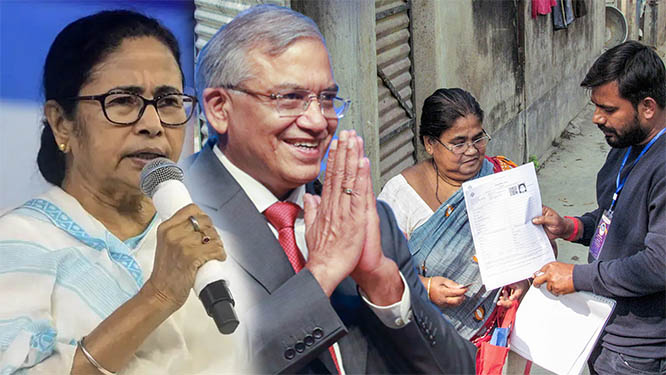
The deletion of over 58 lakh names from West Bengal’s draft electoral rolls following a Special Intensive Revision (SIR) has sparked widespread concern and is likely to deepen political tensions in the poll-bound state.

According to the Election Commission, the revision exercise has identified 24 lakh voters as deceased, 19 lakh as relocated, 12 lakh as missing, and 1.3 lakh as duplicate entries. The draft list, published after the completion of the first phase of SIR, aims to remove errors and duplication from the electoral rolls.

However, the scale of deletions has raised fears that a large number of eligible voters may have been wrongly excluded. The Election Commission has said that individuals whose names are missing can file objections and seek corrections. The final voter list is scheduled to be published in February next year, after which the Assembly election announcement is expected. Notably, the last Special Intensive Revision in Bengal was conducted in 2002.

The development has intensified the political row over the SIR process. Chief Minister Mamata Banerjee and her Trinamool Congress have strongly opposed the exercise, accusing the Centre and the Election Commission of attempting to disenfranchise lakhs of voters ahead of the elections.

Addressing a rally in Krishnanagar earlier this month, Banerjee urged people to protest if their names were removed from the voter list, alleging intimidation during elections and warning of serious consequences if voting rights were taken away.

The BJP, meanwhile, has defended the revision and accused the Trinamool Congress of politicising the issue to protect what it claims is an illegal voter base. Leader of the Opposition Suvendu Adhikari alleged that the ruling party fears losing power due to the removal of deceased, fake, and illegal voters.

The controversy comes amid earlier allegations by the Trinamool Congress that excessive work pressure during the SIR led to the deaths by suicide of some Booth Level Officers (BLOs), for which the party blamed the Election Commission. With the draft list now out, another round of political confrontation appears imminent.

As objections begin to be filed, the focus will be on whether the correction mechanism is accessible, transparent, and timely—critical factors in ensuring that no eligible voter is denied their democratic right ahead of a crucial election.

Comments

Add new comment

  • Coastaldigest.com reserves the right to delete or block any comments.
  • Coastaldigset.com is not responsible for its readers’ comments.
  • Comments that are abusive, incendiary or irrelevant are strictly prohibited.
  • Please use a genuine email ID and provide your name to avoid reject.
News Network
December 19,2025

Saudi Arabia has abolished fees on expatriate workers employed in licensed industrial establishments, signaling a strong push to empower national factories and enhance the Kingdom’s global industrial competitiveness. The move reflects the leadership’s commitment to building a sustainable and resilient industrial economy under Saudi Vision 2030.

The decision was approved by the Council of Ministers, chaired by Crown Prince and Prime Minister Mohammed bin Salman, following a recommendation from the Council of Economic and Development Affairs (CEDA). It forms part of a broader strategy to support, modernize, and strengthen the industrial sector.

By removing fees on foreign workers, industrial establishments gain greater operational flexibility and relief from financial pressures. This is expected to help factories expand production, improve efficiency, and compete more effectively in international markets, while reinforcing long-term sustainability.

The initiative aligns closely with Saudi Vision 2030, which identifies industry as a key pillar of economic diversification. A competitive and resilient industrial base is viewed as essential for driving innovation, attracting investment, and sustaining long-term economic growth.

Overall, the fee exemption underscores the Kingdom’s commitment to creating a supportive environment for industrial development and ensuring that Saudi factories remain globally competitive and capable of leading the nation’s economic transformation.

Comments

Add new comment

  • Coastaldigest.com reserves the right to delete or block any comments.
  • Coastaldigset.com is not responsible for its readers’ comments.
  • Comments that are abusive, incendiary or irrelevant are strictly prohibited.
  • Please use a genuine email ID and provide your name to avoid reject.