



Makkah Criminal Court acquits 13 defendants in Grand Mosque crane collapse

News Network
December 10, 2020

Dubai, Dec 10: The Makkah Criminal Court on Wednesday issued a new ruling acquitting 13 defendants in the Grand Mosque Crane collapse case, including Saudi Binladin Group, Saudi media such as Okaz/Saudi Gazette reported.

In the new verdict, the court said it had found nothing new than what it had earlier ruled in the case.

It said it would send a copy of the verdict to the Court of Appeal to decide on the issue.

In an earlier verdict delivered on October 1, 2017, the Makkah Criminal Court had acquitted all the 13 defendants who were charged with negligence.

The court had said that the defendants are not criminally responsible for the incident in which 108 people lost their lives and another 238 were injured when a crane involved in the Grand Mosque expansion project collapsed on September 11, 2015.

The disaster was caused by heavy rains and thunderstorms, rather than human error or fault, the court had said in its previous judgement.

“The crane was in an upright, correct and safe position. There was no error committed by the accused, who had taken all the necessary safety precautions,” the court declared in its decision. The Attorney General challenged the decision and appealed against it.

In December 2017, however, the Appeals Court upheld the previous ruling of the Criminal Court. The Appeals Court said that the crane, though placed in a safe position, toppled due to a severe thunderstorm and violent winds. The court also directed the Criminal Court to re-examine the case.

The court issued the new verdict on Wednesday after re-examining the entire aspects of the crane crash.

As per the latest Saudi media reports, the court noted that the General Authority of Meteorology and Environmental Protection had issued a bulletin on weather conditions on the day of the accident and the day before it. The warning showed that the wind speed in the Red Sea ranged between one and 38 kilometres per hour only, and did not include warning of the weather conditions with a possibility of hurricanes.

The court noted that there was no mention in the lawsuit about the warning of the General Authority of Meteorology and Environmental Protection that this disaster would occur. The court also indicated that what happened in Makkah that day could be attached to a celestial phenomenon that was difficult to predict. As such, the defendants cannot be held culpable or the tragedy.

The Court of Appeal had stressed, in its earlier ruling, the need to clarify, define and know precisely the tasks of the safety division of the Haram expansion project. This is because the company which was implementing the project had an integrated department for monitoring weather fluctuations, which means that it was fully responsible for detecting and forecasting weather conditions and did not need to wait for meteorological reports.

The Court of Appeal also drew attention to the response of an official among the defendants that he was not informed of the outbreak of the storm on the day of the crane tragedy, as it occurred on Friday during which he was on leave. The appeals court’s remarks emphasised that none of the accused officials indicated that there was a special meteorology unit associated with the project.

The court also noted the dereliction of duty on the part of the Environmental Department affiliated to the Department of Safety and its role in collecting reports on weather conditions and preparing daily reports. The court also directed a first-grade court to examine this aspect of the incident.

Comments

Sameer koya
 - 
Monday, 21 Dec 2020

I have not yet received approval

Asad
 - 
Wednesday, 16 Dec 2020

When it change
60days red nd green status
Tell me

Add new comment

  • Coastaldigest.com reserves the right to delete or block any comments.
  • Coastaldigset.com is not responsible for its readers’ comments.
  • Comments that are abusive, incendiary or irrelevant are strictly prohibited.
  • Please use a genuine email ID and provide your name to avoid reject.
News Network
January 20,2026

DGP.jpg

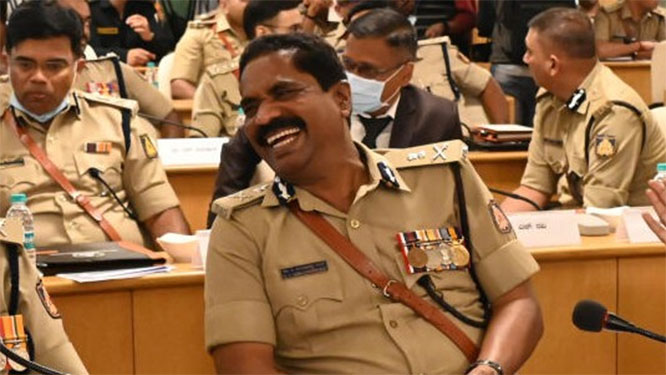
Karnataka DGP (Civil Rights Enforcement) K Ramachandra Rao was suspended with immediate effect, as per a state government order issued on Monday, 19 January. The order cited conduct unbecoming of a government servant and causing embarrassment to the state administration.

The Karnataka government suspended Rao after a purported video showed him in a compromising position with a woman inside his official chamber. The video went viral on social media. Rao rejected the videos outright, terming them "fabricated and false".

Who is K Ramachandra Rao?

Rao is a DGP-rank officer who was heading the Directorate of Civil Rights Enforcement until his suspension. He was promoted to DGP in September 2023 and assumed office in October 2023, the Sunday Guardian reported.

He also served as the Chairman and Managing Director of the Karnataka State Police Housing and Infrastructure Development Corporation Limited.

His stint as the Inspector General of Police (IGP) for the Southern Range was also marred by controversy. In 2014, during a cash seizure near Mysuru’s Yelwal, officials claimed the seized amount was ₹20 lakh, while the accused (Kerala-based merchants) claimed it was around ₹2.27 crore.

Rao, who was present during the seizure, denied all allegations. However, he was transferred soon after.

Allegations of collusion with a businessman surfaced, and a senior police officer was quoted by The Sunday Guardian as saying, “In Rao’s case, the CID has clearly mentioned that there was a great degree of lapse on the part of Rao and a deputy superintendent of police after it was brought to their notice that a few policemen, including a gunman attached to the IGP, were involved in the robbery.”

Rao had denied all wrongdoing in that incident. Despite past controversies, he rose to the state’s top police position, the Sunday Guardian reported.

Ranya Rao’s stepfather

Rao is the stepfather of Kannada actress Harshavardhini Ranya alias Ranya Rao, accused of orchestrating the illegal import of gold worth over ₹12.56 crore from Dubai to India along with two others — businessman Tarun Raju, and jewellery dealer Sahil Jain.

‘Obscene video’ controversy

A viral video showed Rao behaving inappropriately with a woman inside his office while in uniform.

The Karnataka government said in its Monday order that “vide videos and news reports widely broadcast on public news channels and media platforms, it is observed that Dr K Ramachandra Rao has acted in an obscene manner which is unbecoming of a Government Servant and also causing embarrassment to the Government.”

The order said the matter was examined by the state government, which found that the officer's conduct amounted to a violation of Rule 3 of the All India Services (Conduct) Rules, 1968.

The government said it is prima facie satisfied that "it is necessary to place Rao under suspension with immediate effect, pending inquiry".

During the suspension period, Rao will be entitled to subsistence allowance as per Rule 4 of the All India Services (Discipline and Appeal) Rules, 1969.

The order also places restrictions on his movement, stating that during the period of suspension, the officer must not leave headquarters under any circumstances without the written permission of the state government.

Comments

Add new comment

  • Coastaldigest.com reserves the right to delete or block any comments.
  • Coastaldigset.com is not responsible for its readers’ comments.
  • Comments that are abusive, incendiary or irrelevant are strictly prohibited.
  • Please use a genuine email ID and provide your name to avoid reject.
News Network
February 1,2026

Bengaluru: The Karnataka High Court has refused to quash an investigation against a WhatsApp group administrator accused of allowing the circulation of obscene and offensive images depicting Hindutva politicians and idols in 2021.

Justice M Nagaprasanna observed that, prima facie, the ingredients of the offence under Section 295A of the Indian Penal Code were made out. “The offence under Section 295A of the IPC is met to every word of its ingredient, albeit prima facie,” the judge said.

The petitioner, Sirajuddin, a resident of Belthangady taluk in Dakshina Kannada district, had challenged the FIR registered against him at the CEN (Cyber, Economics and Narcotics) police station, Mangaluru, for offences under Section 295A of the IPC and Section 67 of the Information Technology Act. Section 295A relates to punishment for deliberate and malicious acts intended to outrage the religious feelings of any class of citizens.

According to the complaint filed by K Jayaraj Salian, also a resident of Belthangady taluk, he received a WhatsApp group link from an unknown source and was added to the group after accessing it. The group reportedly had six administrators and around 250 participants, where obscene and offensive images depicting Hindu deities and certain political figures were allegedly circulated repeatedly.

Sirajuddin was arrested in connection with the case and later released on bail on February 16, 2021. He argued before the court that he was being selectively targeted, while other administrators—including the creator of the group—were neither arrested nor investigated. He also contended that the Magistrate could not have taken cognisance of the offence under Section 295A without prior sanction under Section 196(1) of the CrPC.

Rejecting the argument, Justice Nagaprasanna held that prior sanction is required only at the stage of taking cognisance, and not at the stage of registration of the crime or during investigation.

The judge noted that the State had produced the entire investigation material before the court. “A perusal of the material reveals depictions of Hindu deities in an extraordinarily obscene, demeaning and profane manner. The content is such that its reproduction in a judicial order would itself be inappropriate,” the court said, adding that the material, on its face, had the tendency to outrage religious feelings and disturb communal harmony.

Observing that the case was still at the investigation stage, the court said it could not interdict the probe at this juncture. However, it expressed concern that the investigating officer appeared to have not proceeded uniformly against all administrators. The court clarified that if the investigation revealed the active involvement of any member in permitting the circulation of such content, they must also be proceeded against.

“At this investigative stage, any further observation by this Court would be unnecessary,” the order concluded.

Comments

Add new comment

  • Coastaldigest.com reserves the right to delete or block any comments.
  • Coastaldigset.com is not responsible for its readers’ comments.
  • Comments that are abusive, incendiary or irrelevant are strictly prohibited.
  • Please use a genuine email ID and provide your name to avoid reject.