



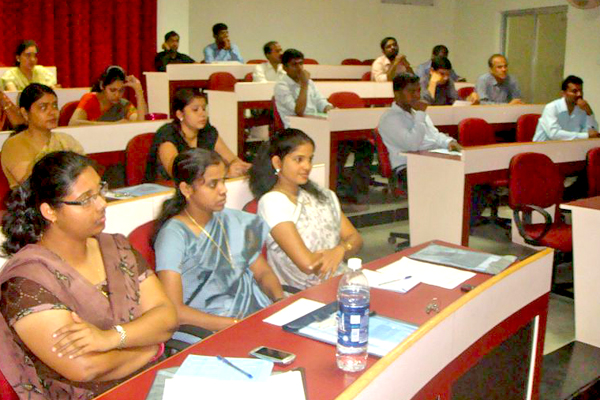
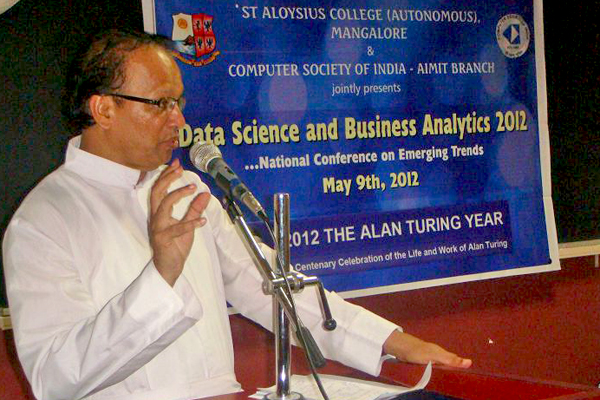
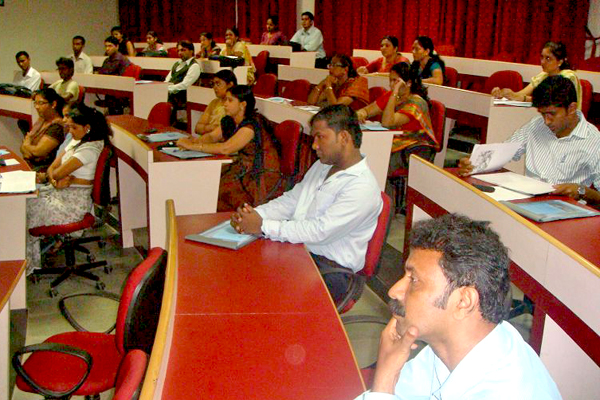
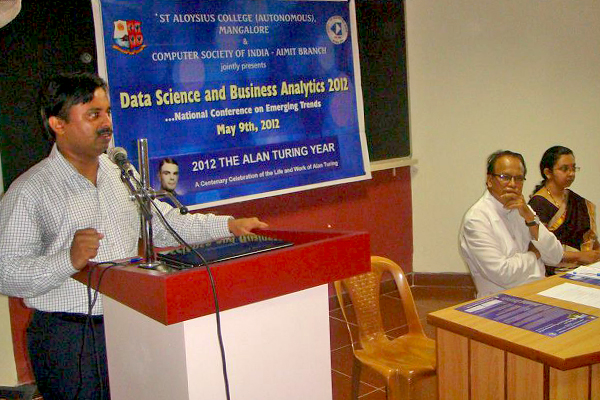
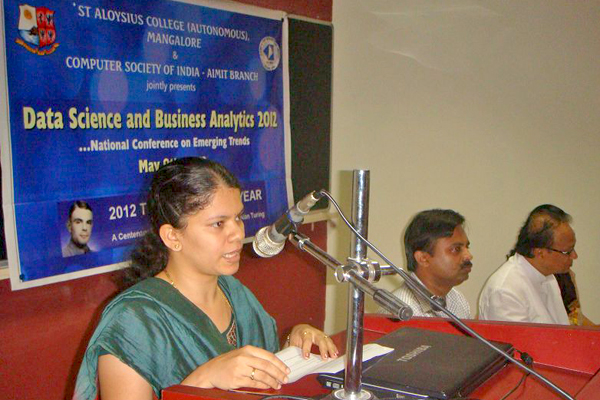
Mangalore, May 10: The national level conference on Data Science and Business Analytics was held at AIMIT campus of St Aloysius College on Wednesday.
Denzil Lobo S.J., Director, AIMIT in his inaugural speech spoke about the processing power of our brain and said, “the most sophisticated computers even today cannot compare with the working of brain of an ant in its ability to process and store voluminous amount of data”.
He spoke of future development in computing paradigms and the day would come when our computers will try to mimic the functioning of a human brain and will be self-learning machines. He also stressed on the need of change in learning paradigm and said that students must be encouraged to THINK rather than memorise.
Prof. Santosh Rebello, Dean of the I.T. section, AIMIT, in his introductory remarks and welcome speech spoke about management of “big” data. He said that unstructured data has revolutionized the world and said that if we have to progress, we need to accept and adapt the changes that are taking place. Medha Kudari proposed the vote of thanks.
Sessions
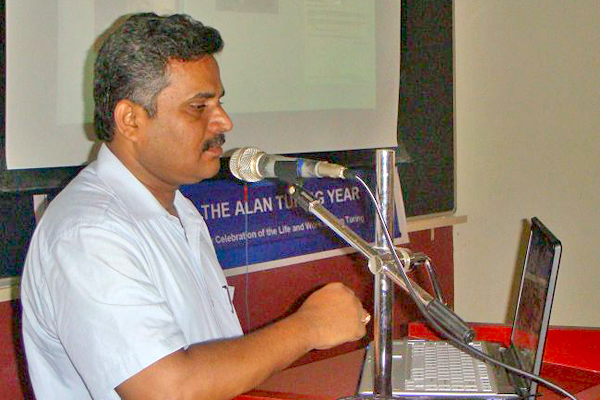
The first session of the day started with the keynote address delivered by Mr. Shekhar, Dept. of M.C.A., Mangalore University. It was on “Machine learning for Vision Applications”. He started his talk by stating that learning is good only when it is efficient; and that whenever changes are made to the system, it should be adaptable and efficient. He illustrated the importance of training and clustering in Machine learning, gave a brief idea of computer vision and started examples with applications. It was concluded that extreme dependence on the machines to reduce the functional capabilities of the person. Finally, Prof. Santosh Rebello mentioned a few insights on Digital space and how to create value out of it.
During the second session papers by the participants were presented. The first paper, titled “Business Intelligence – Achieving success through Data Quality” was presented by Ms. Anusha G. Sabhahit followed by the next paper “Industry Application of Data Mining” by Mr. D M Arvind Mallik. Ms. Kavitha presented the paper “Enhanced Adaptive Item Sequencing using Biserial Correlation and Bayesian Classification” and the paper on “Evolution of statistical software design: Futuristic Agenda” by Ms. Sumitha P V, Mr. Ashok D'souza and Mr. Madhukar S M was presented.
A paper on “Time series data mining algorithm” by Yachana was presented by Ankitha Nayak and Neetha Kripalani Bangera and the paper on “Introduction to Nano-sensors for detecting diabetics and its importance”by Shobha K Bawiskar, Savitha A Lothe, Aqueel Ahmed and Ramesh Manza was presented by Ashwin Kumar and Manish Bharadwaj.
The afternoon session started at 2pm. The keynote address was delivered by Mrs. Rohini Rao, Dept. of M.C.A., Manipal Institute of Technology based on “The role of Domain Ontology in Semantic Data Integration”. She elaborated the definition of Ontology – branch of Metaphysics. She explained about Domain Ontology and how it can be possible to create our own Ontology. She further illustrated on the use of Domain Ontology in data integration with a set of examples.
A paper on “Optimizing Artificial Neural Networks for protein secondary structure prediction” was presented by Mr. Lanwin Lobo. Next, a paper on “A practical approach for implementing Business Intelligence in terms of DSS and KM in socio-economic reality of organization” by Mr. Suman A Lasrado, Mr. Arun D'silva and Mr. Roshan Suvaris was presented which was followed by a tea break for 15 minutes.
A paper on “Incorporating Divide and Conquer approach for clustering large data set with prior K-means algorithm” by Umadevi C and Sowmyapriya G V was presented by Mithun Kumar Shetty and Sujoy K R and the paper on “Analysis on cloud capabilities and adoption using maturity model” by Thanuja G V was presented by Deeksha J Shetty and Devendra Kumar.
The conference came to an end with the valedictory function where the certificates of participation were distributed to the participants.


Comments
Fantastic blog extremely good well enjoyed with the incredible informative content which surely activates the learners to gain enough knowledge. This, in turn, makes the readers explore themselves and involve deeply in the subject. Wish you to dispatch similar content successively in the future as well.
Machine Learning Courses
Add new comment