



Day after defeat Badal resigns as Punjab CM

March 12, 2017

Chandigarh, Mar 12: Punjab Chief Minister Parkash Singh Badal today submitted his resignation to Governor V P Singh Badnore following his party's defeat in the assembly polls.
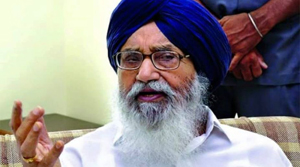
badal
The Punjab cabinet, which met under Badal for the last time, recommended dissolution of the Assembly, paving the way for the constitution of the new legislature.

The 89-year-old Akali leader along with deputy chief minister and his son Sukhbir Singh Badal went to the Raj Bhawan and handed over the resignation letter to the Governor, a Raj Bhawan spokesman said.

Badal, a five-time Chief Minister, retained his Lambi Assembly seat defeating Punjab Congress chief Capt Amarinder Singh. However Amarinder retained his traditional bastion Patiala seat.

The SAD-BJP alliance finished a poor third at the hustings with the combine managing just 18 seats in the 117-member House. SAD won 15 seats while its ally BJP won three.New entrant Aam Aadmi Party (AAP) won 20 seats.

Congress by bagging 77 seats, one short of two-thirds majority swept Punjab and ended the ten year regime of the Badals.

Earlier, Badal held a cabinet meeting in which a resolution was passed to dissolve the Assembly.

Among others who attended the meeting include Sukhbir Singh Badal, N K Sharma and Madan Mohan Mittal.

The Punjab Cabinet decided to recommend the dissolution of the 14th Punjab Vidhan Sabha under the provision of Article 174 (2) (b) of the Constitution, to the Punjab Governor, an official spokesman said.

A decision to this effect was taken in the meeting of Council of Ministers chaired by Badal here at Punjab Bhawan, the spokesman said.

"The Cabinet authorised the Chief Minister to send this proposal to the Governor of Punjab for dissolution of 14th Vidhan Sabha with immediate effect," he said.

After meeting the governor, Badal told the media that his party's fight on the issue of SYL will continue.

Sukhbir said that as a responsible opposition, SAD will offer support to the Congress government on all matters which are in the interests of Punjab.

"I congratulate Captain for the Congress win," he said adding that, "we will introspect why the SAD lost despite doing lot of development works."

The Chief Minister expressed his sincere and deepest gratitude to his Cabinet colleagues, officers, officials and the people of the state for extending full support and cooperation to the incumbent government during its tenure to ensure overall development and prosperity besides maintaining peace and communal harmony at all costs.

The Council of Ministers thanked the people of state for their support and cooperation during the last decade for upholding the ethos of peace and communal harmony besides ensuring all round development of the state.

The Cabinet passed a resolution which read, "The last decade saw Punjab becoming a power surplus state, from a power deficit one thereby relieving the people from power cuts besides developing a world class infrastructure along with international airports and perpetuating the glorious legacy of state through beautification of Sri Amritsar Sahib."

"Punjab emerged as a leading state during the last ten years where free power facility was given to farmers, dalits and weaker sections of society, Atta-Dal scheme for economically poor strata, scholarship schemes for students, free health care facilities and huge monetary relief for cancer victims," the resolution said.

Farmers and poor section was provided exemplary facilities which are not available to them in any part of the country.

New era of congenial relations between Centre and state was started due to which Punjab was immensely benefited by Central relief, it said.

During the last ten years utmost attention was given towards securing the interests of the state.

Despite mounting pressure, nobody was allowed to rob even a single drop of water of the state, the resolution said.

"Even the genesis of SYL canal was decimated by de-notifying the land acquired for this canal and giving it back to the original owners," the resolution said.

Several path breaking initiatives were taken for welfare of urban and rural populace. The state government foiled the plans of divisive forces to ignite communal violence in the state and upheld communal harmony, peace and amity at every cost.

"Even the ugly head of conspiracy hatched from foreign land to disturb hard earned peace of the state was crushed with heavy hand," the resolution said.

The Cabinet also expressed gratitude to the police and civil administrative set-up, all government, semi government and other organisations for their support and cooperation during last decade.

The meeting also prayed to God that Punjab should scale new heights of glory in coming days and may this atmosphere of peace and development carry on in the state.

The meeting reiterates its faith and extends full support and cooperation to the new government for safeguarding the rights and interests of the state.

It also extends best wishes to the new Government and Punjabis.

Comments

Add new comment

  • Coastaldigest.com reserves the right to delete or block any comments.
  • Coastaldigset.com is not responsible for its readers’ comments.
  • Comments that are abusive, incendiary or irrelevant are strictly prohibited.
  • Please use a genuine email ID and provide your name to avoid reject.
News Network
December 16,2025

bengal.jpg

The deletion of over 58 lakh names from West Bengal’s draft electoral rolls following a Special Intensive Revision (SIR) has sparked widespread concern and is likely to deepen political tensions in the poll-bound state.

According to the Election Commission, the revision exercise has identified 24 lakh voters as deceased, 19 lakh as relocated, 12 lakh as missing, and 1.3 lakh as duplicate entries. The draft list, published after the completion of the first phase of SIR, aims to remove errors and duplication from the electoral rolls.

However, the scale of deletions has raised fears that a large number of eligible voters may have been wrongly excluded. The Election Commission has said that individuals whose names are missing can file objections and seek corrections. The final voter list is scheduled to be published in February next year, after which the Assembly election announcement is expected. Notably, the last Special Intensive Revision in Bengal was conducted in 2002.

The development has intensified the political row over the SIR process. Chief Minister Mamata Banerjee and her Trinamool Congress have strongly opposed the exercise, accusing the Centre and the Election Commission of attempting to disenfranchise lakhs of voters ahead of the elections.

Addressing a rally in Krishnanagar earlier this month, Banerjee urged people to protest if their names were removed from the voter list, alleging intimidation during elections and warning of serious consequences if voting rights were taken away.

The BJP, meanwhile, has defended the revision and accused the Trinamool Congress of politicising the issue to protect what it claims is an illegal voter base. Leader of the Opposition Suvendu Adhikari alleged that the ruling party fears losing power due to the removal of deceased, fake, and illegal voters.

The controversy comes amid earlier allegations by the Trinamool Congress that excessive work pressure during the SIR led to the deaths by suicide of some Booth Level Officers (BLOs), for which the party blamed the Election Commission. With the draft list now out, another round of political confrontation appears imminent.

As objections begin to be filed, the focus will be on whether the correction mechanism is accessible, transparent, and timely—critical factors in ensuring that no eligible voter is denied their democratic right ahead of a crucial election.

Comments

Add new comment

  • Coastaldigest.com reserves the right to delete or block any comments.
  • Coastaldigset.com is not responsible for its readers’ comments.
  • Comments that are abusive, incendiary or irrelevant are strictly prohibited.
  • Please use a genuine email ID and provide your name to avoid reject.
News Network
December 13,2025

New Delhi: School-going children are picking up drug and smoking habits and engaging in consumption of alcohol, with the average age of introduction to such harmful substances found to be around 13 years, suggesting a need for earlier interventions as early as primary school, a multi-city survey by AIIMS-Delhi said.

The findings also showed substance use increased in higher grades, with grade XI/XII students two times more likely to report use of substances when compared with grade VIII students. This emphasised the importance of continued prevention and intervention through middle and high school.

The study led by Dr Anju Dhawan of AIIMS's National Drug Dependence Treatment Centre, published in the National Medical Journal of India this month, looks at adolescent substance use across diverse regions.

The survey included 5,920 students from classes 8, 9, 11 and 12 in urban government, private and rural schools across 10 cities -- Bengaluru, Chandigarh, Delhi, Dibrugarh, Hyderabad, Imphal, Jammu, Lucknow, Mumbai, and Ranchi. The data were collected between May 2018 and June 2019.

The average age of initiation for any substance was 12.9 (2.8) years. It was lowest for inhalants (11.3 years) followed by heroin (12.3 years) and opioid pharmaceuticals (without prescription; 12.5 years).

Overall, 15.1 per cent of participants reported lifetime use, 10.3 per cent reported past year use, and 7.2 per cent reported use in the past month of any substance, the study found.

The most common substances used in the past year, after tobacco (4 per cent) and alcohol (3.8 per cent), were opioids (2.8 per cent), followed by cannabis (2 per cent) and inhalants (1.9 per cent). Use of non-prescribed pharmaceutical opioids was most common among opioid users (90.2 per cent).

On being asked, 'Do you think this substance is easily available for a person of your age' separately for each substance category, nearly half the students (46.3 per cent) endorsed that tobacco products and more than one-third of the students (36.5 per cent) agreed that a person of their age can easily procure alcohol products.

Similarly, for Bhang (21.9 per cent), ganja/charas (16.1 per cent), inhalants (15.2 per cent), sedatives (13.7 per cent), opium and heroin (10 per cent each), the students endorsed that these can be easily procured.

About 95 per cent of the children, irrespective of their grade, agreed with the statement that 'drug use is harmful'.

The rates of substance use (any) among boys were significantly higher than those of girls for substance use (ever), use in the past year and use in the past 30 days. Compared to grade VIII students, grade IX students were more likely, and grade XI/XII students were twice as likely to have used any substance (ever).

The likelihood of past-year use of any substance was also higher for grade IX students and for grade XI/XII students as compared to grade VIII students.

About 40 per cent of students mentioned that they had a family member who used tobacco or alcohol each. The use of cannabis (any product) and opioid (any product) by a family member was reported by 8.2 per cent and 3.9 per cent of students, respectively, while the use of other substances, such as inhalants/sedatives by family was 2-3 per cent, the study found.

A relatively smaller percentage of students reported use of tobacco or alcohol among peers as compared to among family members, while a higher percentage reported inhalants, sedatives, cannabis or opioid use among peers.

Children using substances (past year) compared to non-users reported significantly higher any substance use by their family members and peers.

There were 25.7 per cent students who replied 'yes' to the question 'conflicts/fights often occur in your family'. Most students also replied affirmatively to 'family members are aware of how their time is being spent' and 'damily members are aware of with whom they spend their time'.

Comments

Add new comment

  • Coastaldigest.com reserves the right to delete or block any comments.
  • Coastaldigset.com is not responsible for its readers’ comments.
  • Comments that are abusive, incendiary or irrelevant are strictly prohibited.
  • Please use a genuine email ID and provide your name to avoid reject.
