



Days after IAF airstrike, satellite images show JeM buildings still standing

Agencies
March 6, 2019

New Delhi/Singapore, Mar 6: High-resolution satellite images reviewed by Reuters show that a religious school run by Jaish-e-Mohammad (JeM) in northeastern Pakistan appears to be still standing days after India claimed its warplanes had hit the Islamist group's training camp on the site and killed a large number of militants.

The images produced by Planet Labs Inc, a San Francisco-based private satellite operator, show at least six buildings on the madrasa site on March 4, six days after the airstrike.

Until now, no high-resolution satellite images were publicly available. But the images from Planet Labs, which show details as small as 72 cm (28 inches), offer a clearer look at the structures the Indian government said it attacked.

The image is virtually unchanged from an April 2018 satellite photo of the facility. There are no discernible holes in the roofs of buildings, no signs of scorching, blown-out walls, displaced trees around the madrasa or other signs of an aerial attack.

The images cast further doubt on statements made over the last eight days by the Indian government of Prime Minister Narendra Modi that the raids, early on Feb. 26, had hit all the intended targets at the madrasa site near Jaba village and the town of Balakot in Pakistan's Khyber Pakhtunkhwa province.

India's foreign and defence ministries did not reply to emailed questions sent in the past few days seeking comment on what is shown in the satellite images and whether they undermine its official statements on the airstrikes.

MISSED THE TARGET?

Jeffrey Lewis, director of the East Asia Nonproliferation Project at the Middlebury Institute of International Studies, who has 15 years' experience in analysing satellite images of weapons sites and systems, confirmed that the high-resolution satellite picture showed the structures in question.

"The high-resolution images don't show any evidence of bomb damage," he said. Lewis viewed three other high-resolution Planet Labs pictures of the site taken within hours of the image provided to Reuters.

The Indian government has not publicly disclosed what weapons were used in the strike.

Government sources told Reuters last week that 12 Mirage 2000 jets carrying 1,000 kg (2,200 lbs) bombs carried out the attack. On Tuesday, a defence official said the aircraft used the 2,000-lb Israeli-made SPICE 2000 glide bomb in the strike.

A warhead of that size is meant to destroy hardened targets such as concrete shelters.

Lewis and Dave Schmerler, a senior research associate at the James Martin Center for Nonproliferation studies who also analyses satellite images, said weapons that large would have caused obvious damage to the structures visible in the picture.

"If the strike had been successful, given the information we have about what kind of munitions were used, I would expect to see signs that the buildings had been damaged," Lewis added. "I just don't see that here."

Pakistan has disputed India's account, saying the operation was a failure that saw Indian jets, under pressure from Pakistani planes, drop their bombs on a largely empty hillside.

"There has been no damage to any infrastructure or human life as a result of Indian incursion," Major General Asif Ghafoor, the director general of the Pakistan military's press wing, in a statement to Reuters.

"This has been vindicated by both domestic and international media after visiting the site."

BOMB CRATERS

In two visits to the Balakot area in Pakistan by Reuters reporters last Tuesday and Thursday, and extensive interviews with people in the surrounding area, there was no evidence found of a destroyed camp or of anyone being killed. [https://graphics.reuters.com/INDIA-KASHMIR/010090XM162/index.html]

Villagers said there had been a series of huge explosions but the bombs appeared to have landed among trees.

On the wooded slopes above Jaba, they pointed to four craters and some splintered pine trees, but noted little other impact from the blasts that jolted them awake about 3 a.m. on Feb. 26.

"It shook everything," said Abdur Rasheed, a van driver who works in the area.

He said there weren't any human casualties: "No one died. Only some pine trees died, they were cut down. A crow also died."

Mohammad Saddique from Jaba Basic Health Unit and Zia Ul Haq, senior medical officer at Tehsil Headquarters Hospital in Balakot said they had seen no casualties.

POLITICAL FIRE

India must hold a general election by May, and pollsters say Modi and his Hindu nationalist party stand to benefit from his aggressive response to a suicide bomb attack that killed 40 Indian paramilitary police in the disputed Kashmir region on Feb. 14.

India's Foreign Secretary Vijay Gokhale said on the day of the strike that "a very large number of Jaish-e-Mohammad terrorists, trainers, senior commanders, and groups of jihadis who were being trained for Fidayeen action were eliminated" in the attack. Fidayeen is a term used to describe Islamist militants on suicide missions.

Another senior government official told reporters on the same day that about 300 militants had been killed. On Sunday the president of the ruling Bharatiya Janata Party (BJP), Amit Shah, put the number killed at more than 250.

The Indian government has not produced evidence that a camp was destroyed or that any militants were killed in the raid.

That has prompted some opposition politicians to push for more details.

"We want to know how many people actually died," said Mamata Banerjee, the firebrand chief minister of West Bengal state, in a video published by her All India Trinamool Congress party in a tweet on Feb. 28. "Where did the bombs fall? Did they actually fall in the right place?"

Banerjee, who is seen as a potential prime ministerial candidate, said that she stood behind the Indian Armed Forces, but that they should be given a chance to speak the truth.

"We don't want a war for political reasons, to win an election," she said.

Modi has accused the opposition Congress party, and other opponents such as Banerjee, of helping India's enemies by demanding evidence of the attacks.

"At a time when our army is engaged in crushing terrorism, inside the country and outside, there are some people within the country who are trying to break their morale, which is cheering our enemy," Modi said at an election rally on Sunday.

Comments

Add new comment

  • Coastaldigest.com reserves the right to delete or block any comments.
  • Coastaldigset.com is not responsible for its readers’ comments.
  • Comments that are abusive, incendiary or irrelevant are strictly prohibited.
  • Please use a genuine email ID and provide your name to avoid reject.
News Network
December 7,2025

envoy.jpg

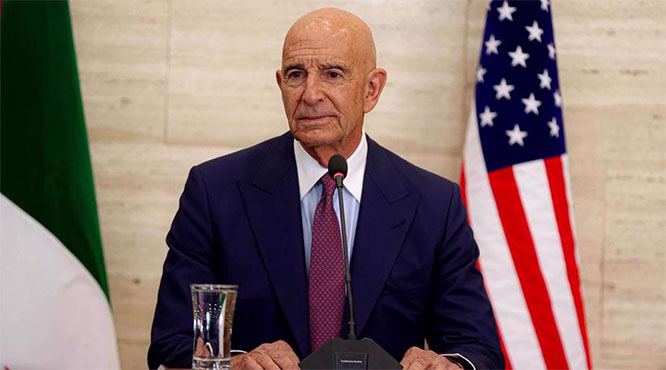
Since 1946, the United States has attempted 93 coups or “regime change” operations across the world — including two in Iran, US Special Envoy for Syria Tom Barrack has admitted.

Speaking to the UAE-based IMI Media Group, in remarks published by The National, Barrack said Washington tried twice to overthrow the Iranian government but failed both times. 

“For (Trump) then to be imputed with regime change — we had two regime changes in Iran already. Neither one worked. So I think wisely leave it to the region to solve,” said Barrack, who also serves as the US ambassador to Turkey.

His comments come six months after the US joined Israel in airstrikes against Iran during ongoing indirect nuclear negotiations between Tehran and Washington.

On June 13, Israel launched an attack on Iran that killed at least 1,064 people and hit civilian infrastructure. Days later, the United States targeted three nuclear facilities — Fordow, Natanz and Isfahan — in what Iran called a clear violation of international law. Iranian retaliation eventually forced a halt to the assault on June 24.

Barrack further claimed that US President Donald Trump and Foreign Secretary Marco Rubio are “not into regime change” and prefer a regional approach driven by Middle Eastern countries themselves. According to him, regional dialogue and non-interference by outside powers offer a more durable path forward.

He added that Washington is still open to an agreement with Tehran if Iranian authorities show “seriousness” and willingness to engage constructively.

However, Iran maintains the US has not shown readiness for meaningful talks. In an interview with Japan’s Kyodo News, Iranian Foreign Minister Abbas Araghchi said negotiations could advance only if Washington acknowledges Iran’s right to peaceful nuclear energy and lifts unilateral sanctions.

Comments

Add new comment

  • Coastaldigest.com reserves the right to delete or block any comments.
  • Coastaldigset.com is not responsible for its readers’ comments.
  • Comments that are abusive, incendiary or irrelevant are strictly prohibited.
  • Please use a genuine email ID and provide your name to avoid reject.
News Network
December 15,2025

Mangaluru, Dec 15: Air India Express has announced that it will resume direct flight services between Mangaluru and Muscat from March 2026, restoring an important international air link for passengers from the coastal region.

Airport authorities said the service will operate twice a week—on Sundays and Tuesdays—from March 1. The initial flights are scheduled on March 3, 8 and 10, followed by March 15 and 17, with the same operating pattern to continue thereafter. The flight duration is approximately three hours and 25 minutes.

The Mangaluru–Muscat route was earlier operated under the 2025 summer schedule, with services beginning on July 14. At that time, Air India Express had operated four flights a week before suspending the service.

Officials said the summer schedule will come into effect from March 29, after which changes in flight timings and departure schedules from Mangaluru are expected. Passengers have been advised to check the latest schedules while planning their travel.

The resumption of direct flights to Muscat is expected to significantly benefit expatriates, business travellers and others, further strengthening Mangaluru’s air connectivity with the Gulf region.

Comments

Add new comment

  • Coastaldigest.com reserves the right to delete or block any comments.
  • Coastaldigset.com is not responsible for its readers’ comments.
  • Comments that are abusive, incendiary or irrelevant are strictly prohibited.
  • Please use a genuine email ID and provide your name to avoid reject.
News Network
December 13,2025

New Delhi: School-going children are picking up drug and smoking habits and engaging in consumption of alcohol, with the average age of introduction to such harmful substances found to be around 13 years, suggesting a need for earlier interventions as early as primary school, a multi-city survey by AIIMS-Delhi said.

The findings also showed substance use increased in higher grades, with grade XI/XII students two times more likely to report use of substances when compared with grade VIII students. This emphasised the importance of continued prevention and intervention through middle and high school.

The study led by Dr Anju Dhawan of AIIMS's National Drug Dependence Treatment Centre, published in the National Medical Journal of India this month, looks at adolescent substance use across diverse regions.

The survey included 5,920 students from classes 8, 9, 11 and 12 in urban government, private and rural schools across 10 cities -- Bengaluru, Chandigarh, Delhi, Dibrugarh, Hyderabad, Imphal, Jammu, Lucknow, Mumbai, and Ranchi. The data were collected between May 2018 and June 2019.

The average age of initiation for any substance was 12.9 (2.8) years. It was lowest for inhalants (11.3 years) followed by heroin (12.3 years) and opioid pharmaceuticals (without prescription; 12.5 years).

Overall, 15.1 per cent of participants reported lifetime use, 10.3 per cent reported past year use, and 7.2 per cent reported use in the past month of any substance, the study found.

The most common substances used in the past year, after tobacco (4 per cent) and alcohol (3.8 per cent), were opioids (2.8 per cent), followed by cannabis (2 per cent) and inhalants (1.9 per cent). Use of non-prescribed pharmaceutical opioids was most common among opioid users (90.2 per cent).

On being asked, 'Do you think this substance is easily available for a person of your age' separately for each substance category, nearly half the students (46.3 per cent) endorsed that tobacco products and more than one-third of the students (36.5 per cent) agreed that a person of their age can easily procure alcohol products.

Similarly, for Bhang (21.9 per cent), ganja/charas (16.1 per cent), inhalants (15.2 per cent), sedatives (13.7 per cent), opium and heroin (10 per cent each), the students endorsed that these can be easily procured.

About 95 per cent of the children, irrespective of their grade, agreed with the statement that 'drug use is harmful'.

The rates of substance use (any) among boys were significantly higher than those of girls for substance use (ever), use in the past year and use in the past 30 days. Compared to grade VIII students, grade IX students were more likely, and grade XI/XII students were twice as likely to have used any substance (ever).

The likelihood of past-year use of any substance was also higher for grade IX students and for grade XI/XII students as compared to grade VIII students.

About 40 per cent of students mentioned that they had a family member who used tobacco or alcohol each. The use of cannabis (any product) and opioid (any product) by a family member was reported by 8.2 per cent and 3.9 per cent of students, respectively, while the use of other substances, such as inhalants/sedatives by family was 2-3 per cent, the study found.

A relatively smaller percentage of students reported use of tobacco or alcohol among peers as compared to among family members, while a higher percentage reported inhalants, sedatives, cannabis or opioid use among peers.

Children using substances (past year) compared to non-users reported significantly higher any substance use by their family members and peers.

There were 25.7 per cent students who replied 'yes' to the question 'conflicts/fights often occur in your family'. Most students also replied affirmatively to 'family members are aware of how their time is being spent' and 'damily members are aware of with whom they spend their time'.

Comments

Add new comment

  • Coastaldigest.com reserves the right to delete or block any comments.
  • Coastaldigset.com is not responsible for its readers’ comments.
  • Comments that are abusive, incendiary or irrelevant are strictly prohibited.
  • Please use a genuine email ID and provide your name to avoid reject.