Defence Ministry begins process for Army's much-needed Assault Rifles

Agencies
September 1, 2018

New Delhi, Sept 1: The Ministry of Defence has come out with the Request for Information (RFI) Assault Rifles which is being placed to add push to the indigenization process. The whole process will be under the 'Buy and Make (Indian)' with 'Buy' component being kept nil.

The Army is looking to replace around 8 lakh Insas Rifles which are produced by the Ordinance Factory Board. The RFI being issued is for 6, 50,000 rifles which will become the frontline personal weapon system of the important infantry soldier of the Indian Army.

Infantry takes on the enemy from the front. The Indian Army has around 400 units of infantry serving in the most difficult parts which also included the significant part of the unit strengths of the Rashtriya Rifles units entrusted with the counter-terrorism operations in the state of Jammu and Kashmir.

In order to fulfil the needs of Assault Rifles, 72, 400 units of such rifles are being procured through the Fast Track Procedure from the international market. The Army had sent a nine-member delegation, led by a Brigadier, to five other countries in order to select the best available from the options in those countries. The delegation is back and it is expected to start the process of fast-track procurement soon.

The Request for Proposal for the larger procurement is expected to take place by December this year.

Comments

Add new comment

  • Coastaldigest.com reserves the right to delete or block any comments.
  • Coastaldigset.com is not responsible for its readers’ comments.
  • Comments that are abusive, incendiary or irrelevant are strictly prohibited.
  • Please use a genuine email ID and provide your name to avoid reject.
News Network
December 22,2025

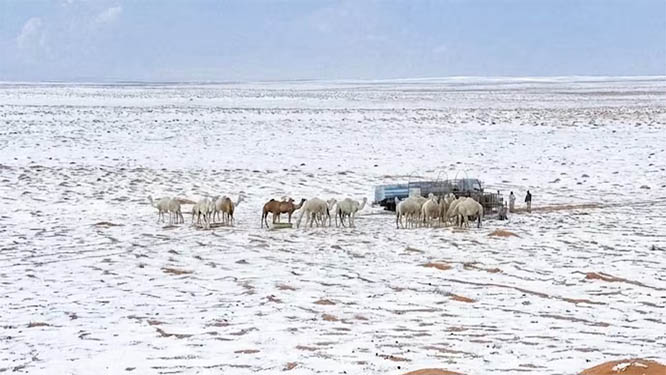
saudisnow.jpg

Saudi Arabia has witnessed rare snowfall in several parts of the country, including the northern regions, where such an event has been reported for the first time in 30 years, leaving residents in awe. 

The white blanket of snow covered vast desert areas, from the Tuwaiq mountain range in the west to regions near Riyadh. The rare event has sparked excitement and disbelief among residents, who have shared videos and photos of the Gulf nation blanketed in white.

A video shared on X captured an unusual scene: a group of camels standing in a desert area covered in snow, with dark clouds looming overhead.

Snowfall transformed parts of the country into an unexpected winter playground. Another video showed adults enjoying the snow by skiing, celebrating, and capturing a scene rarely seen in the Kingdom.

Local TV channels have described the snowfall as historic, while many residents have expressed concerns over the cold conditions and icy roads. The National Meteorology Center (NCM) had earlier warned of a sharp drop in temperatures and urged the public to take safety precautions.

Additionally, the Trojena Highlands and parts of the Tabuk region experienced unusually low temperatures due to snow last week. Jabal Al-Lawz in Tabuk reported heavy snowfall on Wednesday, accompanied by thick fog and strong winds, according to the Saudi Gazette.

The NCM has forecast a high chance of snow in the Qassim region and northern parts of Riyadh on Thursday, as an intense weather system continues to affect large areas of the kingdom. Authorities have cautioned the public to exercise extreme care during the severe weather.

While snow in Saudi Arabia is rare, it is not unprecedented. Last February, the Trojena Mountains saw snowfall and sub-zero temperatures, and parts of Al-Jawf reportedly experienced snow for the first time.

Comments

Add new comment

  • Coastaldigest.com reserves the right to delete or block any comments.
  • Coastaldigset.com is not responsible for its readers’ comments.
  • Comments that are abusive, incendiary or irrelevant are strictly prohibited.
  • Please use a genuine email ID and provide your name to avoid reject.
News Network
December 19,2025

Mangaluru: Public transport in Mangaluru is set for a state-led transformation as the government moves to deploy 100 new electric govt buses to replace unreliable private services. The initiative aims to provide a dependable alternative to private operators who have been frequently "cutting trips," leaving thousands of commuters stranded.

The announcement was made by Deputy Commissioner and MCC Administrator Darshan HV during a public phone-in session. The move specifically targets routes where private bus service has become erratic, ensuring that citizens no longer have to rely on a fluctuating private sector for their daily commute.

Restoring the Govt Presence

The transport crisis was brought to the forefront by Ramayya, a resident of Bajal, who highlighted a growing trend of private buses skipping morning and night trips. With the previous KSRTC (govt) services discontinued, residents have been left without a fallback option.

To fix this, the DC confirmed that the PM-eBus Sewa Scheme will bring 100 government-owned electric buses to the city:

•    Phased Deployment: The first 50 of the new 100 government buses are scheduled to arrive by March 2026.

•    State Infrastructure: Two new government depots, including one at Mudipu, are being prepared for operations.

•    Recruitment: The state has already begun training a new batch of government bus drivers to ensure the fleet is operational the moment it arrives.

Comments

Add new comment

  • Coastaldigest.com reserves the right to delete or block any comments.
  • Coastaldigset.com is not responsible for its readers’ comments.
  • Comments that are abusive, incendiary or irrelevant are strictly prohibited.
  • Please use a genuine email ID and provide your name to avoid reject.
News Network
December 22,2025

The Bharatiya Janata Party (BJP) received ₹6,654.93 crore in donations during the 2024-25 financial year — a Lok Sabha election year — registering a 68 per cent increase over the previous fiscal.

In its annual contribution report submitted to the Election Commission on December 8, two days ahead of the deadline, the BJP disclosed all donations exceeding ₹20,000. The report, now available on the Commission’s website, covers contributions received between April 1, 2024 and March 30, 2025 — a period marked by the general election and Assembly polls in Arunachal Pradesh, Sikkim, Andhra Pradesh, Odisha, Jammu and Kashmir, Haryana, Jharkhand, Maharashtra and Delhi.

The BJP, the world’s largest political party by membership, had reported donations of ₹3,967 crore in 2023-24. The latest figures represent the party’s highest donation receipts in the last five years.

Electoral trusts accounted for around 40 per cent of the BJP’s total donations. The Prudent Electoral Trust contributed ₹2,180 crore, followed by the Progressive Electoral Trust with ₹757 crore and the New Democratic Electoral Trust with ₹150 crore. Contributions from other electoral trusts together amounted to ₹3,112.5 crore. The remaining funds came from corporate donors and individuals. Electoral trusts are entities set up by companies to channel donations to political parties.

Among major corporate contributors, Serum Institute of India donated ₹100 crore, Rungta Sons Private Limited ₹95 crore, Vedanta ₹67 crore, and Macrotech Developers (formerly Lodha Developers) ₹65 crore. Three Bajaj Group companies together contributed ₹65 crore, while Derive Investments donated ₹50 crore.

Other notable donors included Malabar Gold (₹10 crore), Kalyan Jewellers (₹15.1 crore), Hero Group (₹23.65 crore), Dilip Buildcon Group (₹29 crore), ITC Limited (₹35 crore), Wave Industries (₹5.25 crore) and Zerodha’s investment firm, promoted by Nikhil Kamath, which contributed ₹1.5 crore.

Several BJP leaders also made individual donations. Assam Chief Minister Himanta Biswa Sarma donated ₹3 lakh, Assam minister Pijush Hazarika ₹2.75 lakh, Union Education Minister Dharmendra Pradhan ₹1 lakh, Odisha Chief Minister Mohan Charan Majhi ₹5 lakh, Indore Mayor Pushyamitra Bhargava ₹1 lakh, and Akash Vijayvargiya, son of senior BJP leader Kailash Vijayvargiya, also donated ₹1 lakh, among others.

In contrast, most opposition parties reported a sharp decline in donations. The Congress received ₹522.13 crore in 2024-25, a fall of about 43 per cent from ₹1,129 crore in the previous year. The Trinamool Congress saw donations drop to ₹184.08 crore from ₹618.8 crore, while the Bharat Rashtra Samithi reported just ₹15.09 crore, down from ₹580 crore.

The Aam Aadmi Party, however, recorded an increase, collecting ₹39.2 crore compared to ₹22.1 crore last year. The Telugu Desam Party received ₹85.2 crore in donations, down from ₹274 crore, but also earned ₹102 crore through fees and subscriptions. The Biju Janata Dal reported ₹60 crore in donations, compared to ₹246 crore in the previous fiscal.

The 2024-25 financial year is also the first without electoral bonds, after the Supreme Court struck down the scheme as unconstitutional in February 2024. Since its introduction in 2018, the electoral bond scheme had enabled political parties to receive over ₹16,000 crore in anonymous donations, with the BJP receiving the largest share. 

Comments

Add new comment

  • Coastaldigest.com reserves the right to delete or block any comments.
  • Coastaldigset.com is not responsible for its readers’ comments.
  • Comments that are abusive, incendiary or irrelevant are strictly prohibited.
  • Please use a genuine email ID and provide your name to avoid reject.