



Delhiites more exposed to black carbon than Americans

Agencies
July 11, 2018

London, Jul 11: Travelling by car in Delhi exposes people to black carbon levels five times higher than Europe and America, say scientists who found that Asian residents are exposed to nine times more air pollution than their Western counterparts.

According to the World Health Organisation (WHO), about 88 per cent of premature deaths in low- and middle-income countries in Asia can be attributed to air pollution.

The number of road vehicles in Beijing increased from 1.5 million in 2000 to more than 5 million in 2014 and the number in Delhi is expected to increase from 4.7 million in 2010 to 25.6 million by 2030.

In a study published in the journal Atmospheric Environment, researchers looked at studies of pollution exposure and concentration levels in Asian transport microenvironments (walking, driving, cycling, motorbike riding and bus riding).

Researchers from the University of Surrey in the UK focused on the levels of fine particles, black carbon produced by carbon-rich fuels such as gasoline and diesel fuel, and ultrafine particles (UFP) small enough to travel deep into a citizen's lungs.

The study found evidence that pedestrians walking along busy roadsides in Asian cities are exposed to up to 1.6 times higher fine particle levels than people in European and American cities.

Car drivers in Asia are exposed to up to nine times more pollution than Europeans and Americans, while black carbon levels were seven times higher for Asian pedestrians than Americans.

The study reported that in Hong Kong, UFP levels were up to four times higher than in cities in Europe. In New Delhi, average black carbon concentration in cars was up to five times higher compared to Europe or North America.

"Care should be taken in directly comparing and contrasting the results of different studies due to varying amounts of information available on personal exposure in studied regions," said Prashant Kumar, Director of the Global Centre for Clean Air Research at the University of Surrey.

However, there is compelling evidence that people travelling in urban areas in Asian cities are being exposed to a significantly higher level of air pollution.

"A noticeable gap still exists in studies that focus on the Asian population living in rural, semi-rural or smaller cities, where pollution exposure could be as harmful as in urban areas owing to several unattended sources," said Kumar.

"There were rare data on cyclist and motorcyclist exposure despite substantial use in Asian cities; studies were limited for other transport modes too," he said.

"It is important that this knowledge gap is filled if we are to get a complete picture of the pollution exposure challenge that the Asian population faces," he added.

"There are increasing efforts in Asia to install properly designed and calibrated portable monitoring systems to measure actual exposures, using the data to better understand why high exposures occur and how to prevent them," said Chris Frey of North Carolina State University in the US.

"These measurements of personal exposures will help individuals, businesses, and governments to develop and implement strategies to reduce such exposures," said Frey.

Comments

Add new comment

  • Coastaldigest.com reserves the right to delete or block any comments.
  • Coastaldigset.com is not responsible for its readers’ comments.
  • Comments that are abusive, incendiary or irrelevant are strictly prohibited.
  • Please use a genuine email ID and provide your name to avoid reject.
News Network
December 7,2025

envoy.jpg

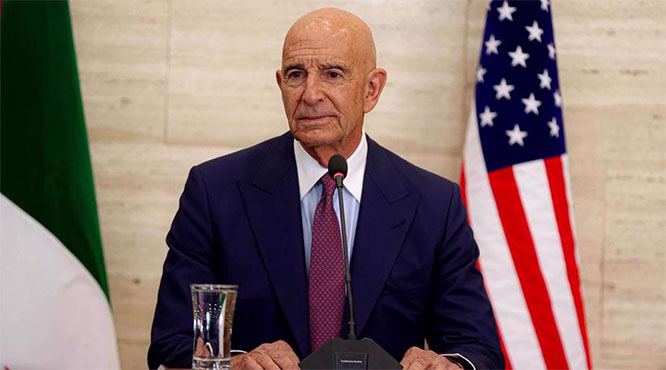
Since 1946, the United States has attempted 93 coups or “regime change” operations across the world — including two in Iran, US Special Envoy for Syria Tom Barrack has admitted.

Speaking to the UAE-based IMI Media Group, in remarks published by The National, Barrack said Washington tried twice to overthrow the Iranian government but failed both times. 

“For (Trump) then to be imputed with regime change — we had two regime changes in Iran already. Neither one worked. So I think wisely leave it to the region to solve,” said Barrack, who also serves as the US ambassador to Turkey.

His comments come six months after the US joined Israel in airstrikes against Iran during ongoing indirect nuclear negotiations between Tehran and Washington.

On June 13, Israel launched an attack on Iran that killed at least 1,064 people and hit civilian infrastructure. Days later, the United States targeted three nuclear facilities — Fordow, Natanz and Isfahan — in what Iran called a clear violation of international law. Iranian retaliation eventually forced a halt to the assault on June 24.

Barrack further claimed that US President Donald Trump and Foreign Secretary Marco Rubio are “not into regime change” and prefer a regional approach driven by Middle Eastern countries themselves. According to him, regional dialogue and non-interference by outside powers offer a more durable path forward.

He added that Washington is still open to an agreement with Tehran if Iranian authorities show “seriousness” and willingness to engage constructively.

However, Iran maintains the US has not shown readiness for meaningful talks. In an interview with Japan’s Kyodo News, Iranian Foreign Minister Abbas Araghchi said negotiations could advance only if Washington acknowledges Iran’s right to peaceful nuclear energy and lifts unilateral sanctions.

Comments

Add new comment

  • Coastaldigest.com reserves the right to delete or block any comments.
  • Coastaldigset.com is not responsible for its readers’ comments.
  • Comments that are abusive, incendiary or irrelevant are strictly prohibited.
  • Please use a genuine email ID and provide your name to avoid reject.
News Network
December 16,2025

bengal.jpg

The deletion of over 58 lakh names from West Bengal’s draft electoral rolls following a Special Intensive Revision (SIR) has sparked widespread concern and is likely to deepen political tensions in the poll-bound state.

According to the Election Commission, the revision exercise has identified 24 lakh voters as deceased, 19 lakh as relocated, 12 lakh as missing, and 1.3 lakh as duplicate entries. The draft list, published after the completion of the first phase of SIR, aims to remove errors and duplication from the electoral rolls.

However, the scale of deletions has raised fears that a large number of eligible voters may have been wrongly excluded. The Election Commission has said that individuals whose names are missing can file objections and seek corrections. The final voter list is scheduled to be published in February next year, after which the Assembly election announcement is expected. Notably, the last Special Intensive Revision in Bengal was conducted in 2002.

The development has intensified the political row over the SIR process. Chief Minister Mamata Banerjee and her Trinamool Congress have strongly opposed the exercise, accusing the Centre and the Election Commission of attempting to disenfranchise lakhs of voters ahead of the elections.

Addressing a rally in Krishnanagar earlier this month, Banerjee urged people to protest if their names were removed from the voter list, alleging intimidation during elections and warning of serious consequences if voting rights were taken away.

The BJP, meanwhile, has defended the revision and accused the Trinamool Congress of politicising the issue to protect what it claims is an illegal voter base. Leader of the Opposition Suvendu Adhikari alleged that the ruling party fears losing power due to the removal of deceased, fake, and illegal voters.

The controversy comes amid earlier allegations by the Trinamool Congress that excessive work pressure during the SIR led to the deaths by suicide of some Booth Level Officers (BLOs), for which the party blamed the Election Commission. With the draft list now out, another round of political confrontation appears imminent.

As objections begin to be filed, the focus will be on whether the correction mechanism is accessible, transparent, and timely—critical factors in ensuring that no eligible voter is denied their democratic right ahead of a crucial election.

Comments

Add new comment

  • Coastaldigest.com reserves the right to delete or block any comments.
  • Coastaldigset.com is not responsible for its readers’ comments.
  • Comments that are abusive, incendiary or irrelevant are strictly prohibited.
  • Please use a genuine email ID and provide your name to avoid reject.
News Network
December 7,2025

Mangaluru, Dec 7: A 34-year-old fruit and vegetable trader in Mangaluru has reportedly lost ₹33.1 lakh after falling victim to an online investment scam run through a fake mobile app.

Police said the scam began in September, when the victim received a link on Facebook. Clicking it connected him to a WhatsApp number, where an unidentified person introduced a high-return investment scheme and instructed him to download an app.

To build trust, the fraudster asked him to invest ₹30,000 on September 24. The trader soon received ₹34,000 as “profit,” convincing him the scheme was genuine. Over the next two months, he transferred money in multiple instalments via Google Pay and IMPS to different scanner codes and bank accounts shared by the scammers. Between September 24 and December 3, he ended up sending a total of ₹33.1 lakh.

When he later requested a refund of his investment and promised returns, the scammers demanded additional payments, claiming he needed to pay a “service tax” first. Even after he paid a small amount, no money was returned, and the scammers continued pressuring him for more.

A case has been registered at the CEN Crime Police Station.

Comments

Add new comment

  • Coastaldigest.com reserves the right to delete or block any comments.
  • Coastaldigset.com is not responsible for its readers’ comments.
  • Comments that are abusive, incendiary or irrelevant are strictly prohibited.
  • Please use a genuine email ID and provide your name to avoid reject.
