Desi rocket launcher, explosives recovered from terror module: NIA

Agencies
December 26, 2018

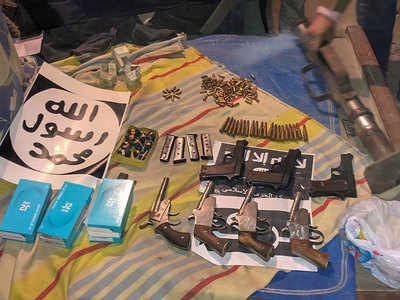
New Delhi, Dec 26: A country-made rocket launcher, 12 pistols, 100 alarm clocks, 100 mobile phones, 135 SIM cards and laptops were among the other things recovered by the National Investigation Agency after busting an ISIS-inspired terror module on Wednesday.
Inspector General of Police (NIA) Alok Mittal said the module was planning attacks on important political and security offices in Delhi.

The agency said the "highly-radicalised module" was completely self-funded and no criminal antecedent of its members had surfaced so far.

"It was a self-funded group. They stole gold ornaments from their homes and sold it to fund their activities. They were planning to detonate a remote-controlled bomb or a fidayeen kind of attack," Mittal said.

Mittal said that questioning of those nabbed would reveal vital information about the module, their plans and handlers.

The arrested suspects also tried to make bullet-proof fidayeen vest. It was recovered from Amroha.

Those arrested include the alleged mastermind, 29-year-old Mohammed Sohail, a 'mufti', or a Muslim legal expert empowered to give rulings on religious matters, from Amroha in western Uttar Pradesh, an engineering student of a private university in Noida and a third-year graduation student in humanities as well as two welders, he said.

Mittal added that the agency found a video where Sohail is demonstrating how to complete a bomb circuit.

During the searches, conducted across 17 locations, the agency recovered a huge cache of handmade weapons, including a yet to be tested rocket launcher, material for suicide vests, 12 locally made pistols, hundreds of live rounds of bullets, 100 mobiles and 135 SIM cards, he disclosed.

The agency also recovered Rs 7.5 lakh in cash and 25 kilograms of bomb making ingredients - potassium nitrate, potassium chlorate, sugar paste and sulphur.

Giving details of the initial investigation by the agency, Mittal said the suspects had done a reconnaissance of vital government installations and planned to target political personalities and other important people.

"The level of preparation showed they were planning to carry out fidayeen attacks in near future," he said.

According to investigations, the module was founded about three-four months ago by Sohail who brought all its members together. They remained in touch through data-based messaging applications WhatsApp and Telegram.

Surveillance of suspected members of the group started after the agency got inputs about their plans.

Seeing their alarming pace of progress, the agency decided to bust the group with help from Delhi Police's Special Cell and Uttar Pradesh Police's Anti-Terrorist Squad.

The NIA believes the module has foreign-based handler(s) but their identity and location are still being probed.

"So far, no criminal record of any of the arrested members of the module has surfaced. It looks like they were self-trained and self-motivated through internet," Mittal said.

The officials refused to comment on media reports quoting other agencies involved in the operation that RSS headquarters and Delhi Police headquarters were also on the hit list.

"They (other agencies) can say whatever they feel like. But being the investigating agency of this case... we cannot make any such claim unless we have some corroborative material to support it," a senior NIA officer said requesting anonymity.


Comments

Add new comment

  • Coastaldigest.com reserves the right to delete or block any comments.
  • Coastaldigset.com is not responsible for its readers’ comments.
  • Comments that are abusive, incendiary or irrelevant are strictly prohibited.
  • Please use a genuine email ID and provide your name to avoid reject.
News Network
December 16,2025

jordan.jpg

Prime Minister Narendra Modi on Monday held talks with Jordan’s King Abdullah II in Amman, during which the two leaders discussed ways to further strengthen bilateral relations, with the Prime Minister outlining an eight-point vision covering key areas of cooperation.

Describing the meeting as “productive”, PM Modi said he shared a roadmap focused on trade and economy, fertilisers and agriculture, information technology, healthcare, infrastructure, critical and strategic minerals, civil nuclear cooperation, and people-to-people ties.

In a post on social media platform X, the Prime Minister praised King Abdullah II’s personal commitment to advancing India–Jordan relations, particularly as both countries mark the 75th anniversary of the establishment of diplomatic ties this year.

“Held productive discussions with His Majesty King Abdullah II in Amman. His personal commitment towards vibrant India-Jordan relations is noteworthy. This year, we are celebrating the 75th anniversary of our bilateral diplomatic relations,” PM Modi said.

The meeting took place at the Al Husseiniya Palace, where the two leaders also exchanged views on regional and global issues of mutual interest. According to the Ministry of External Affairs (MEA), both sides agreed to further deepen cooperation in areas including trade and investment, defence and security, counter-terrorism and de-radicalisation, fertilisers and agriculture, infrastructure, renewable energy, tourism, and heritage.

The MEA said both leaders reaffirmed their united stand against terrorism.

PM Modi arrived in Amman earlier on Monday and was received by Jordanian Prime Minister Jafar Hassan, who accorded him a formal welcome. Following the talks, King Abdullah II hosted a banquet dinner in honour of the Prime Minister, reflecting the warmth of bilateral ties.

Jordan is the first leg of PM Modi’s three-nation tour. From Amman, the Prime Minister will travel to Ethiopia at the invitation of Prime Minister Abiy Ahmed Ali, marking his first official visit to the African nation. The tour will conclude with a visit to Oman.

Comments

Add new comment

  • Coastaldigest.com reserves the right to delete or block any comments.
  • Coastaldigset.com is not responsible for its readers’ comments.
  • Comments that are abusive, incendiary or irrelevant are strictly prohibited.
  • Please use a genuine email ID and provide your name to avoid reject.
News Network
December 6,2025

pilot.jpg

New Delhi: IndiGo, India’s largest airline, faced major operational turbulence this week after failing to prepare for new pilot-fatigue regulations issued by the Directorate General of Civil Aviation (DGCA). The stricter rules—designed to improve flight safety—took effect in phases through 2024, with the latest implementation on November 1. IndiGo has acknowledged that inadequate roster planning led to widespread cancellations and delays.

Below are the key DGCA rules that affected IndiGo’s operations:

1. Longer Mandatory Weekly Rest

Weekly rest for pilots has been increased from 36 hours to 48 hours.

The government says the extended break is essential to curb cumulative fatigue. This rule remains in force despite the current crisis.

2. Cap on Night Landings

Pilots can now perform only two night landings per week—a steep reduction from the earlier limit of six.

Night hours, defined as midnight to early morning, are considered the least alert period for pilots.

Given the disruptions, this rule has been temporarily relaxed for IndiGo until February 10.

3. Reduced Maximum Night Flight Duty

Flight duty that stretches into the night is now capped at 10 hours.

This measure has also been kept on hold for IndiGo until February 10 to stabilize operations.

4. Weekly Rest Cannot Be Replaced With Personal Leave

Airlines can no longer count a pilot’s personal leave as part of the mandatory 48-hour rest.

Pilots say this closes a loophole that previously reduced actual rest time.

Currently, all airlines are exempt from this rule to normalise travel.

5. Mandatory Fatigue Monitoring

Airlines must submit quarterly fatigue reports along with corrective actions to DGCA.

This system aims to create a transparent fatigue-tracking framework across the industry.

The DGCA has stressed that these rules were crafted to strengthen flight safety and align India with global fatigue-management standards. The temporary relaxations are expected to remain until February 2025, giving IndiGo time to stabilise its schedules and restore normal air travel.

Comments

Add new comment

  • Coastaldigest.com reserves the right to delete or block any comments.
  • Coastaldigset.com is not responsible for its readers’ comments.
  • Comments that are abusive, incendiary or irrelevant are strictly prohibited.
  • Please use a genuine email ID and provide your name to avoid reject.
News Network
December 7,2025

SHRIMP.jpg

Mangaluru, Dec 7: A rare bamboo shrimp has been rediscovered on mainland India more than 70 years after it was last reported, confirming for the first time the presence of Atyopsis spinipes in the country. The find was made by researchers from the Centre for Climate Change Studies at Sathyabama Institute of Science and Technology, Chennai, during surveys in Karnataka and Odisha.

The team — shrimp expert Dr S Prakash, PhD scholar K Kunjulakshmi, and Mangaluru-based researcher Maclean Antony Santos — combined field surveys, ecological assessments and DNA analysis to identify the elusive species. Their findings, published in Zootaxa, resolve decades of taxonomic confusion stemming from a 1951 report that misidentified the species as Atyopsis moluccensis without strong evidence.

The shrimp has now been confirmed at two locations: the Mulki–Pavanje estuary near Mangaluru and the Kuakhai River in Bhubaneswar. Historical specimens from the Andaman Islands, previously labelled as A. moluccensis, were also found to be misidentified and actually belong to A. spinipes.

The rediscovery began after an aquarium hobbyist in Odisha spotted a shrimp in 2022, prompting systematic surveys across Udupi, Karwar and Mangaluru. Four female specimens were collected in Mulki and one in Odisha, all genetically matching.

Researchers warn the species may exist in very small, vulnerable populations as freshwater habitats face increasing pressure from pollution, sand mining and infrastructure development. All verified specimens have been deposited with the Zoological Survey of India for future reference.

Comments

Add new comment

  • Coastaldigest.com reserves the right to delete or block any comments.
  • Coastaldigset.com is not responsible for its readers’ comments.
  • Comments that are abusive, incendiary or irrelevant are strictly prohibited.
  • Please use a genuine email ID and provide your name to avoid reject.