



Drinking water standards have improved in India: WWC

May 6, 2017

Washington, May 6: The standard of drinking water in India has improved in the last five years but a lot of work still remains to be done, the head of the World Water Council has said. World Water Council (WWC) recently carried out a major survey on water awareness in major parts of the world, including India. The survey was done ahead of the 8th World Water Forum that is scheduled to take place in the Brazilian capital Brasilia in March 2018.
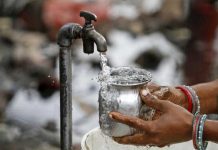
Water
As per the survey, more than one-third of Indians think that not enough is being done to achieve the UN's Sustainable Development Goals to make water and sanitation for all a reality by 2030, World Water Council president Benedito Braga said. "There has been some work done in the past five years to improve the drinking water standards in India. Of course, there's still a lot of work to do there," Braga told PTI. Braga said more than three quarters of the Asians were convinced that governments need to lead the fight to make global access to safe drinking water and sanitation reality.

According to the survey, 31 per cent of Indians said they had been in a situation where it was unsafe to drink water but they had no other choice and suffered from diseases like diarrhoea and gastroenteritis. A majority (71 per cent) of Indians said that safe drinking water had improved over the last five years. The survey stated that 62 per cent of the Indians said they believed that the government was doing enough to support access to safe drinking water.

Referring to the 'Swachha Bharat Campaign', Braga praised Prime Minister Narendra Modi for his efforts towards clean drinking water and sanitation. "I think Mr Modi is very much concerned with water and sanitation issues. He has even appointed a special secretary in the ministry of water resources to deal with the Ganga River cleanup," he said.

"I understand there is a major effort from the current aid in government towards improving water and sanitation access in the country. That's my perception," Braga said. "World leaders realise that sanitation is fundamental to public health, but we need to act now. In order to make water and sanitation universally available by 2030, we need commitment at the highest levels. Of equal importance is that water sources are being optimised to ensure that they are safe water sources," he said.

Braga argued that for every dollar invested in water and sanitation, there is an estimated USD 4.3 dollars (400 per cent) return in the form of reduced health care costs for individuals and society worldwide. "This does not take into account the benefits to global development, which enables countries and societies to progress economically, culturally and politically. For example, for every USD 1 billion dollars invested in water and waste water, an estimated 28.5 jobs will be created," he said.


Comments

Add new comment

  • Coastaldigest.com reserves the right to delete or block any comments.
  • Coastaldigset.com is not responsible for its readers’ comments.
  • Comments that are abusive, incendiary or irrelevant are strictly prohibited.
  • Please use a genuine email ID and provide your name to avoid reject.
News Network
December 16,2025

bengal.jpg

The deletion of over 58 lakh names from West Bengal’s draft electoral rolls following a Special Intensive Revision (SIR) has sparked widespread concern and is likely to deepen political tensions in the poll-bound state.

According to the Election Commission, the revision exercise has identified 24 lakh voters as deceased, 19 lakh as relocated, 12 lakh as missing, and 1.3 lakh as duplicate entries. The draft list, published after the completion of the first phase of SIR, aims to remove errors and duplication from the electoral rolls.

However, the scale of deletions has raised fears that a large number of eligible voters may have been wrongly excluded. The Election Commission has said that individuals whose names are missing can file objections and seek corrections. The final voter list is scheduled to be published in February next year, after which the Assembly election announcement is expected. Notably, the last Special Intensive Revision in Bengal was conducted in 2002.

The development has intensified the political row over the SIR process. Chief Minister Mamata Banerjee and her Trinamool Congress have strongly opposed the exercise, accusing the Centre and the Election Commission of attempting to disenfranchise lakhs of voters ahead of the elections.

Addressing a rally in Krishnanagar earlier this month, Banerjee urged people to protest if their names were removed from the voter list, alleging intimidation during elections and warning of serious consequences if voting rights were taken away.

The BJP, meanwhile, has defended the revision and accused the Trinamool Congress of politicising the issue to protect what it claims is an illegal voter base. Leader of the Opposition Suvendu Adhikari alleged that the ruling party fears losing power due to the removal of deceased, fake, and illegal voters.

The controversy comes amid earlier allegations by the Trinamool Congress that excessive work pressure during the SIR led to the deaths by suicide of some Booth Level Officers (BLOs), for which the party blamed the Election Commission. With the draft list now out, another round of political confrontation appears imminent.

As objections begin to be filed, the focus will be on whether the correction mechanism is accessible, transparent, and timely—critical factors in ensuring that no eligible voter is denied their democratic right ahead of a crucial election.

Comments

Add new comment

  • Coastaldigest.com reserves the right to delete or block any comments.
  • Coastaldigset.com is not responsible for its readers’ comments.
  • Comments that are abusive, incendiary or irrelevant are strictly prohibited.
  • Please use a genuine email ID and provide your name to avoid reject.