Elephant extinction may raise carbon dioxide levels in atmosphere: Study

Agencies
August 3, 2019

Washington D.C., Aug 3: Forest elephants engineer the ecosystem of the entire central African forest, but their catastrophic decline toward extinction has catastrophic implications for carbon policy.

One of the last remaining megaherbivores, forest elephants shape their environment by serving as seed dispersers and forest bulldozers as they eat over a hundred species of fruit, trample bushes, knock over trees and create trails and clearings. Their ecological impact also affects tree populations and carbon levels in the forest, researchers report, with significant implications for climate and conservation policies.

In a paper published in the journal of 'Nature Geoscience,' researchers found that elephant populations in central African forests encourage the growth of slow-growing trees with the high wood density that sequesters more carbon from the atmosphere than fast-growing species which are the preferred foods of elephants.

As forest elephants preferentially browse on the fast-growing species, they cause high levels of damage and mortality to these species compared to the slow-growing, high wood density species. The collapse of forest elephant populations will likely, therefore, causes an increase in the abundance of fast-growing tree species at the expense of slow-growing species, and reduce the ability of the forest to capture carbon.

Stephen Blake, one of the researchers of the study, spent 17 years in central Africa doing, among other things, applied for research and conservation work with elephants. While there, he collected a data set on forest structure and species composition in the Nouabale-Ndoki Forest of northern Congo.

In the current study, Blake's collaborators developed a mathematical computer model to answer the question 'What would happen to the composition of the forest over time with and without elephant browsing?'

To find out, they simulated elephant damage through browsing in the forest and assumed they browse certain plant species at different rates. Elephants prefer fast-growing species in more open spaces. As they feed and browse, they cause damage, knocking off a limb or breaking a shrub. The model calculated feeding and breakage rates along with elephant mortality rates to see their effect on certain woody plants.

"Lo and behold, as we look at numbers of elephants in a forest and we look at the composition of forest over time, we find that the proportion of trees with high-density wood is higher in forests with elephants," Blake said.

"The simulation found that the slow-growing plant species survive better when elephants are present. These species aren't eaten by elephants and, over time, the forest becomes dominated by these slow-growing species. Wood (lignin) has a carbon backbone, meaning it has a large number of carbon molecules in it. Slow growing high wood density species contain more carbon molecules per unit volume than fast-growing low wood density species. As the elephants "thin" the forest, they increase the number of slow-growing trees and the forest is capable of storing more carbon."

These findings suggested far-ranging ecological consequences of past and present extinction. The loss of elephants will seriously reduce the ability of the remaining forest to sequester carbon. Trees and plants use carbon dioxide during photosynthesis, removing it from the atmosphere. For this reason, plants are helpful in combating global warming and serve to store carbon emissions.

Without the forest elephants, less carbon dioxide will be taken out of the atmosphere. In monetary terms, forest elephants represent a carbon storage service of $43 billion.

"The sad reality is that humanity is doing its best to rid the planet of elephants as quickly as it can. Forest elephants are rapidly declining and facing extinction. From a climate perspective, all of their positive effect on carbon and their myriad other ecological roles as forest gardeners and engineers will be lost," Blake concluded.


Comments

Add new comment

  • Coastaldigest.com reserves the right to delete or block any comments.
  • Coastaldigset.com is not responsible for its readers’ comments.
  • Comments that are abusive, incendiary or irrelevant are strictly prohibited.
  • Please use a genuine email ID and provide your name to avoid reject.
News Network
December 3,2025

arrival.jpg

Mangaluru, Dec 3: A group of Congress workers gathered at the Mangaluru International Airport on Wednesday to welcome AICC general secretary K C Venugopal, but the reception quickly turned into a display of support for Deputy Chief Minister D K Shivakumar.

Venugopal arrived in the city to participate in the centenary commemoration of the historic dialogue between Mahatma Gandhi and Narayana Guru. The event, organised by the Sivagiri Mutt, Varkala, in association with the Mangalore University Sri Narayana Guru Study Chair, is being held on the university’s Konaje campus.

KPCC general secretary Mithun Rai and several party workers had assembled at the airport to receive Venugopal. However, the moment he stepped out, workers began raising slogans backing Shivakumar.

The university programme will be inaugurated by Chief Minister Siddaramaiah.

This show of support comes just a day after Siddaramaiah remarked that Shivakumar would lead the government “when the high command decides.” The chief minister made the comment after a breakfast meeting at Shivakumar’s residence—another public display of camaraderie between the two leaders amid ongoing attempts by the party high command to downplay their leadership rivalry.

Comments

Add new comment

  • Coastaldigest.com reserves the right to delete or block any comments.
  • Coastaldigset.com is not responsible for its readers’ comments.
  • Comments that are abusive, incendiary or irrelevant are strictly prohibited.
  • Please use a genuine email ID and provide your name to avoid reject.
Agencies
November 22,2025

indiapak.jpg

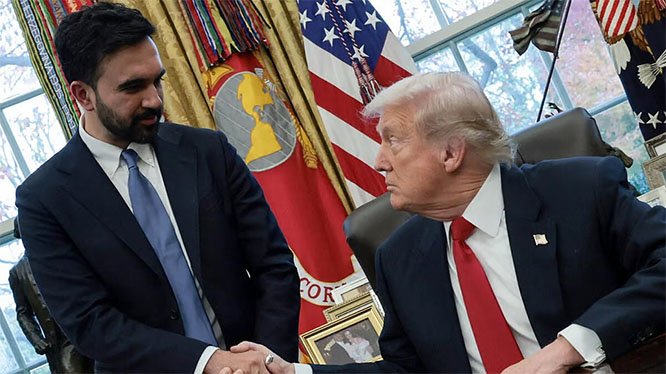
New York/Washington: US President Donald Trump has again claimed to have solved the conflict between India and Pakistan, repeating his assertion during a meeting with New York City Mayor-elect Zohran Mamdani in the Oval Office.

Mamdani flew to Washington DC for his first meeting with Trump in the White House on Friday. Trump said he “enjoyed” the meeting, which he described as “great.”

During remarks in the Oval Office, with Mamdani standing next to him, Trump repeated his claim that he solved the May conflict between India and Pakistan.

"I did eight peace deals of countries, including India and Pakistan,” he said.

On Wednesday, Trump had said he threatened to put 350 per cent tariffs on India and Pakistan if they did not end their conflict, repeating his claim that he solved the fighting between the nuclear-armed neighbours and that Prime Minister Narendra Modi had called him to say “we're not going to go to war.”

Since May 10, when Trump announced on social media that India and Pakistan had agreed to a “full and immediate” ceasefire after a “long night” of talks mediated by Washington, he has repeated his claim over 60 times that he “helped settle” the tensions between India and Pakistan.

India has consistently denied any third-party intervention. India launched Operation Sindoor on May 7, targeting terror infrastructure in Pakistan and Pakistan-occupied Kashmir in retaliation for the April 22 Pahalgam attack that killed 26 civilians. India and Pakistan reached an understanding on May 10 to end the conflict after four days of intense cross-border drone and missile strikes.

Mamdani emerged victorious in the closely-watched battle for New York City Mayor, becoming the first South Asian and Muslim to be elected to sit at the helm of the largest city in the US.

He had been the front-runner in the NYC Mayoral election for months and defeated Republican nominee Curtis Sliwa and political heavyweight former New York State Governor Andrew Cuomo, who ran as an independent candidate and was officially endorsed by Trump just hours before the elections.

Indian-descent Mamdani is the son of renowned filmmaker Mira Nair and Columbia University professor Mahmood Mamdani. He was born and raised in Kampala, Uganda and moved to New York City with his family when he was 7. Mamdani became a naturalised US citizen only recently, in 2018.

Comments

Add new comment

  • Coastaldigest.com reserves the right to delete or block any comments.
  • Coastaldigset.com is not responsible for its readers’ comments.
  • Comments that are abusive, incendiary or irrelevant are strictly prohibited.
  • Please use a genuine email ID and provide your name to avoid reject.
News Network
November 21,2025

Bengaluru, Nov 21: The Karnataka government is facing pressure to overhaul its employment system after a high-level Cabinet sub-committee recommended the complete phase-out of job outsourcing in government offices, boards, and corporations by March 2028. The move is aimed at tackling a systemic issue that has led to the potential violation of constitutional reservation policies and the exploitation of workers.

The Call for Systemic Change

With over three lakh vacant posts currently being filled through private agencies on an outsource, insource, or daily wage basis, the sub-committee highlighted a significant lapse. "As a result, reservations are not being followed as per the Constitution and state laws. It’s an urgent need to take serious steps to change the system. It has been recommended to completely stop the system of outsourcing by March 2028," the panel stated in a document.

The practice of outsourcing involves private companies hiring workers to perform duties for a government agency. Critics argue this model results in lesser salaries, a lack of social security benefits (otherwise available to permanent government employees), and a failure to adhere to the provisions of Articles 14 and 15 of the Constitution, which guarantee equality before the law and prohibit discrimination.

The 'Bidar Model' as a Stop-Gap Solution

To regulate the current mode of employment and reduce worker exploitation until the 2028 deadline, the government plans to establish workers’ services multi-purpose cooperative societies across all districts, following the successful "Bidar Model."

The Bidar District Services of Labour Multi-purpose Cooperative Society Ltd., which operates under the District Commissioner, is cited as a successful example of providing a measure of social security to outsourced staff. Labour Department officials argue this society ensures workers receive their due wages and statutory facilities like ESI (Employees' State Insurance) and PF (Provident Fund), in exchange for a 1% service fee collected from the employees.

legislative push and Priority Insourcing

The recommendations, led by the sub-committee headed by Law and Parliamentary Affairs Minister H K Patil, are set to be discussed at the next Cabinet meeting. The committee has proposed the introduction of the Karnataka Outsourced Employees (Regulation, Placement and Welfare) Bill 2025.

In a move addressing immediate concerns, Labour Minister Santosh Lad, a member of the sub-committee, has reportedly assured that steps will be taken over the next 2-3 years to insource workers in "life-threatening services" on a priority basis. This includes essential personnel like pourakarmikas (sanitation workers), drivers, electrical staff in the Energy Department, and Health Department staff handling contagious diseases. The transition aims to grant these workers the long-term security and benefits they currently lack under the outsourcing system. 

Comments

Add new comment

  • Coastaldigest.com reserves the right to delete or block any comments.
  • Coastaldigset.com is not responsible for its readers’ comments.
  • Comments that are abusive, incendiary or irrelevant are strictly prohibited.
  • Please use a genuine email ID and provide your name to avoid reject.