Emergency a misadventure, Indira paid a heavy price:Pranab

December 11, 2014

New Delhi, Dec 11: The 1975 Emergency was perhaps an "avoidable event" and Congress and Indira Gandhi had to pay a heavy price for this "misadventure" as suspension of fundamental rights and political activity, large scale arrests and press censorship adversely affected people, says President Pranab Mukherjee.
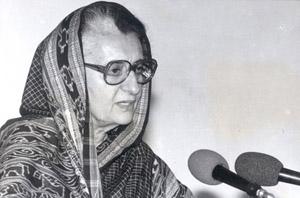
indira gandhi

A junior minister under Gandhi in those turbulent times, Mukherjee however, is also unsparing of the opposition then under the leadership of the late Jayaprakash Narayan, JP, whose movement appeared to him to be "directionless".

The President has penned his thoughts about the tumultuous period in India's post-independence history in his book "The Dramatic Decade: the Indira Gandhi Years" that has just been released.

He discloses that Indira Gandhi was not aware of the Constitutional provisions allowing for declaration of Emergency that was imposed in 1975 and it was Siddartha Shankar Ray who led her into the decision.

Ironically, it was Ray, then Chief Minister of West Bengal, who also took a sharp about-turn on the authorship of the Emergency before the Shah Commission that went into 'excesses' during that period and disowned that decision, according to Mukherjee.

Mukherjee, who celebrated his 79th birthday today, says,"The Dramatic Decade is the first of a trilogy; this book covers the period between 1969 and 1980...I intent to deal with the period between 1980 and 1998 in volume II, and the period between 1998 and 2012, which marked the end of my active political career, in volume III."

"At this point in the book, it will be sufficient to say here that many of us who were part of the Union Cabinet at that time (I was a junior minister) did not then understand its deep and far reaching impact."

Mukherjee's 321-page book covers various chapters including the liberation of Bangladesh, JP's offensive, the defeat in the 1977 elections, split in Congress and return to power in 1980 and after.

The President says there was no doubt that Emergency brought discipline in public life, a growing economy, controlled inflation, a reversed trade deficit for the first time, enhanced developmental expenditure and a crack down on tax evasion and smuggling but "it was perhaps an avoidable event".

"Suspension of fundamental rights and political activity (including trade union activity), large scale arrests of political leaders and activists, press censorship, and extending the life of legislatures by not conducting elections were some instances of Emergency adversely affecting the interests of the people. The Congress and Indira Gandhi had to pay a heavy price for this misadventure," says Mukherjee.

Recounting the dramatic moments leading to declaration of Emergency minutes before midnight of June 25, 1975, he says that it was the suggestion of Ray, then Chief Minister of West Bengal, and Indira Gandhi acted on it.

"Indira Gandhi told me subsequently that she was not even aware of the Constitutional provisions allowing for the declaration of a state of Emergency on grounds of internal disturbance particularly since a state of Emergency had already been proclaimed as a consequence of Indo-Pak conflict in 1971", he says.

Ray, then member of CWC and Central Parliamentary Board, was one of the "most influential advisors" of Indira Gandhi with his views being sought on diverse issues.

"Siddhartha Babu had considerable influence over the decision making process of the organisation and administration...In matters relating to West Bengal, he was the decisive voice. So it was not surprising that he was privy to considerable information...," the President said.

Interestingly, though not surprisingly, once it was declared, there were a whole host of people claiming authorship of idea of declaring the Emergency.

And, again not surprisingly, these very people took a sharp about-turn before the Shah Commission.

"Not only did they disown their involvement, they pinned all the blame on Indira Gandhi pleading their own innocence. Siddartha babu was no exception. Deposing before the Shah Commission, he ran into Indira Gandhi--draped in a crimson sari that day--in the Commission hall and tossed a sprightly remark: 'You look pretty today'.

'Despite your efforts,' retorted a curt Indira Gandhi.

Terming the Shah Commission proceedings as "peculiar", Mukherjee said,"Suffice it to say that it seemed that the Commission was collecting materials and information only to substantiate a pre-conceived conclusion."

Mukherjee recalled that a number of ministers and bureaucrats deposed before the Commission blaming Indira Gandhi "alone" for the imposition of the Emergency with the Cabinet not being taken into confidence.

Giving details of the testimony of the then Home Minister Kasu Bramhananda Reddy before the Commission, the President said Reddy told the panel that he was called by the Prime Minister at 10.30 PM and was told that on account of deteriorating law and order situation, it was necessary to impose an internal Emergency.

According to Reddy, he told the Prime Minister that the powers already available under the existing Emergency could be availed of to deal with the situation but was overruled by Indira Gandhi saying internal Emergency was "considered necessary."

"Bramhananda Reddy told the Commission that he then signed a letter to the President of the Republic and appended the draft proclamation of Emergency for the President's assent with this letter. The Letter signed by Brahmananda Reddy was on a plain sheet of paper and not on the letter head of the Home Minister of India," he said.

Comments

Add new comment

  • Coastaldigest.com reserves the right to delete or block any comments.
  • Coastaldigset.com is not responsible for its readers’ comments.
  • Comments that are abusive, incendiary or irrelevant are strictly prohibited.
  • Please use a genuine email ID and provide your name to avoid reject.
News Network
December 6,2025

indigoticket.jpg

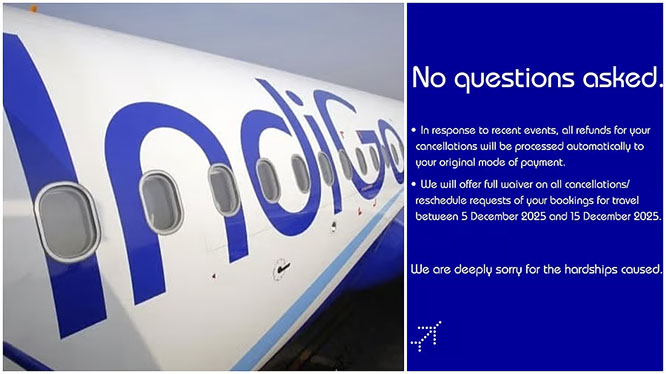
With IndiGo flight disruptions impacting thousands of passengers, the airline on Saturday said that it will offer full waiver on all cancellations/reschedule requests for travel bookings between December 5, 2025 and December 15, 2025.

Earlier in the day, the civil aviation ministry had directed the airline to complete the ticket refund process for the cancelled flights by Sunday evening, as well as ensure baggage separated from the travellers are delivered in the next two days.

In a post on X, titled 'No questions asked', IndiGo wrote, "In response to recent events, all refunds for your cancellations will be processed automatically to your original mode of payment."

"We are deeply sorry for the hardships caused," it further added.

Several passengers, however, complained of not getting full refund as promised by the airline.

Netizens have shared screenchots of getting charged for airline cancellation fee and convenience fee.

"Please tell me why u have did this airline cancellation charges when u say full amount will be refunded (sic)," a user wrote sharing a screenshot of the refund page.

"Well, but you have still debited the convenience charges," wrote another.

Passengers have also raised concerns about the "cancel" option being disabled on the IndiGo app. "First enable the 'Cancel' button on your App & offer full refund on tickets cancelled by customers between the said dates," wrote a user.

A day after the country's largest airline, IndiGo, cancelled more than 1,000 flights and caused disruptions for the fifth day on Saturday, the ministry said that any delay or non-compliance in refund processing will invite immediate regulatory action.

The refund process for all cancelled or disrupted flights must be completed by 8 pm on Sunday, the ministry said in a statement.

"Airlines have also been instructed not to levy any rescheduling charges for passengers whose travel plans were affected by cancellations," it said.

On Saturday, more than 400 flights were cancelled at various airports.

IndiGo has also been instructed to set up dedicated passenger support and refund facilitation cells.

Comments

Add new comment

  • Coastaldigest.com reserves the right to delete or block any comments.
  • Coastaldigset.com is not responsible for its readers’ comments.
  • Comments that are abusive, incendiary or irrelevant are strictly prohibited.
  • Please use a genuine email ID and provide your name to avoid reject.
News Network
December 5,2025

indigoCEO.jpg

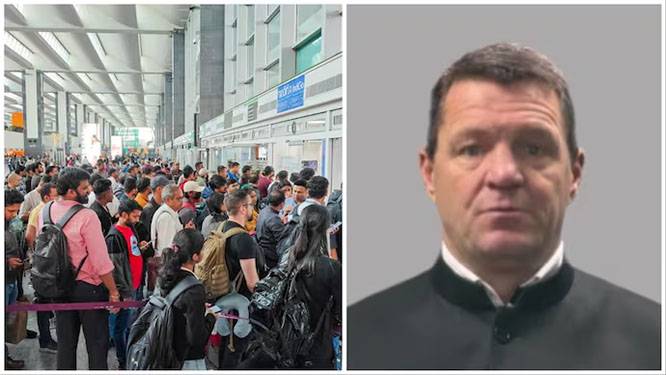
New Delhi, Dec 5: IndiGo CEO Pieter Elbers issued a public apology this evening after more than a thousand flights were cancelled today, making it the "most severely impacted day" in terms of cancellations. The biggest airline of the country cancelled "more than half" of its daily number of flights on Friday, said Elbers. He also said that even though the crisis will persist on Saturday, the airline anticipates fewer than 1,000 flight cancellations.

"Full normalisation is expected between December 10 and 15, though IndiGo cautions that recovery will take time due to the scale of operations," the IndiGo CEO said. 

IndiGo operates around 2,300 domestic and international flights daily.

Pieter Elbers, while apologising for the major inconvenience due to delays and cancellations, said the situation is a result of various causes.

The crisis at IndiGo stems from new regulations that boost pilots' weekly rest requirements by 12 hours to 48 and allow only two night-time landings per week, down from six. IndiGo has attributed the mass cancellations to "misjudgment and planning gaps".

Elbers also listed three lines of action that the airline will adopt to address the issue.

"Firstly, customer communication and addressing your needs, for this, messages have been sent on social media. And just now, a more detailed communication with information, refunds, cancellations and other customer support measures was sent," he said.

The airline has also stepped up its call centre capacity.

"Secondly, due to yesterday's situation, we had customers stranded mostly at the nation's largest airports. Our focus was for all of them to be able to travel today itself, which will be achieved. For this, we also ask customers whose flights are cancelled not to come to the airports as notifications are sent," the CEO said.

"Thirdly, cancellations were made for today to align our crew and planes to be where they need to start tomorrow morning afresh. Earlier measures of the last few days, regrettable, have proven not to be enough, but we have decided today to reboot all our systems and schedules, resulting in the highest numbers of cancellations so far, but imperative for progressive improvements starting from tomorrow," he added.

As airports witnessed chaotic scenes, the Directorate General of Civil Aviation (DGCA) stepped in to grant IndiGo a temporary exemption from stricter night duty rules for pilots. It also allowed substitution of leaves with a weekly rest period. 

Civil Aviation Minister Ram Mohan Naidu has said a high-level inquiry will be ordered and accountability will be fixed.

Comments

Add new comment

  • Coastaldigest.com reserves the right to delete or block any comments.
  • Coastaldigset.com is not responsible for its readers’ comments.
  • Comments that are abusive, incendiary or irrelevant are strictly prohibited.
  • Please use a genuine email ID and provide your name to avoid reject.
News Network
December 16,2025

jordan.jpg

Prime Minister Narendra Modi on Monday held talks with Jordan’s King Abdullah II in Amman, during which the two leaders discussed ways to further strengthen bilateral relations, with the Prime Minister outlining an eight-point vision covering key areas of cooperation.

Describing the meeting as “productive”, PM Modi said he shared a roadmap focused on trade and economy, fertilisers and agriculture, information technology, healthcare, infrastructure, critical and strategic minerals, civil nuclear cooperation, and people-to-people ties.

In a post on social media platform X, the Prime Minister praised King Abdullah II’s personal commitment to advancing India–Jordan relations, particularly as both countries mark the 75th anniversary of the establishment of diplomatic ties this year.

“Held productive discussions with His Majesty King Abdullah II in Amman. His personal commitment towards vibrant India-Jordan relations is noteworthy. This year, we are celebrating the 75th anniversary of our bilateral diplomatic relations,” PM Modi said.

The meeting took place at the Al Husseiniya Palace, where the two leaders also exchanged views on regional and global issues of mutual interest. According to the Ministry of External Affairs (MEA), both sides agreed to further deepen cooperation in areas including trade and investment, defence and security, counter-terrorism and de-radicalisation, fertilisers and agriculture, infrastructure, renewable energy, tourism, and heritage.

The MEA said both leaders reaffirmed their united stand against terrorism.

PM Modi arrived in Amman earlier on Monday and was received by Jordanian Prime Minister Jafar Hassan, who accorded him a formal welcome. Following the talks, King Abdullah II hosted a banquet dinner in honour of the Prime Minister, reflecting the warmth of bilateral ties.

Jordan is the first leg of PM Modi’s three-nation tour. From Amman, the Prime Minister will travel to Ethiopia at the invitation of Prime Minister Abiy Ahmed Ali, marking his first official visit to the African nation. The tour will conclude with a visit to Oman.

Comments

Add new comment

  • Coastaldigest.com reserves the right to delete or block any comments.
  • Coastaldigset.com is not responsible for its readers’ comments.
  • Comments that are abusive, incendiary or irrelevant are strictly prohibited.
  • Please use a genuine email ID and provide your name to avoid reject.