



Fadnavis wins trust vote; Shiv Sena, Cong cry foul

November 12, 2014

Mumbai, Nov 12: The 13-day-old BJP government in Maharashtra today won the trust vote in the Assembly but the passage of the confidence motion triggered a huge controversy with Shiv Sena and Congress contesting the procedure and claiming it had failed to prove majority.

Calling the development a "black day" in the history of the state, the two opposition parties announced that they would register their protest with Governor C Vidyasagar Rao.
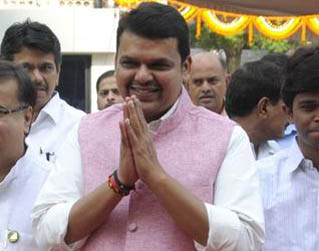
Fadnavis
Earlier, BJP MLA Ashish Shelar moved a one-line motion seeking confidence of the House in the Devendra Fadnavis-led government, which was put to a voice vote by Speaker Haribhau Bagde.

As the legislators supporting the motion exclaimed "Aye", the Speaker declared it passed, triggering a storm of protest among Shiv Sena and Congress MLAs, who rushed to the Well of the House. Sena earlier in the day formally decided to occupy the main Opposition's space in the Assembly.

"The motion has been passed," Bagde was heard saying over the din. Agitated MLAs of Shiv Sena and Congress were seen arguing with the Speaker even as the decibel level rose steadily, forcing him to adjourn the proceedings.

During the proceedings, members of NCP, which had offered outside support to the BJP government, remained quietly seated.

Sena had earlier staked its claim to the Leader of Opposition's position and the Speaker had said he would take up its demand after the trust vote as Congress too had demanded the post on the grounds that Sena continues to be a constituent of the BJP-led NDA.

As proceedings resumed, the Speaker announced appointment of Sena Legislature Party leader Eknath Shinde as the Leader of the Opposition in the House.
Led by Shinde, Sena MLAs again took up their protest and called for the confidence motion to be determined by a division of votes.

BJP has 121 MLAs and, together with NCP's 41, has the support of 162 MLAs, 18 more than required for a majority in the House which has an effective strength of 287. The party has also claimed the support of seven Independents, three of Bahujan Vikas Aaghadi and some others from smaller parties.

Earlier in the day, BJP's Bagde was elected as the Speaker after Vijay Auti and Varsha Gaikwad, the Sena and Congress nominees, respectively, withdrew from the race, sending signals that the trust vote would go through unhindered with the government easily proving its majority with NCP's help.

Unhappy with the confidence motion passed through voice vote, the Sena MLAs said it amounted to "strangling democracy".

"The House should be run as per rules and the Constitution should not be trampled upon. The new government is strangulating democracy. We sought division but the trust motion was passed by voice vote," Shinde said.

Rejecting his contention, however, the Speaker said, "The issue is over. The trust vote has been passed."

Fadnavis, joining issue with Shinde, said, "Although there is the word opposition in your designation, the expectation is that you should not oppose each and every issue and support the government's pro-people decisions."

Meanwhile, strongly deprecating the passage of confidence motion by a voice vote, former Chief Minister Prithviraj Chavan said it was "unprecedented" in democratic history and demanded that the government seek a division of votes to prove its majority.

"It is a black day for democratic process in Maharashtra. Never has a confidence motion been passed by voice vote. Until the government proves its majority in the House by division, the government is illegitimate," he told reporters outside the Assembly.

State Congress president Manikrao Thakre held that the motion had "not been passed" as there was no division of votes.

"Being a minority government, it was the duty of the government to pass the motion through division. They are around 25 MLAs short (of majority). The Atal Bihari Vajpayee government fell by one vote in Parliament.

"We will frustrate all attempts to manipulate a majority and not allow the Assembly to conduct any business until the government obtains a fresh trust vote," Thakre said, adding that the party's MLAs will call on the Governor to lodge a formal protest over the issue.

Further, claiming that the Fadnavis government had manipulated the trust vote as it did not enjoy majority in the House, Shiv Sena leader Ramdas Kadam said, "Vidhan Sabha stands tarnished today.

"A division would have made it clear whether they have the support of the majority of MLAs. The confidence motion has not been passed."

Raising questions about the conduct of the Speaker, Kadam said he would speak to leaders of all non-BJP parties, including NCP, whether a no-confidence motion should be brought against him.

"People of Maharashtra will not forgive the BJP government for what they have done," he said, adding that the party would take legal recourse in the matter.


Comments

Add new comment

  • Coastaldigest.com reserves the right to delete or block any comments.
  • Coastaldigset.com is not responsible for its readers’ comments.
  • Comments that are abusive, incendiary or irrelevant are strictly prohibited.
  • Please use a genuine email ID and provide your name to avoid reject.
News Network
December 6,2025

pilot.jpg

New Delhi: IndiGo, India’s largest airline, faced major operational turbulence this week after failing to prepare for new pilot-fatigue regulations issued by the Directorate General of Civil Aviation (DGCA). The stricter rules—designed to improve flight safety—took effect in phases through 2024, with the latest implementation on November 1. IndiGo has acknowledged that inadequate roster planning led to widespread cancellations and delays.

Below are the key DGCA rules that affected IndiGo’s operations:

1. Longer Mandatory Weekly Rest

Weekly rest for pilots has been increased from 36 hours to 48 hours.

The government says the extended break is essential to curb cumulative fatigue. This rule remains in force despite the current crisis.

2. Cap on Night Landings

Pilots can now perform only two night landings per week—a steep reduction from the earlier limit of six.

Night hours, defined as midnight to early morning, are considered the least alert period for pilots.

Given the disruptions, this rule has been temporarily relaxed for IndiGo until February 10.

3. Reduced Maximum Night Flight Duty

Flight duty that stretches into the night is now capped at 10 hours.

This measure has also been kept on hold for IndiGo until February 10 to stabilize operations.

4. Weekly Rest Cannot Be Replaced With Personal Leave

Airlines can no longer count a pilot’s personal leave as part of the mandatory 48-hour rest.

Pilots say this closes a loophole that previously reduced actual rest time.

Currently, all airlines are exempt from this rule to normalise travel.

5. Mandatory Fatigue Monitoring

Airlines must submit quarterly fatigue reports along with corrective actions to DGCA.

This system aims to create a transparent fatigue-tracking framework across the industry.

The DGCA has stressed that these rules were crafted to strengthen flight safety and align India with global fatigue-management standards. The temporary relaxations are expected to remain until February 2025, giving IndiGo time to stabilise its schedules and restore normal air travel.

Comments

Add new comment

  • Coastaldigest.com reserves the right to delete or block any comments.
  • Coastaldigset.com is not responsible for its readers’ comments.
  • Comments that are abusive, incendiary or irrelevant are strictly prohibited.
  • Please use a genuine email ID and provide your name to avoid reject.
News Network
December 13,2025

New Delhi: School-going children are picking up drug and smoking habits and engaging in consumption of alcohol, with the average age of introduction to such harmful substances found to be around 13 years, suggesting a need for earlier interventions as early as primary school, a multi-city survey by AIIMS-Delhi said.

The findings also showed substance use increased in higher grades, with grade XI/XII students two times more likely to report use of substances when compared with grade VIII students. This emphasised the importance of continued prevention and intervention through middle and high school.

The study led by Dr Anju Dhawan of AIIMS's National Drug Dependence Treatment Centre, published in the National Medical Journal of India this month, looks at adolescent substance use across diverse regions.

The survey included 5,920 students from classes 8, 9, 11 and 12 in urban government, private and rural schools across 10 cities -- Bengaluru, Chandigarh, Delhi, Dibrugarh, Hyderabad, Imphal, Jammu, Lucknow, Mumbai, and Ranchi. The data were collected between May 2018 and June 2019.

The average age of initiation for any substance was 12.9 (2.8) years. It was lowest for inhalants (11.3 years) followed by heroin (12.3 years) and opioid pharmaceuticals (without prescription; 12.5 years).

Overall, 15.1 per cent of participants reported lifetime use, 10.3 per cent reported past year use, and 7.2 per cent reported use in the past month of any substance, the study found.

The most common substances used in the past year, after tobacco (4 per cent) and alcohol (3.8 per cent), were opioids (2.8 per cent), followed by cannabis (2 per cent) and inhalants (1.9 per cent). Use of non-prescribed pharmaceutical opioids was most common among opioid users (90.2 per cent).

On being asked, 'Do you think this substance is easily available for a person of your age' separately for each substance category, nearly half the students (46.3 per cent) endorsed that tobacco products and more than one-third of the students (36.5 per cent) agreed that a person of their age can easily procure alcohol products.

Similarly, for Bhang (21.9 per cent), ganja/charas (16.1 per cent), inhalants (15.2 per cent), sedatives (13.7 per cent), opium and heroin (10 per cent each), the students endorsed that these can be easily procured.

About 95 per cent of the children, irrespective of their grade, agreed with the statement that 'drug use is harmful'.

The rates of substance use (any) among boys were significantly higher than those of girls for substance use (ever), use in the past year and use in the past 30 days. Compared to grade VIII students, grade IX students were more likely, and grade XI/XII students were twice as likely to have used any substance (ever).

The likelihood of past-year use of any substance was also higher for grade IX students and for grade XI/XII students as compared to grade VIII students.

About 40 per cent of students mentioned that they had a family member who used tobacco or alcohol each. The use of cannabis (any product) and opioid (any product) by a family member was reported by 8.2 per cent and 3.9 per cent of students, respectively, while the use of other substances, such as inhalants/sedatives by family was 2-3 per cent, the study found.

A relatively smaller percentage of students reported use of tobacco or alcohol among peers as compared to among family members, while a higher percentage reported inhalants, sedatives, cannabis or opioid use among peers.

Children using substances (past year) compared to non-users reported significantly higher any substance use by their family members and peers.

There were 25.7 per cent students who replied 'yes' to the question 'conflicts/fights often occur in your family'. Most students also replied affirmatively to 'family members are aware of how their time is being spent' and 'damily members are aware of with whom they spend their time'.

Comments

Add new comment

  • Coastaldigest.com reserves the right to delete or block any comments.
  • Coastaldigset.com is not responsible for its readers’ comments.
  • Comments that are abusive, incendiary or irrelevant are strictly prohibited.
  • Please use a genuine email ID and provide your name to avoid reject.