Filing review petition will harm Hindu-Muslim unity, claims Rizvi

News Network
November 24, 2019

New Delhi, Nov 24: Filing a review petition challenging the Supreme Court's Ayodhya verdict will not be in the interest of Muslims and will "harm" Hindu-Muslim unity, National Commission for Minorities chairperson Ghayorul Hasan Rizvi said on Sunday.
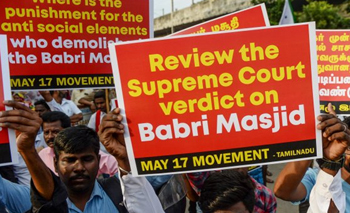
The minority panel chief said filing the review petition would send a message to the Hindus that they were trying to put roadblocks in the way of building the Ram temple.

He also urged the Muslim side to accept the five-acre alternative land to be given for a mosque, saying they would be respecting the judiciary by doing so.

In an interview to PTI, Rizvi said the NCM had held a meeting after the Supreme Court verdict and all its members in one voice had said the verdict should be accepted.

The NCM chairperson said Muslims should help in building the temple in Ayodhya, while Hindus should help in the construction of the mosque. He said it would prove to be a milestone in strengthening the social harmony between the two communities.

According to Rizvi, filing of the review petition would send a message to the Hindus that the Muslim community wanted to put roadblocks in the way of building of the Ram temple in Ayodhya, which he said would "harm" Hindu-Muslim unity.

"Review petition should not be filed at all because all sides, including the All India Muslim Personal Law Board (AIMPLB) and the Jamiat Ulema-i-Hind, had promised that the verdict given by the Supreme Court will be respected," Rizvi said.

He alleged that Muslim bodies like the AIMPLB and the Jamiat were going back on their word after making the proclamation that the apex court's verdict would be respected.

"Not just now, for years they have been saying that they will accept the verdict by the Supreme Court, then what is the need for review?" Rizvi asked.

He wondered what was the point of the Muslim bodies in filing a review petition if they were also saying the review petition would be rejected "100 per cent".

"The common Muslim of this country is not in favour of a review petition because he or she does not want that matters which have been settled are again raised and the community gets caught up in such things," the NCM chief said.

"So the question is for whom are you filing the petition for? Are you filing the petition to harm the brotherhood and disturb the harmony among the communities? Are you doing this for your personal satisfaction?" he asked.

Rizvi said just four-five members of the AIMPLB, including All India Majlis-e-Ittehad-ul-Muslimeen (AIMIM) chief Asaduddin Owaisi, were in favour of filing a review petition.

The NCM chief alleged that Owaisi does politics using Muslims and wants to "keep them caught up in such issues so that he gets the votes".

Rizvi underscored that leaders should avoid all this as there are several issues of Muslims and work should be done for that.

"This (review) will not be in the interest of Muslims. As the chairman of the commission, a number of Muslims meet me everyday and they say that review should not be filed," he said.

"It will not be in the interest of Muslims because the message will go to the Hindus that Muslims want to keep the temple issue unresolved which in a way will harm Hindu-Muslim unity," Rizvi said.

In its judgement in the Babri Masjid-Ram Janmabhoomi title case on November 9, the Supreme Court had ruled that the entire 2.77 acres of disputed land should be handed over to deity 'Ram Lalla' (infant Ram), who was one of the three litigants.

The five-judge constitution bench also directed the Centre to allot a five-acre plot to the Sunni Waqf Board in Ayodhya to build a mosque.

Rizvi said the Muslim side should accept the five-acre land, adding that they would be respecting the government and the court by doing so.

"There are six-seven mosques in Ayodhya and Muslim population is not much so they suffice," he said. "But it is not an issue of mosque, if the Muslim side accepts the land to be allotted by the government, it will be respecting the government and the court."

The AIMPLB and the Maulana Arshad Madani-led Jamiat had announced last Sunday that a review petition would be filed against the Ayodhya verdict.

The board, after a meeting in Lucknow, had also said it was against accepting the five-acre alternative land given for a mosque as it "will neither balance equity nor repair the damage caused".

The Maulana Mahmood Madani-led faction of the Jamiat, however, has said filing a review would not be fruitful.

The Uttar Pradesh Sunni Central Waqf Board has said it would not file a review petition in the Ayodhya verdict. The board will hold a meeting to discuss various issues related to the verdict at its meeting on Tuesday.

Comments

abbu
 - 
Monday, 25 Nov 2019

rizvi jiii where is unity now within muslims and hindu.... raise your voice on lynching ... and other cases which is happening everyday to the muslims.... where is brotherhood now... even majority of hindus are saying that this verdict is not correct.. what u say abt that....

patroit
 - 
Sunday, 24 Nov 2019

robber come and attack your house and demolish then you go to supreme court of india to get justic but the court say give the land to robber who demolished your house....wah re waaa what a justic of our hindu suprem court...in other word


if you say we have power now & we are majoriry then mark my word in commining centure we will build the masjid in same place...

Add new comment

  • Coastaldigest.com reserves the right to delete or block any comments.
  • Coastaldigset.com is not responsible for its readers’ comments.
  • Comments that are abusive, incendiary or irrelevant are strictly prohibited.
  • Please use a genuine email ID and provide your name to avoid reject.
News Network
December 7,2025

envoy.jpg

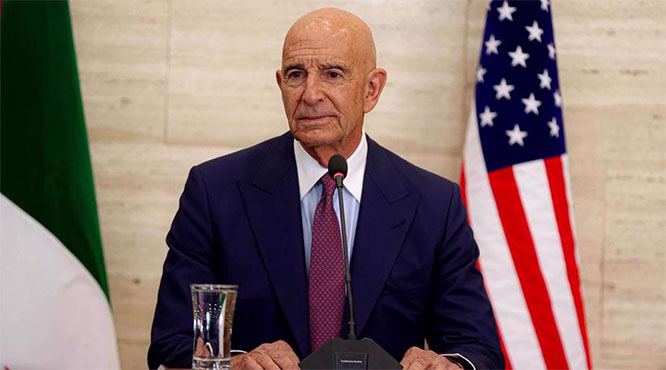
Since 1946, the United States has attempted 93 coups or “regime change” operations across the world — including two in Iran, US Special Envoy for Syria Tom Barrack has admitted.

Speaking to the UAE-based IMI Media Group, in remarks published by The National, Barrack said Washington tried twice to overthrow the Iranian government but failed both times. 

“For (Trump) then to be imputed with regime change — we had two regime changes in Iran already. Neither one worked. So I think wisely leave it to the region to solve,” said Barrack, who also serves as the US ambassador to Turkey.

His comments come six months after the US joined Israel in airstrikes against Iran during ongoing indirect nuclear negotiations between Tehran and Washington.

On June 13, Israel launched an attack on Iran that killed at least 1,064 people and hit civilian infrastructure. Days later, the United States targeted three nuclear facilities — Fordow, Natanz and Isfahan — in what Iran called a clear violation of international law. Iranian retaliation eventually forced a halt to the assault on June 24.

Barrack further claimed that US President Donald Trump and Foreign Secretary Marco Rubio are “not into regime change” and prefer a regional approach driven by Middle Eastern countries themselves. According to him, regional dialogue and non-interference by outside powers offer a more durable path forward.

He added that Washington is still open to an agreement with Tehran if Iranian authorities show “seriousness” and willingness to engage constructively.

However, Iran maintains the US has not shown readiness for meaningful talks. In an interview with Japan’s Kyodo News, Iranian Foreign Minister Abbas Araghchi said negotiations could advance only if Washington acknowledges Iran’s right to peaceful nuclear energy and lifts unilateral sanctions.

Comments

Add new comment

  • Coastaldigest.com reserves the right to delete or block any comments.
  • Coastaldigset.com is not responsible for its readers’ comments.
  • Comments that are abusive, incendiary or irrelevant are strictly prohibited.
  • Please use a genuine email ID and provide your name to avoid reject.
News Network
December 21,2025

hadith.jpg

Invoking the teachings of Prophet Muhammad—“pay the worker before his sweat dries”—the Madras High Court has directed a municipal corporation to settle long-pending legal dues owed to a former counsel. The court observed that this principle reflects basic fairness and applies equally to labour and service-related disputes.

Justice G. R. Swaminathan made the observation while hearing a petition filed by advocate P. Thirumalai, who claimed that the Madurai City Municipal Corporation failed to pay him legal fees amounting to ₹13.05 lakh. Earlier, the High Court had asked the corporation to consider his representation. However, a later order rejected a major portion of his claim, prompting the present petition.

The court allowed Thirumalai to approach the District Legal Services Authority (DLSA) and submit a list of cases in which he had appeared. It also directed the corporation to settle the verified fee bills within two months, without interest. The court noted that the petitioner had waited nearly 18 years before challenging the non-payment and that the corporation could not be fully blamed, as the fee bills were not submitted properly.

‘A Matter of Embarrassment’

Justice Swaminathan described it as a “matter of embarrassment” that the State has nearly a dozen Additional Advocate Generals. He observed that appointing too many law officers often leads to unnecessary allocation of work and frequent adjournments, as government counsel claim that senior officers are engaged elsewhere.

He expressed hope that such practices would end at least in the Madurai Bench of the High Court and added that Additional Advocate Generals should “turn a new leaf” from 2026 onwards.

‘Scandalously High Amounts’

While stating that the court cannot examine the exact fees paid to senior counsel or law officers, Justice Swaminathan stressed that good governance requires public funds to be used prudently. He expressed concern over the “scandalously high amounts” paid by government and quasi-government bodies to a few favoured law officers.

In contrast, the court noted that Thirumalai’s total claim was “a pittance” considering the large number of cases he had handled.

Background

Thirumalai served as the standing counsel for the Madurai City Municipal Corporation for more than 14 years, from 1992 to 2006. During this period, he represented the corporation in about 818 cases before the Madurai District Courts.

As the former counsel was unable to hire a clerk to obtain certified copies of judgments in all 818 cases, the court directed the District Legal Services Authority to collect the certified copies within two months. The court further ordered the corporation to bear the cost incurred by the DLSA and deduct that amount from the final settlement payable to the petitioner.

Comments

Add new comment

  • Coastaldigest.com reserves the right to delete or block any comments.
  • Coastaldigset.com is not responsible for its readers’ comments.
  • Comments that are abusive, incendiary or irrelevant are strictly prohibited.
  • Please use a genuine email ID and provide your name to avoid reject.
News Network
December 16,2025

jordan.jpg

Prime Minister Narendra Modi on Monday held talks with Jordan’s King Abdullah II in Amman, during which the two leaders discussed ways to further strengthen bilateral relations, with the Prime Minister outlining an eight-point vision covering key areas of cooperation.

Describing the meeting as “productive”, PM Modi said he shared a roadmap focused on trade and economy, fertilisers and agriculture, information technology, healthcare, infrastructure, critical and strategic minerals, civil nuclear cooperation, and people-to-people ties.

In a post on social media platform X, the Prime Minister praised King Abdullah II’s personal commitment to advancing India–Jordan relations, particularly as both countries mark the 75th anniversary of the establishment of diplomatic ties this year.

“Held productive discussions with His Majesty King Abdullah II in Amman. His personal commitment towards vibrant India-Jordan relations is noteworthy. This year, we are celebrating the 75th anniversary of our bilateral diplomatic relations,” PM Modi said.

The meeting took place at the Al Husseiniya Palace, where the two leaders also exchanged views on regional and global issues of mutual interest. According to the Ministry of External Affairs (MEA), both sides agreed to further deepen cooperation in areas including trade and investment, defence and security, counter-terrorism and de-radicalisation, fertilisers and agriculture, infrastructure, renewable energy, tourism, and heritage.

The MEA said both leaders reaffirmed their united stand against terrorism.

PM Modi arrived in Amman earlier on Monday and was received by Jordanian Prime Minister Jafar Hassan, who accorded him a formal welcome. Following the talks, King Abdullah II hosted a banquet dinner in honour of the Prime Minister, reflecting the warmth of bilateral ties.

Jordan is the first leg of PM Modi’s three-nation tour. From Amman, the Prime Minister will travel to Ethiopia at the invitation of Prime Minister Abiy Ahmed Ali, marking his first official visit to the African nation. The tour will conclude with a visit to Oman.

Comments

Add new comment

  • Coastaldigest.com reserves the right to delete or block any comments.
  • Coastaldigset.com is not responsible for its readers’ comments.
  • Comments that are abusive, incendiary or irrelevant are strictly prohibited.
  • Please use a genuine email ID and provide your name to avoid reject.