



First Indian Tax Amnesty Since 1997 Seeks To Boost Compliance: Foreign Media

March 1, 2016

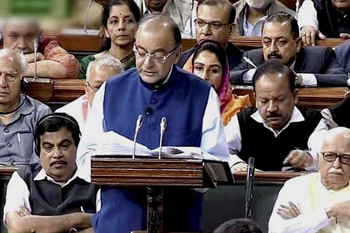
Mar 1: India's Finance Minister Arun Jaitley offered residents with undisclosed income a one-time amnesty from prosecution as pressure mounted on Prime Minister Narendra Modi to deliver on his poll promise of unearthing black money.
jaitley
The window for declaring assets will open on June 1 for four months, Jaitley said in his budget speech on Monday. Taxpayers can get immunity from prosecution by paying levies of 45 percent, including a penalty and surcharge, on the undisclosed income within two months of the declaration. That compares with a maximum 35 percent income tax.

The first tax amnesty on local assets in almost two decades may lure evaders to take up Jaitley's offer and potentially bring more people into the tax net, according to Mukesh Butani, a New Delhi-based managing partner at BMR Legal. In 1997, the government raised 100 billion rupees ($1.5 billion) with such an offer. A similar pardon for illicit assets overseas, locally known as black money, raised just was 0.07 percent of the estimated $510 billion of illegal outflows in the nine years to 2013.

"With effective tax rates anyway being around 35 percent, this seems like a fair deal," Butani said by phone. "Black Money law last year was targeting the overseas assets while the amnesty scheme offered this year is for domestic assets, so they are looking at different categories."

India collected 40 billion rupees in 2013 under a service tax disclosure program. The amnesty last year on money stashed abroad yielded only about 25 billion rupees. A report on illicit financial flows from emerging markets by Global Financial Integrity said $510 billion of funds were illegally moved overseas from India.

"Our government is fully committed to remove black money from the economy," Jaitley said in parliament. "Having given one opportunity for evaded income to be declared once, we would then like to focus all our resources for bringing people with black money to books."

Clamping down on black money has long been a hot topic in India.

"If we bring back those rupees then each and every poor man in India will get 1.5 million to 2 million rupees, for free," Modi said at a rally in January 2014, before he won India's largest lower-house majority in 30 years. A year later, Amit Shah, president of Modi's ruling party, said the remark shouldn't be taken literally.


Comments

IBRAHIM.HUSSAIN
 - 
Tuesday, 1 Mar 2016

Where is poll promised black money retrieved from foreign banks to every family of Indian citizen. Modi and his Hench ministers coming up with new ideas just to silence the people anger on poll promises. We have not heard anything about SC appointed SIT on the black money?

All promises and new ideas are blunder just stay in power?????

Add new comment

  • Coastaldigest.com reserves the right to delete or block any comments.
  • Coastaldigset.com is not responsible for its readers’ comments.
  • Comments that are abusive, incendiary or irrelevant are strictly prohibited.
  • Please use a genuine email ID and provide your name to avoid reject.
News Network
December 16,2025

bengal.jpg

The deletion of over 58 lakh names from West Bengal’s draft electoral rolls following a Special Intensive Revision (SIR) has sparked widespread concern and is likely to deepen political tensions in the poll-bound state.

According to the Election Commission, the revision exercise has identified 24 lakh voters as deceased, 19 lakh as relocated, 12 lakh as missing, and 1.3 lakh as duplicate entries. The draft list, published after the completion of the first phase of SIR, aims to remove errors and duplication from the electoral rolls.

However, the scale of deletions has raised fears that a large number of eligible voters may have been wrongly excluded. The Election Commission has said that individuals whose names are missing can file objections and seek corrections. The final voter list is scheduled to be published in February next year, after which the Assembly election announcement is expected. Notably, the last Special Intensive Revision in Bengal was conducted in 2002.

The development has intensified the political row over the SIR process. Chief Minister Mamata Banerjee and her Trinamool Congress have strongly opposed the exercise, accusing the Centre and the Election Commission of attempting to disenfranchise lakhs of voters ahead of the elections.

Addressing a rally in Krishnanagar earlier this month, Banerjee urged people to protest if their names were removed from the voter list, alleging intimidation during elections and warning of serious consequences if voting rights were taken away.

The BJP, meanwhile, has defended the revision and accused the Trinamool Congress of politicising the issue to protect what it claims is an illegal voter base. Leader of the Opposition Suvendu Adhikari alleged that the ruling party fears losing power due to the removal of deceased, fake, and illegal voters.

The controversy comes amid earlier allegations by the Trinamool Congress that excessive work pressure during the SIR led to the deaths by suicide of some Booth Level Officers (BLOs), for which the party blamed the Election Commission. With the draft list now out, another round of political confrontation appears imminent.

As objections begin to be filed, the focus will be on whether the correction mechanism is accessible, transparent, and timely—critical factors in ensuring that no eligible voter is denied their democratic right ahead of a crucial election.

Comments

Add new comment

  • Coastaldigest.com reserves the right to delete or block any comments.
  • Coastaldigset.com is not responsible for its readers’ comments.
  • Comments that are abusive, incendiary or irrelevant are strictly prohibited.
  • Please use a genuine email ID and provide your name to avoid reject.