Fourth phase of Assembly Elections: Voting for 18 J&K seats, 15 Jharkhand constituencies begins

December 14, 2014

Assembly Elections
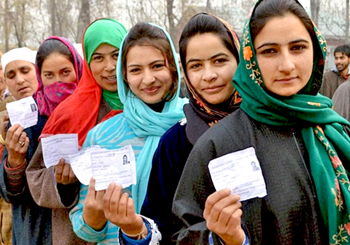
Srinagar/Ranchi, Dec 14: Polling began on Sunday for the penultimate round of the five-phased elections as votes were being cast for 18 seats in Jammu and Kashmir and 15 Assembly seats in Jharkhand.

Jharkhand Chief Minister Babulal Marandi and three incumbent ministers are among the heavyweights in Jharkhand whose future will be sealed in the ballot boxes today; while in J&K the fate of 182 candidates including two chief ministerial aspirants and Speaker of the Assembly will be decided.

Well before the polling began, Prime Minister Narendra Modi urged voters to turn up in large number. He tweeted: "I urge all friends across J&K and Jharkhand voting today in the 4th phase of the Vidhan Sabha elections to vote in large numbers."

In the 18 Assembly seats of Jammu and Kashmir over 14.73 lakh voters including 7.05 lakh females are eligible to exercise their franchise at 1,890 polling stations in four districts of the state Srinagar, Anantnag, Shopian (Kashmir Valley) and Samba (Jammu region).

All eyes will be on the eight constituencies of Srinagar currently being represented by the National Conference (NC)? as the voter turnout has generally remained low in the district along with some parts of Anantnag and Shopian.

Chief Minister Omar Abdullah is contesting from Sonwar Assembly segment of Srinagar after he chose not to contest from his family stronghold of Ganderbal constituency.

Omar was also in fray from Beerwah seat, in central Kashmir's Budgam district, which went to polls in the third phase.

Peoples Democratic Party (PDP) patron and party chief ministerial candidate Mufti Mohammad Sayeed is seeking re-election from Anantnag constituency in south Kashmir.

Depending on the eventual party positions in terms of seats won, either Omar or Sayeed is likely to be the front-runner for the chief minister's post.

Other prominent candidates who are in fray include J&K Assembly Speaker Mubarak Gul, Omar's close confidante Nasir Aslam Wani, Congress ministers Peerzada Mohammad Sayeed and Ghulam Ahmad Mir, and PDP's Abdul Rehman Veeri and Altaf Bukhari.

The campaign in the four districts was by and large peaceful but militants hurled a grenade at a police station in Anantnag town on Thursday, resulting in injuries to three policemen.

The ultras also planted an IED under a culvert in Shopian district on the same day but the explosive was detected by security forces and defused by a bomb disposal squad.

Security arrangements in all the four districts have been strengthened to ensure peaceful polling.

Prime Minister Narendra Modi, BJP president Amit Shah, Union Minister of State Mukhtar Abbas Naqvi, cricketer-turned politician Navjot Singh Sidhu and Bollywood actor and party MP Vinod Khanna campaigned for BJP candidates in the seats going to polls in the fourth phase.

The BJP, which is making its first serious bid for power in Jammu and Kashmir, has come out all guns blazing to make its presence felt in the Valley.

Congress president Sonia Gandhi, Leader of Opposition in Rajya Sabha Ghulam Nabi Azad and Pradesh Congress Committee president Saifuddin Soz also campaigned for their candidates. Omar, working president of the NC, was the only star campaigner for his party in the absence of his father and former chief minister Farooq Abdullah, who is undergoing medical treatment in London.

Omar crisscrossed the four districts to campaign for his party candidates including himself.

PDP's Sayeed and party president Mehbooba Mufti also campaigned for their party candidates.

Of the 18 seats going to polls tomorrow, the ruling NC had won nine in 2008 while the opposition PDP bagged six seats. Congress had won two seats while National Panthers Party clinched the Samba seat in Jammu region.

With the fourth phase, the polling process will come to an end in Kashmir Valley as all the 20 seats going to polls in the fifth and the last phase on December 20 are in Jammu region.

On the 15 Assembly seats of Jharkhand that go to polls today, a total of 43,48,709 voters are eligible to decide the fate of 217 candidates, including 16 women.

Adequate security arrangements have been made in all the 15 constituencies with many being Maoist-hit.

Polling in the worst-hit Maoist areas in the previous three rounds passed off peacefully.

CM Marandi, whose fate has already been sealed in the third of the five-phase polling from Dhanwar, is among the 13 candidates in the fray from the Giridih seat this time.

He had represented Giridih in the Lok Sabha in the previous House.

Polling will end at 5 PM in Dhanbad and Bokaro while the EVM will be sealed at 3 PM in the rest of the constituencies.

Jharkhand Disaster Management Minister Mannan Mallick (Congress-Dhanbad), Tourism Minister Suresh Paswan (RJD-Deogarh) and Building Construction Minister Haji Hussain Ansari (JMM-Madhupur) are in the field, besides 11 MLAs seeking re-election.

The Jharkhand Mukti Morcha and the Bahujan Samaj Party have fielded the maximum of 14 candidates each followed by the Jharkhand Vikas Party (Prajatantrik-13 candidates), CPI (three) CPI (M) and NCP in two seats each.

The fourth phase seats include Madhupur, Deogarh (SC), Bagodar, Jamua (SC), Gandey, Giridih, Dumri, Bokaro, Chandankyari (SC), Sindri, Nirsa, Dhanbad, Jharia, Tundi and Baghmara but there is no separate seat for tribals.

With 28 candidates, Bokaro has the maximum number of contestants while Jamua, Chandankyari and Tundi have the minimum of ten candidates each.

In all, 716 out of 3,718 polling stations are marked as highly sensitive and 2007 as sensitive and only 615 polling station locations are situated in urban areas.

The Election Commission assigned 335 polling stations for webcasting.

The EC has also deployed 27,410 polling personnel across the 15 constituencies with 5,482 Control Units for EVM and 6,978 ballot units.

VVPAT (Voter verified paper audit trail) will be used in a combined total of 917 polling stations in Bokaro and Dhanbad. The Election Commission has also deployed 15 general observers, six expenditure observers, two police observers, two awareness observers and 1,069 micro observers, according to EC sources.

Polling to 50 of the 81 seats has already been concluded in the previous three phases.

Comments

Add new comment

  • Coastaldigest.com reserves the right to delete or block any comments.
  • Coastaldigset.com is not responsible for its readers’ comments.
  • Comments that are abusive, incendiary or irrelevant are strictly prohibited.
  • Please use a genuine email ID and provide your name to avoid reject.
News Network
December 6,2025

indigoticket.jpg

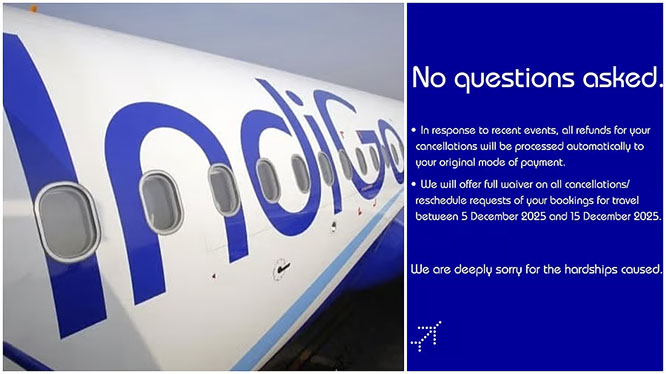
With IndiGo flight disruptions impacting thousands of passengers, the airline on Saturday said that it will offer full waiver on all cancellations/reschedule requests for travel bookings between December 5, 2025 and December 15, 2025.

Earlier in the day, the civil aviation ministry had directed the airline to complete the ticket refund process for the cancelled flights by Sunday evening, as well as ensure baggage separated from the travellers are delivered in the next two days.

In a post on X, titled 'No questions asked', IndiGo wrote, "In response to recent events, all refunds for your cancellations will be processed automatically to your original mode of payment."

"We are deeply sorry for the hardships caused," it further added.

Several passengers, however, complained of not getting full refund as promised by the airline.

Netizens have shared screenchots of getting charged for airline cancellation fee and convenience fee.

"Please tell me why u have did this airline cancellation charges when u say full amount will be refunded (sic)," a user wrote sharing a screenshot of the refund page.

"Well, but you have still debited the convenience charges," wrote another.

Passengers have also raised concerns about the "cancel" option being disabled on the IndiGo app. "First enable the 'Cancel' button on your App & offer full refund on tickets cancelled by customers between the said dates," wrote a user.

A day after the country's largest airline, IndiGo, cancelled more than 1,000 flights and caused disruptions for the fifth day on Saturday, the ministry said that any delay or non-compliance in refund processing will invite immediate regulatory action.

The refund process for all cancelled or disrupted flights must be completed by 8 pm on Sunday, the ministry said in a statement.

"Airlines have also been instructed not to levy any rescheduling charges for passengers whose travel plans were affected by cancellations," it said.

On Saturday, more than 400 flights were cancelled at various airports.

IndiGo has also been instructed to set up dedicated passenger support and refund facilitation cells.

Comments

Add new comment

  • Coastaldigest.com reserves the right to delete or block any comments.
  • Coastaldigset.com is not responsible for its readers’ comments.
  • Comments that are abusive, incendiary or irrelevant are strictly prohibited.
  • Please use a genuine email ID and provide your name to avoid reject.
News Network
December 16,2025

bengal.jpg

The deletion of over 58 lakh names from West Bengal’s draft electoral rolls following a Special Intensive Revision (SIR) has sparked widespread concern and is likely to deepen political tensions in the poll-bound state.

According to the Election Commission, the revision exercise has identified 24 lakh voters as deceased, 19 lakh as relocated, 12 lakh as missing, and 1.3 lakh as duplicate entries. The draft list, published after the completion of the first phase of SIR, aims to remove errors and duplication from the electoral rolls.

However, the scale of deletions has raised fears that a large number of eligible voters may have been wrongly excluded. The Election Commission has said that individuals whose names are missing can file objections and seek corrections. The final voter list is scheduled to be published in February next year, after which the Assembly election announcement is expected. Notably, the last Special Intensive Revision in Bengal was conducted in 2002.

The development has intensified the political row over the SIR process. Chief Minister Mamata Banerjee and her Trinamool Congress have strongly opposed the exercise, accusing the Centre and the Election Commission of attempting to disenfranchise lakhs of voters ahead of the elections.

Addressing a rally in Krishnanagar earlier this month, Banerjee urged people to protest if their names were removed from the voter list, alleging intimidation during elections and warning of serious consequences if voting rights were taken away.

The BJP, meanwhile, has defended the revision and accused the Trinamool Congress of politicising the issue to protect what it claims is an illegal voter base. Leader of the Opposition Suvendu Adhikari alleged that the ruling party fears losing power due to the removal of deceased, fake, and illegal voters.

The controversy comes amid earlier allegations by the Trinamool Congress that excessive work pressure during the SIR led to the deaths by suicide of some Booth Level Officers (BLOs), for which the party blamed the Election Commission. With the draft list now out, another round of political confrontation appears imminent.

As objections begin to be filed, the focus will be on whether the correction mechanism is accessible, transparent, and timely—critical factors in ensuring that no eligible voter is denied their democratic right ahead of a crucial election.

Comments

Add new comment

  • Coastaldigest.com reserves the right to delete or block any comments.
  • Coastaldigset.com is not responsible for its readers’ comments.
  • Comments that are abusive, incendiary or irrelevant are strictly prohibited.
  • Please use a genuine email ID and provide your name to avoid reject.
News Network
December 13,2025

New Delhi: School-going children are picking up drug and smoking habits and engaging in consumption of alcohol, with the average age of introduction to such harmful substances found to be around 13 years, suggesting a need for earlier interventions as early as primary school, a multi-city survey by AIIMS-Delhi said.

The findings also showed substance use increased in higher grades, with grade XI/XII students two times more likely to report use of substances when compared with grade VIII students. This emphasised the importance of continued prevention and intervention through middle and high school.

The study led by Dr Anju Dhawan of AIIMS's National Drug Dependence Treatment Centre, published in the National Medical Journal of India this month, looks at adolescent substance use across diverse regions.

The survey included 5,920 students from classes 8, 9, 11 and 12 in urban government, private and rural schools across 10 cities -- Bengaluru, Chandigarh, Delhi, Dibrugarh, Hyderabad, Imphal, Jammu, Lucknow, Mumbai, and Ranchi. The data were collected between May 2018 and June 2019.

The average age of initiation for any substance was 12.9 (2.8) years. It was lowest for inhalants (11.3 years) followed by heroin (12.3 years) and opioid pharmaceuticals (without prescription; 12.5 years).

Overall, 15.1 per cent of participants reported lifetime use, 10.3 per cent reported past year use, and 7.2 per cent reported use in the past month of any substance, the study found.

The most common substances used in the past year, after tobacco (4 per cent) and alcohol (3.8 per cent), were opioids (2.8 per cent), followed by cannabis (2 per cent) and inhalants (1.9 per cent). Use of non-prescribed pharmaceutical opioids was most common among opioid users (90.2 per cent).

On being asked, 'Do you think this substance is easily available for a person of your age' separately for each substance category, nearly half the students (46.3 per cent) endorsed that tobacco products and more than one-third of the students (36.5 per cent) agreed that a person of their age can easily procure alcohol products.

Similarly, for Bhang (21.9 per cent), ganja/charas (16.1 per cent), inhalants (15.2 per cent), sedatives (13.7 per cent), opium and heroin (10 per cent each), the students endorsed that these can be easily procured.

About 95 per cent of the children, irrespective of their grade, agreed with the statement that 'drug use is harmful'.

The rates of substance use (any) among boys were significantly higher than those of girls for substance use (ever), use in the past year and use in the past 30 days. Compared to grade VIII students, grade IX students were more likely, and grade XI/XII students were twice as likely to have used any substance (ever).

The likelihood of past-year use of any substance was also higher for grade IX students and for grade XI/XII students as compared to grade VIII students.

About 40 per cent of students mentioned that they had a family member who used tobacco or alcohol each. The use of cannabis (any product) and opioid (any product) by a family member was reported by 8.2 per cent and 3.9 per cent of students, respectively, while the use of other substances, such as inhalants/sedatives by family was 2-3 per cent, the study found.

A relatively smaller percentage of students reported use of tobacco or alcohol among peers as compared to among family members, while a higher percentage reported inhalants, sedatives, cannabis or opioid use among peers.

Children using substances (past year) compared to non-users reported significantly higher any substance use by their family members and peers.

There were 25.7 per cent students who replied 'yes' to the question 'conflicts/fights often occur in your family'. Most students also replied affirmatively to 'family members are aware of how their time is being spent' and 'damily members are aware of with whom they spend their time'.

Comments

Add new comment

  • Coastaldigest.com reserves the right to delete or block any comments.
  • Coastaldigset.com is not responsible for its readers’ comments.
  • Comments that are abusive, incendiary or irrelevant are strictly prohibited.
  • Please use a genuine email ID and provide your name to avoid reject.