



Govt vs RBI | The 18 wise men tasked with supervision of the Mint Street

Agencies
November 11, 2018

Mumbai, Nov 11: As an unprecedented fight plays out between the RBI and the government, it is the central bank's 18 board members who are being keenly watched for their next course of action -- they are not only central bankers and government officials but also business leaders, economists and activists.

The RBI board is scheduled to meet next on November 19 amid an ongoing tussle with the government on multiple fronts.

Going by the public utterances of the RBI and government officials so far, the contentious issues are how to manage the huge surplus the RBI has accumulated, how should it deal with errant lenders and borrowers amid a persisting bad loan crisis and what could be the 'public interest' for the government to dictate directions so that it is not seen as an attack on the central bank's autonomy.

As per the RBI website, its central board currently has 18 members, though the provision is that it can go up to 21.

The members include Governor Urjit Patel and his four deputies as 'full-time official directors', while the rest 13 have been nominated by the government, including two Finance Ministry officials -- Economic Affairs Secretary Subhash Chandra Garg and Financial Services Secretary Rajiv Kumar.

There are also Swadeshi ideologue Swaminathan Gurumurthy and cooperative banker Satish Marathe, nominated by the government as "part-time non-official directors".

The entire board is appointed by the government under the RBI Act, which mandates the central board with "general superintendence and direction of the Reserve Bank's affairs".

The government can nominate 10 'non-official' directors from various fields and two government officials. The four non-official directors are one each from the four regional boards of the RBI.

Besides Patel, the four official directors are N S Vishwanathan and Viral Acharya, both of whom have gone public with their direct or indirect criticism of any attempt to undermine the RBI's autonomy, as also B P Kanungo and M K Jain.

Patel became Governor in September 2016 after serving as Deputy Governor since January 2013. Previously, he had served at the International Monetary Fund (IMF) and was also on deputation from the IMF to the RBI during 1996-1997.

He was a Consultant to the Ministry of Finance from 1998 to 2001 and has a PhD in economics from Yale University, an M Phil from University of Oxford and a BSc from the University of London.

Acharya is a New York University Professor of Economics, while Kanungo and Vishwanathan are career central bankers. Jain was appointed as a Deputy Governor in June 2018 and previously headed IDBI Bank and Indian Bank, among other professional banking roles.

The business leaders on the RBI board include Tata group chief Natarajan Chandrasekaran, former Mahindra group veteran Bharat Narotam Doshi, Teamlease Services co-founder Manish Sabharwal and Sun Pharma chief Dilip Shanghvi.

The other members are Sudhir Mankad (retired IAS officer whose last assignment was as Gujarat government's Chief Secretary), Ashok Gulati (agricultural economist), Prasanna Mohanty (ex-IAS officer and economist), Sachin Chaturvedi of Delhi-based think-tank Research and Information System for Developing Countries (RIS) and Revathy Iyer (a former Deputy Comptroller and Auditor General).

In the past also, the RBI's board has had several business leaders such as Ratan Tata, Kumar Mangalam Birla, NR Narayana Murthy, Azim Premji, G M Rao, Y C Deveshwar and K P Singh.

Recently, the tenure of board member Nachiket Mor, who had previously been an executive director at ICICI Bank, was cut short -- nearly a year after he was re-nominated by the government in August 2017 for a second term of four years.

The central board members in the past also included Kiran S Karnik, Y H Malegam, Ela Bhatt, V Rajeev Gowda, Suresh Tendulkar and Suresh Neotia.

The RBI was established on April 1, 1935 and the appointment and tenure of the board members are governed by Section 8 of the RBI Act.

It is Section 7, which has been in news lately, that provides that the "Central Government may from time to time give such directions to the Bank as it may, after consultation with the Governor of the Bank, consider necessary in the public interest".

"Subject to any such directions, the general superintendence and direction of the affairs and business of the Bank shall be entrusted to a Central Board of Directors which may exercise all powers and do all acts and things which may be exercised or done by the Bank," Section 7 further says.

It also provides that "save as otherwise provided in regulations made by the Central Board, the Governor and in his absence the Deputy Governor nominated by him in his behalf, shall also have powers of general superintendence and direction of the affairs and the business of the Bank, and may exercise all powers and do all acts and things which may be exercised or done by the Bank".

Though originally privately owned, since nationalisation in 1949, the Reserve Bank is fully owned by the Government of India.

The RBI is mandated "to regulate the issue of bank notes and keeping of reserves with a view to securing monetary stability in India and generally to operate the currency and credit system of the country to its advantage".

It is also required "to have a modern monetary policy framework to meet the challenge of an increasingly complex economy, to maintain price stability while keeping in mind the objective of growth.

Comments

Add new comment

  • Coastaldigest.com reserves the right to delete or block any comments.
  • Coastaldigset.com is not responsible for its readers’ comments.
  • Comments that are abusive, incendiary or irrelevant are strictly prohibited.
  • Please use a genuine email ID and provide your name to avoid reject.
News Network
December 7,2025

envoy.jpg

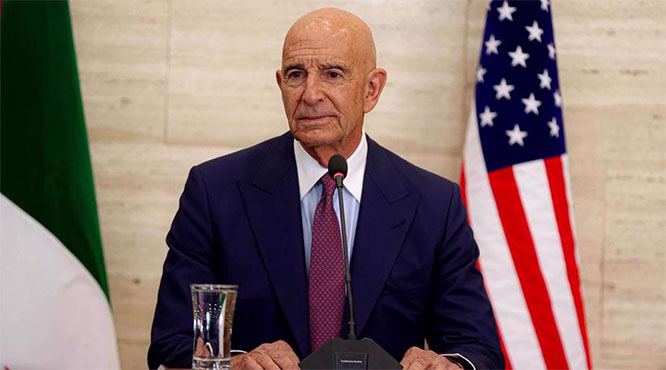
Since 1946, the United States has attempted 93 coups or “regime change” operations across the world — including two in Iran, US Special Envoy for Syria Tom Barrack has admitted.

Speaking to the UAE-based IMI Media Group, in remarks published by The National, Barrack said Washington tried twice to overthrow the Iranian government but failed both times. 

“For (Trump) then to be imputed with regime change — we had two regime changes in Iran already. Neither one worked. So I think wisely leave it to the region to solve,” said Barrack, who also serves as the US ambassador to Turkey.

His comments come six months after the US joined Israel in airstrikes against Iran during ongoing indirect nuclear negotiations between Tehran and Washington.

On June 13, Israel launched an attack on Iran that killed at least 1,064 people and hit civilian infrastructure. Days later, the United States targeted three nuclear facilities — Fordow, Natanz and Isfahan — in what Iran called a clear violation of international law. Iranian retaliation eventually forced a halt to the assault on June 24.

Barrack further claimed that US President Donald Trump and Foreign Secretary Marco Rubio are “not into regime change” and prefer a regional approach driven by Middle Eastern countries themselves. According to him, regional dialogue and non-interference by outside powers offer a more durable path forward.

He added that Washington is still open to an agreement with Tehran if Iranian authorities show “seriousness” and willingness to engage constructively.

However, Iran maintains the US has not shown readiness for meaningful talks. In an interview with Japan’s Kyodo News, Iranian Foreign Minister Abbas Araghchi said negotiations could advance only if Washington acknowledges Iran’s right to peaceful nuclear energy and lifts unilateral sanctions.

Comments

Add new comment

  • Coastaldigest.com reserves the right to delete or block any comments.
  • Coastaldigset.com is not responsible for its readers’ comments.
  • Comments that are abusive, incendiary or irrelevant are strictly prohibited.
  • Please use a genuine email ID and provide your name to avoid reject.
News Network
December 6,2025

pilot.jpg

New Delhi: IndiGo, India’s largest airline, faced major operational turbulence this week after failing to prepare for new pilot-fatigue regulations issued by the Directorate General of Civil Aviation (DGCA). The stricter rules—designed to improve flight safety—took effect in phases through 2024, with the latest implementation on November 1. IndiGo has acknowledged that inadequate roster planning led to widespread cancellations and delays.

Below are the key DGCA rules that affected IndiGo’s operations:

1. Longer Mandatory Weekly Rest

Weekly rest for pilots has been increased from 36 hours to 48 hours.

The government says the extended break is essential to curb cumulative fatigue. This rule remains in force despite the current crisis.

2. Cap on Night Landings

Pilots can now perform only two night landings per week—a steep reduction from the earlier limit of six.

Night hours, defined as midnight to early morning, are considered the least alert period for pilots.

Given the disruptions, this rule has been temporarily relaxed for IndiGo until February 10.

3. Reduced Maximum Night Flight Duty

Flight duty that stretches into the night is now capped at 10 hours.

This measure has also been kept on hold for IndiGo until February 10 to stabilize operations.

4. Weekly Rest Cannot Be Replaced With Personal Leave

Airlines can no longer count a pilot’s personal leave as part of the mandatory 48-hour rest.

Pilots say this closes a loophole that previously reduced actual rest time.

Currently, all airlines are exempt from this rule to normalise travel.

5. Mandatory Fatigue Monitoring

Airlines must submit quarterly fatigue reports along with corrective actions to DGCA.

This system aims to create a transparent fatigue-tracking framework across the industry.

The DGCA has stressed that these rules were crafted to strengthen flight safety and align India with global fatigue-management standards. The temporary relaxations are expected to remain until February 2025, giving IndiGo time to stabilise its schedules and restore normal air travel.

Comments

Add new comment

  • Coastaldigest.com reserves the right to delete or block any comments.
  • Coastaldigset.com is not responsible for its readers’ comments.
  • Comments that are abusive, incendiary or irrelevant are strictly prohibited.
  • Please use a genuine email ID and provide your name to avoid reject.
News Network
December 19,2025

Mangaluru: In a decisive move to tackle the city’s deteriorating sanitation infrastructure, the Mangaluru City Corporation (MCC) has announced a massive ₹1,200 crore action plan to overhaul its underground drainage (UGD) network.

The initiative, spearheaded by Deputy Commissioner and MCC Administrator Darshan HV, aims to bridge "missing links" in the current system that have left residents grappling with overflowing sewage and environmental hazards.

The Breaking Point

The announcement follows a high-intensity phone-in session on Thursday, where the DC was flooded with grievances from frustrated citizens. Residents, including Savithri from Yekkur, described a harrowing reality: raw sewage from apartments leaking into stormwater drains, creating a "permanent stink" and turning residential zones into mosquito breeding grounds.

"We are facing immense difficulties due to the stench and the health risks. Local officials have remained silent until now," one resident reported during the session.

The Strategy: A Six-Year Vision

DC Darshan HV confirmed that the proposed plan is not a temporary patch but a comprehensive six-year roadmap designed to accommodate Mangaluru’s projected population growth. Key highlights of the plan include:

•    Infrastructure Expansion: Laying additional pipelines to connect older neighborhoods to the main grid.

•    STP Crackdown: Stricter enforcement of Sewage Treatment Plant (STP) regulations. While new apartments are required to have functional STPs, many older buildings lack them entirely, and several newer units are reportedly non-functional.

•    Budgetary Push: The plan has already been discussed with the district in-charge minister and the Secretary of the Urban Development Department. It is slated for formal presentation in the upcoming state budget.

Comments

Add new comment

  • Coastaldigest.com reserves the right to delete or block any comments.
  • Coastaldigset.com is not responsible for its readers’ comments.
  • Comments that are abusive, incendiary or irrelevant are strictly prohibited.
  • Please use a genuine email ID and provide your name to avoid reject.
