Govt vs RBI | The 18 wise men tasked with supervision of the Mint Street

Agencies
November 11, 2018

Mumbai, Nov 11: As an unprecedented fight plays out between the RBI and the government, it is the central bank's 18 board members who are being keenly watched for their next course of action -- they are not only central bankers and government officials but also business leaders, economists and activists.

The RBI board is scheduled to meet next on November 19 amid an ongoing tussle with the government on multiple fronts.

Going by the public utterances of the RBI and government officials so far, the contentious issues are how to manage the huge surplus the RBI has accumulated, how should it deal with errant lenders and borrowers amid a persisting bad loan crisis and what could be the 'public interest' for the government to dictate directions so that it is not seen as an attack on the central bank's autonomy.

As per the RBI website, its central board currently has 18 members, though the provision is that it can go up to 21.

The members include Governor Urjit Patel and his four deputies as 'full-time official directors', while the rest 13 have been nominated by the government, including two Finance Ministry officials -- Economic Affairs Secretary Subhash Chandra Garg and Financial Services Secretary Rajiv Kumar.

There are also Swadeshi ideologue Swaminathan Gurumurthy and cooperative banker Satish Marathe, nominated by the government as "part-time non-official directors".

The entire board is appointed by the government under the RBI Act, which mandates the central board with "general superintendence and direction of the Reserve Bank's affairs".

The government can nominate 10 'non-official' directors from various fields and two government officials. The four non-official directors are one each from the four regional boards of the RBI.

Besides Patel, the four official directors are N S Vishwanathan and Viral Acharya, both of whom have gone public with their direct or indirect criticism of any attempt to undermine the RBI's autonomy, as also B P Kanungo and M K Jain.

Patel became Governor in September 2016 after serving as Deputy Governor since January 2013. Previously, he had served at the International Monetary Fund (IMF) and was also on deputation from the IMF to the RBI during 1996-1997.

He was a Consultant to the Ministry of Finance from 1998 to 2001 and has a PhD in economics from Yale University, an M Phil from University of Oxford and a BSc from the University of London.

Acharya is a New York University Professor of Economics, while Kanungo and Vishwanathan are career central bankers. Jain was appointed as a Deputy Governor in June 2018 and previously headed IDBI Bank and Indian Bank, among other professional banking roles.

The business leaders on the RBI board include Tata group chief Natarajan Chandrasekaran, former Mahindra group veteran Bharat Narotam Doshi, Teamlease Services co-founder Manish Sabharwal and Sun Pharma chief Dilip Shanghvi.

The other members are Sudhir Mankad (retired IAS officer whose last assignment was as Gujarat government's Chief Secretary), Ashok Gulati (agricultural economist), Prasanna Mohanty (ex-IAS officer and economist), Sachin Chaturvedi of Delhi-based think-tank Research and Information System for Developing Countries (RIS) and Revathy Iyer (a former Deputy Comptroller and Auditor General).

In the past also, the RBI's board has had several business leaders such as Ratan Tata, Kumar Mangalam Birla, NR Narayana Murthy, Azim Premji, G M Rao, Y C Deveshwar and K P Singh.

Recently, the tenure of board member Nachiket Mor, who had previously been an executive director at ICICI Bank, was cut short -- nearly a year after he was re-nominated by the government in August 2017 for a second term of four years.

The central board members in the past also included Kiran S Karnik, Y H Malegam, Ela Bhatt, V Rajeev Gowda, Suresh Tendulkar and Suresh Neotia.

The RBI was established on April 1, 1935 and the appointment and tenure of the board members are governed by Section 8 of the RBI Act.

It is Section 7, which has been in news lately, that provides that the "Central Government may from time to time give such directions to the Bank as it may, after consultation with the Governor of the Bank, consider necessary in the public interest".

"Subject to any such directions, the general superintendence and direction of the affairs and business of the Bank shall be entrusted to a Central Board of Directors which may exercise all powers and do all acts and things which may be exercised or done by the Bank," Section 7 further says.

It also provides that "save as otherwise provided in regulations made by the Central Board, the Governor and in his absence the Deputy Governor nominated by him in his behalf, shall also have powers of general superintendence and direction of the affairs and the business of the Bank, and may exercise all powers and do all acts and things which may be exercised or done by the Bank".

Though originally privately owned, since nationalisation in 1949, the Reserve Bank is fully owned by the Government of India.

The RBI is mandated "to regulate the issue of bank notes and keeping of reserves with a view to securing monetary stability in India and generally to operate the currency and credit system of the country to its advantage".

It is also required "to have a modern monetary policy framework to meet the challenge of an increasingly complex economy, to maintain price stability while keeping in mind the objective of growth.

Comments

Add new comment

  • Coastaldigest.com reserves the right to delete or block any comments.
  • Coastaldigset.com is not responsible for its readers’ comments.
  • Comments that are abusive, incendiary or irrelevant are strictly prohibited.
  • Please use a genuine email ID and provide your name to avoid reject.
News Network
December 16,2025

bengal.jpg

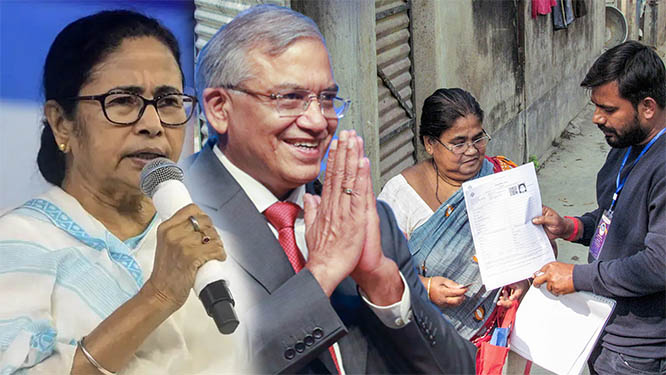
The deletion of over 58 lakh names from West Bengal’s draft electoral rolls following a Special Intensive Revision (SIR) has sparked widespread concern and is likely to deepen political tensions in the poll-bound state.

According to the Election Commission, the revision exercise has identified 24 lakh voters as deceased, 19 lakh as relocated, 12 lakh as missing, and 1.3 lakh as duplicate entries. The draft list, published after the completion of the first phase of SIR, aims to remove errors and duplication from the electoral rolls.

However, the scale of deletions has raised fears that a large number of eligible voters may have been wrongly excluded. The Election Commission has said that individuals whose names are missing can file objections and seek corrections. The final voter list is scheduled to be published in February next year, after which the Assembly election announcement is expected. Notably, the last Special Intensive Revision in Bengal was conducted in 2002.

The development has intensified the political row over the SIR process. Chief Minister Mamata Banerjee and her Trinamool Congress have strongly opposed the exercise, accusing the Centre and the Election Commission of attempting to disenfranchise lakhs of voters ahead of the elections.

Addressing a rally in Krishnanagar earlier this month, Banerjee urged people to protest if their names were removed from the voter list, alleging intimidation during elections and warning of serious consequences if voting rights were taken away.

The BJP, meanwhile, has defended the revision and accused the Trinamool Congress of politicising the issue to protect what it claims is an illegal voter base. Leader of the Opposition Suvendu Adhikari alleged that the ruling party fears losing power due to the removal of deceased, fake, and illegal voters.

The controversy comes amid earlier allegations by the Trinamool Congress that excessive work pressure during the SIR led to the deaths by suicide of some Booth Level Officers (BLOs), for which the party blamed the Election Commission. With the draft list now out, another round of political confrontation appears imminent.

As objections begin to be filed, the focus will be on whether the correction mechanism is accessible, transparent, and timely—critical factors in ensuring that no eligible voter is denied their democratic right ahead of a crucial election.

Comments

Add new comment

  • Coastaldigest.com reserves the right to delete or block any comments.
  • Coastaldigset.com is not responsible for its readers’ comments.
  • Comments that are abusive, incendiary or irrelevant are strictly prohibited.
  • Please use a genuine email ID and provide your name to avoid reject.
News Network
December 15,2025

Mangaluru, Dec 15: Educational institutions in Mangaluru that rely on the popular Mangala Stadium for their annual sports events are bracing for an inconvenience as the city's key sporting venue is set to close its gates for a significant upgrade. The stadium is expected to be unavailable for approximately two months starting from January 15, 2026.

The closure is necessitated by a proposed overhaul of the stadium's facilities, with a special focus on upgrading the synthetic track. Pradeep Dsouza, Assistant Director of the District of Youth Empowerment and Sports (DYES), Dakshina Kannada, confirmed the development.

"Experts have visited the stadium, conducted a thorough inspection, and have given the go-ahead for a complete makeover," Dsouza stated. "Funds have been allocated for the project, and we are currently awaiting the final green signal from state officials to commence the work. We anticipate that the work will likely begin in the second week of January. Consequently, we have stopped renting out the stadium to colleges and other organizations in preparation for the upgrade."

The timing presents a logistical challenge for colleges, as many schools have already concluded their sports meets.

"Colleges will now be organizing their events and will need to find alternative locations to host their sports meets," Dsouza added. He suggested a few potential venues, including the Dakshina Kannada police ground, University College grounds, Panambur grounds, Swaraj Maidan in Moodbidri, and the Mangalore University sports grounds in Konaje.

However, many institutions note that finding a comparable venue will be difficult. While the DK police ground and University College grounds are closer to the city center, they do not possess the extensive facilities and infrastructure offered by Mangala Stadium.

Dr. P Dayananda Pai - P Satisha Govt First Grade College, Carstreet, is one such institution dependent on the stadium. Principal Jayakar Bhandary expressed hope for a swift completion of the work. "We expect the work to be completed at the earliest. If not, we will be forced to look for other venues to host the sports day for our students," Bhandary said, highlighting the pressing need for the city's main sporting facility.

Comments

Add new comment

  • Coastaldigest.com reserves the right to delete or block any comments.
  • Coastaldigset.com is not responsible for its readers’ comments.
  • Comments that are abusive, incendiary or irrelevant are strictly prohibited.
  • Please use a genuine email ID and provide your name to avoid reject.
News Network
December 21,2025

hadith.jpg

Invoking the teachings of Prophet Muhammad—“pay the worker before his sweat dries”—the Madras High Court has directed a municipal corporation to settle long-pending legal dues owed to a former counsel. The court observed that this principle reflects basic fairness and applies equally to labour and service-related disputes.

Justice G. R. Swaminathan made the observation while hearing a petition filed by advocate P. Thirumalai, who claimed that the Madurai City Municipal Corporation failed to pay him legal fees amounting to ₹13.05 lakh. Earlier, the High Court had asked the corporation to consider his representation. However, a later order rejected a major portion of his claim, prompting the present petition.

The court allowed Thirumalai to approach the District Legal Services Authority (DLSA) and submit a list of cases in which he had appeared. It also directed the corporation to settle the verified fee bills within two months, without interest. The court noted that the petitioner had waited nearly 18 years before challenging the non-payment and that the corporation could not be fully blamed, as the fee bills were not submitted properly.

‘A Matter of Embarrassment’

Justice Swaminathan described it as a “matter of embarrassment” that the State has nearly a dozen Additional Advocate Generals. He observed that appointing too many law officers often leads to unnecessary allocation of work and frequent adjournments, as government counsel claim that senior officers are engaged elsewhere.

He expressed hope that such practices would end at least in the Madurai Bench of the High Court and added that Additional Advocate Generals should “turn a new leaf” from 2026 onwards.

‘Scandalously High Amounts’

While stating that the court cannot examine the exact fees paid to senior counsel or law officers, Justice Swaminathan stressed that good governance requires public funds to be used prudently. He expressed concern over the “scandalously high amounts” paid by government and quasi-government bodies to a few favoured law officers.

In contrast, the court noted that Thirumalai’s total claim was “a pittance” considering the large number of cases he had handled.

Background

Thirumalai served as the standing counsel for the Madurai City Municipal Corporation for more than 14 years, from 1992 to 2006. During this period, he represented the corporation in about 818 cases before the Madurai District Courts.

As the former counsel was unable to hire a clerk to obtain certified copies of judgments in all 818 cases, the court directed the District Legal Services Authority to collect the certified copies within two months. The court further ordered the corporation to bear the cost incurred by the DLSA and deduct that amount from the final settlement payable to the petitioner.

Comments

Add new comment

  • Coastaldigest.com reserves the right to delete or block any comments.
  • Coastaldigset.com is not responsible for its readers’ comments.
  • Comments that are abusive, incendiary or irrelevant are strictly prohibited.
  • Please use a genuine email ID and provide your name to avoid reject.