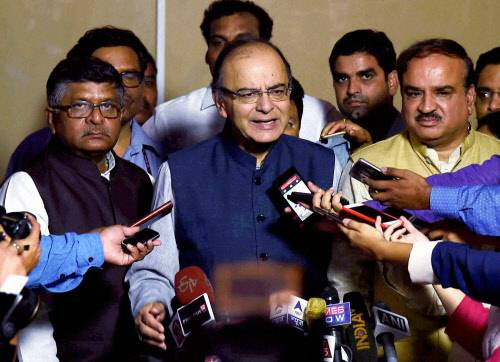
GST Bill passed in Rajya Sabha; decks cleared for India's biggest tax reform

August 4, 2016

GST
New Delhi, Aug 4: In the biggest tax reform since Independence, the national sales tax or GST Bill was Wednesday approved by the Rajya Sabha to replace a raft of different state and local taxes with a single unified value added tax system to turn the country into world's biggest single market.

The 66-year-old Constitution, which gives power to Centre to levy taxes like excise, and empowers states to collect retail sales taxes, was amended though the 122nd Constitution Amendment Bill.

Prime Minister Narendra Modi said the GST will "also be the best example of cooperative federalism" and "Together we will take India to new heights of progress".

The legislation was approved by the Upper House with 203 votes in favour and none against, after a seven-hour debate during which a rare bonhomie was witnessed among the ruling and the opposition parties.

Replying to the debate, Finance Minister Arun Jaitley said the GST rate will be kept "as low as possible" but did not commit to a specific rate despite opposition benches pressing for it.

"We will also try and keep the rate as low as possible, certainly much lower than what the present situation is. And as compliance increases, the possibility of that rate coming down further would be there," he said.

The tax rate, he said, would be decided by the GST Council comprising of Union Finance Minister and representatives of all 29 states.

"We must trust the sense of responsibility of the states who belong to the same political parties as us. Who in their last meeting said that our guiding principle is going to be -- one we will lower the burden of tax," he said.

The Finance Minister said presently 80 percent of goods attract 12.5 percent of Central excise duty while at the state level 55 percent of items are charged with 14.5 percent VAT or sales tax.

The weighted average of the two in 65 percent of the items comes to 27 percent. Adding cess, octroi and entry tax takes the figure to 30 percent, he said.

In deciding the GST rate, "we are guided by two factors -- 27 percent is too high, it is inflationary, it costs the people, so it should come down... The second they said we will collect what is essential for our present revenue requirement," he said.

Jaitley said members will have an opportunity to speak on subjects when the supporting GST Bill comes up in November.

The GST, he said, will make the system more efficient, increase tax compliance and tax avoidance will become more difficult as it will be detected at some stage or the other.

Also, there will be no cascading effect of tax on tax, he said adding there are certain items which will either attract lower rate of tax or no tax at all.

Ruling out GST impacting inflation, Jaitley said 54 percent of goods in the basket used to calculate consumer price inflation are tax exempt and another 32 percent attract low rate of tax. Only 15 percent are taxed at standard rate.

The Goods and Service Tax (GST), which was first proposed a decade back, is seen as potentially transformative for India's economy, adding as much as 2 percentage points to the GDP while also improving the ease of doing business and encourage investment in manufacturing.

It is also expected to result in greater tax compliance, boosting government revenues.

The GST will replace more than a dozen levies central and state levies, including central excise duty, service tax and central sales tax as well as VAT on sale of goods and entry tax, to make movement of goods seamless across 1.3 billion market. Instead of the good being taxed multiple times at different rates, under the new GST regime goods would be taxed at point of consumption.

The Bill passed today will create a GST Council comprising Union Finance Minister and his counterparts from the states. This body will determine the final rate.

The Constitution (122nd Amendment) Bill, 2014, that would lay the ground for roll out of Goods and Services Tax (GST) regime, was passed by the opposition-dominated Upper House after the government moved four amendments.

These included one on scrapping of the proposed tax of up to 1 percent on inter-state transactions to compensate manufacturing states and another one promising to compensate states for any revenue loss in first five years of GST implementation.

The other amendments pertained to a new formulation on a dispute-resolution mechanism and an endorsement of the resolution by the empowered committee of state finance ministers on a revenue-neutral rate to bring down the incidence of tax on the common man while protecting revenues of states.

During the debate former finance minister and Congress leader P Chidambaram reiterated party's demand to keep GST rate below 18 percent and asked government to specify its stand on the issue while including the rate in the subsequent GST bill. He also asked the Government not to convert the subsequent GST laws into money bills to bypass Rajya Sabha.

Money bills do not require approval of the Upper House and their mere passage in the Lok Sabha, where the ruling NDA has absolute majority, is enough for converting it into a law.

His twin demands found favour with other opposition leaders including Sitaram Yechury (CPIM), Naresh Agarwal (SP). AIADMK was the only party which opposed the GST in totality.

The Constitution Amendment Bill had been approved by the Lok Sabha in May last year but the amendments made to it by the Rajya Sabha would mean the legislation would again travel to the Lower House before going to states assemblies.

At least half of the 29 state legislatures need to approve the bill, after which Parliament will have to pass two legislations-- CGST and IGST-- detailing the new tax code, including the GST rate and other modalities.

This could happen in the winter session of Parliament in November.

Similar tax laws will also have to be passed by the states. Also, the government will need a new IT system, on which work has already begun, for rollout of the new regime.

Despite widespread consensus on its desirability, the GST was stalled for years, first by the BJP and then by Congress.

Congress originally mooted GST in 2006 and a constitution amendment bill was introduced in Lok Sabha in March 2011 but was blocked by BJP. The Bill lapsed with the dissolution of the 15th Lok Sabha. And when BJP took power, Congress returned the favour.

The amendment was passed by Lok Sabha in May last year but got stuck in Rajya Sabha as the Congress made several demands, including a cap on GST rate in the statute, abolition of 1 per cent inter-state tax to favour manufacturing states and a legislated dispute-resolution mechanism.

The Bill had been pending Rajya Sabha, where the ruling NDA does not have a majority, since August last year because of opposition from Congress.

Worldover, about 160 countries - the US being the big exception - have some form of GST or value-added tax.

Under GST, the tax gets paid on any purchase of goods or services. But if the purchase feeds into a larger supply chain?raw materials, for example, or parts, then the tax can be refunded. This results in only the end consumer being taxed on a product's full value.

The money collected would go to the state where a product is consumed, not where it is produced. The revenue lost by big manufacturing states will be reimbursed by the Centre.

Unlike some nations, GST in India would be jointly administered by the Union and state governments.

Comments

Add new comment

  • Coastaldigest.com reserves the right to delete or block any comments.
  • Coastaldigset.com is not responsible for its readers’ comments.
  • Comments that are abusive, incendiary or irrelevant are strictly prohibited.
  • Please use a genuine email ID and provide your name to avoid reject.
News Network
December 6,2025

indigoticket.jpg

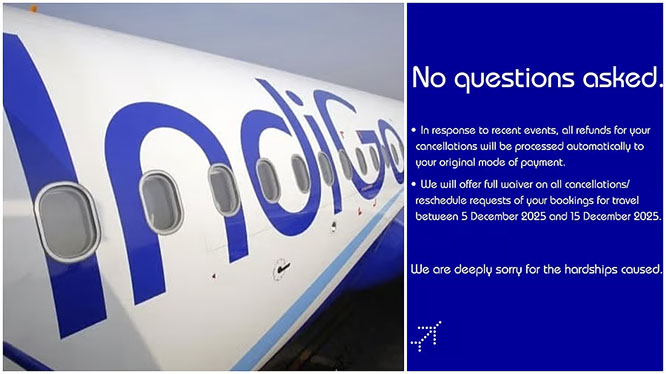
With IndiGo flight disruptions impacting thousands of passengers, the airline on Saturday said that it will offer full waiver on all cancellations/reschedule requests for travel bookings between December 5, 2025 and December 15, 2025.

Earlier in the day, the civil aviation ministry had directed the airline to complete the ticket refund process for the cancelled flights by Sunday evening, as well as ensure baggage separated from the travellers are delivered in the next two days.

In a post on X, titled 'No questions asked', IndiGo wrote, "In response to recent events, all refunds for your cancellations will be processed automatically to your original mode of payment."

"We are deeply sorry for the hardships caused," it further added.

Several passengers, however, complained of not getting full refund as promised by the airline.

Netizens have shared screenchots of getting charged for airline cancellation fee and convenience fee.

"Please tell me why u have did this airline cancellation charges when u say full amount will be refunded (sic)," a user wrote sharing a screenshot of the refund page.

"Well, but you have still debited the convenience charges," wrote another.

Passengers have also raised concerns about the "cancel" option being disabled on the IndiGo app. "First enable the 'Cancel' button on your App & offer full refund on tickets cancelled by customers between the said dates," wrote a user.

A day after the country's largest airline, IndiGo, cancelled more than 1,000 flights and caused disruptions for the fifth day on Saturday, the ministry said that any delay or non-compliance in refund processing will invite immediate regulatory action.

The refund process for all cancelled or disrupted flights must be completed by 8 pm on Sunday, the ministry said in a statement.

"Airlines have also been instructed not to levy any rescheduling charges for passengers whose travel plans were affected by cancellations," it said.

On Saturday, more than 400 flights were cancelled at various airports.

IndiGo has also been instructed to set up dedicated passenger support and refund facilitation cells.

Comments

Add new comment

  • Coastaldigest.com reserves the right to delete or block any comments.
  • Coastaldigset.com is not responsible for its readers’ comments.
  • Comments that are abusive, incendiary or irrelevant are strictly prohibited.
  • Please use a genuine email ID and provide your name to avoid reject.
News Network
December 13,2025

New Delhi: School-going children are picking up drug and smoking habits and engaging in consumption of alcohol, with the average age of introduction to such harmful substances found to be around 13 years, suggesting a need for earlier interventions as early as primary school, a multi-city survey by AIIMS-Delhi said.

The findings also showed substance use increased in higher grades, with grade XI/XII students two times more likely to report use of substances when compared with grade VIII students. This emphasised the importance of continued prevention and intervention through middle and high school.

The study led by Dr Anju Dhawan of AIIMS's National Drug Dependence Treatment Centre, published in the National Medical Journal of India this month, looks at adolescent substance use across diverse regions.

The survey included 5,920 students from classes 8, 9, 11 and 12 in urban government, private and rural schools across 10 cities -- Bengaluru, Chandigarh, Delhi, Dibrugarh, Hyderabad, Imphal, Jammu, Lucknow, Mumbai, and Ranchi. The data were collected between May 2018 and June 2019.

The average age of initiation for any substance was 12.9 (2.8) years. It was lowest for inhalants (11.3 years) followed by heroin (12.3 years) and opioid pharmaceuticals (without prescription; 12.5 years).

Overall, 15.1 per cent of participants reported lifetime use, 10.3 per cent reported past year use, and 7.2 per cent reported use in the past month of any substance, the study found.

The most common substances used in the past year, after tobacco (4 per cent) and alcohol (3.8 per cent), were opioids (2.8 per cent), followed by cannabis (2 per cent) and inhalants (1.9 per cent). Use of non-prescribed pharmaceutical opioids was most common among opioid users (90.2 per cent).

On being asked, 'Do you think this substance is easily available for a person of your age' separately for each substance category, nearly half the students (46.3 per cent) endorsed that tobacco products and more than one-third of the students (36.5 per cent) agreed that a person of their age can easily procure alcohol products.

Similarly, for Bhang (21.9 per cent), ganja/charas (16.1 per cent), inhalants (15.2 per cent), sedatives (13.7 per cent), opium and heroin (10 per cent each), the students endorsed that these can be easily procured.

About 95 per cent of the children, irrespective of their grade, agreed with the statement that 'drug use is harmful'.

The rates of substance use (any) among boys were significantly higher than those of girls for substance use (ever), use in the past year and use in the past 30 days. Compared to grade VIII students, grade IX students were more likely, and grade XI/XII students were twice as likely to have used any substance (ever).

The likelihood of past-year use of any substance was also higher for grade IX students and for grade XI/XII students as compared to grade VIII students.

About 40 per cent of students mentioned that they had a family member who used tobacco or alcohol each. The use of cannabis (any product) and opioid (any product) by a family member was reported by 8.2 per cent and 3.9 per cent of students, respectively, while the use of other substances, such as inhalants/sedatives by family was 2-3 per cent, the study found.

A relatively smaller percentage of students reported use of tobacco or alcohol among peers as compared to among family members, while a higher percentage reported inhalants, sedatives, cannabis or opioid use among peers.

Children using substances (past year) compared to non-users reported significantly higher any substance use by their family members and peers.

There were 25.7 per cent students who replied 'yes' to the question 'conflicts/fights often occur in your family'. Most students also replied affirmatively to 'family members are aware of how their time is being spent' and 'damily members are aware of with whom they spend their time'.

Comments

Add new comment

  • Coastaldigest.com reserves the right to delete or block any comments.
  • Coastaldigset.com is not responsible for its readers’ comments.
  • Comments that are abusive, incendiary or irrelevant are strictly prohibited.
  • Please use a genuine email ID and provide your name to avoid reject.
News Network
December 21,2025

hadith.jpg

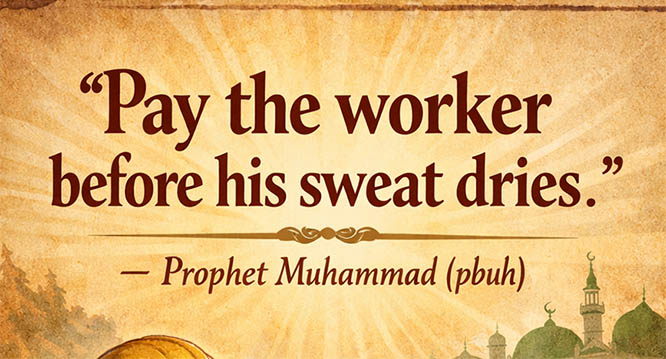
Invoking the teachings of Prophet Muhammad—“pay the worker before his sweat dries”—the Madras High Court has directed a municipal corporation to settle long-pending legal dues owed to a former counsel. The court observed that this principle reflects basic fairness and applies equally to labour and service-related disputes.

Justice G. R. Swaminathan made the observation while hearing a petition filed by advocate P. Thirumalai, who claimed that the Madurai City Municipal Corporation failed to pay him legal fees amounting to ₹13.05 lakh. Earlier, the High Court had asked the corporation to consider his representation. However, a later order rejected a major portion of his claim, prompting the present petition.

The court allowed Thirumalai to approach the District Legal Services Authority (DLSA) and submit a list of cases in which he had appeared. It also directed the corporation to settle the verified fee bills within two months, without interest. The court noted that the petitioner had waited nearly 18 years before challenging the non-payment and that the corporation could not be fully blamed, as the fee bills were not submitted properly.

‘A Matter of Embarrassment’

Justice Swaminathan described it as a “matter of embarrassment” that the State has nearly a dozen Additional Advocate Generals. He observed that appointing too many law officers often leads to unnecessary allocation of work and frequent adjournments, as government counsel claim that senior officers are engaged elsewhere.

He expressed hope that such practices would end at least in the Madurai Bench of the High Court and added that Additional Advocate Generals should “turn a new leaf” from 2026 onwards.

‘Scandalously High Amounts’

While stating that the court cannot examine the exact fees paid to senior counsel or law officers, Justice Swaminathan stressed that good governance requires public funds to be used prudently. He expressed concern over the “scandalously high amounts” paid by government and quasi-government bodies to a few favoured law officers.

In contrast, the court noted that Thirumalai’s total claim was “a pittance” considering the large number of cases he had handled.

Background

Thirumalai served as the standing counsel for the Madurai City Municipal Corporation for more than 14 years, from 1992 to 2006. During this period, he represented the corporation in about 818 cases before the Madurai District Courts.

As the former counsel was unable to hire a clerk to obtain certified copies of judgments in all 818 cases, the court directed the District Legal Services Authority to collect the certified copies within two months. The court further ordered the corporation to bear the cost incurred by the DLSA and deduct that amount from the final settlement payable to the petitioner.

Comments

Add new comment

  • Coastaldigest.com reserves the right to delete or block any comments.
  • Coastaldigset.com is not responsible for its readers’ comments.
  • Comments that are abusive, incendiary or irrelevant are strictly prohibited.
  • Please use a genuine email ID and provide your name to avoid reject.