



'He draws sketches of 93 women he murdered': US killer's lifetime backed by memory

Agencies
October 9, 2019

Washington, Oct 9: Samuel Little's depravity is matched only by his prodigious memory.

Little, a California inmate considered by the FBI to be the most prolific serial killer in US history, has confessed to 93 slayings committed across the country between 1970 and 2005, recounting the crimes with astonishing, near-photographic detail. He even drew colour portraits of dozens of the women he strangled.

His case, featured on "60 Minutes" on Sunday, has offered a frightening look inside the mind of a killer and the wrongheaded assumptions on the part of law enforcement that enabled him to escape justice for so long.

Little, who is 79 and has been behind bars since 2012 for several killings, preyed on prostitutes, drug addicts and other women on the margins, many of them black like Little himself, and many of the deaths were originally deemed overdoses or attributed to accidental or undetermined causes. Some bodies were never found.

In a case out of Tennessee, for example, Martha Cunningham's body was found bruised and nude from the waist down in the woods in 1975, her pantyhose and girdle bunched around her knees. Detectives initially attributed her death to natural causes; the cause was later classified "unknown."

But in 48 straight days of interviews with Texas Ranger James Holland, who kept the killer supplied with pizza and Dr Pepper, Little offered a wealth of details that were used to corroborate his accounts one by one.

One woman wore dentures, for example. Another was killed near a set of arches in Miami. There was a 5-foot-6 woman with brown skin in Florida in the mid-1980s. In 1984 in Kentucky, there was a 25-year-old woman outside a strip club with short blond hair, blue eyes and a "hippie" look.

And in a case from Florida in the 1970s, Little remembered the flowered sundress and necklace the victim wore, and how he played with it before he choked her to death. Fort Myers, Florida, homicide detective Mali Langton, who was among a number of investigators from other jurisdictions who talked to Little in prison as well, said she was astonished by his memory.

"I couldn't tell you who I bought a burger from yesterday," she said.

Noticing that Little liked to draw, Holland gave him art supplies behind bars. Little went on to produce more than 30 portraits of his victims that proved remarkably helpful.

Serial killers are often world-class liars and manipulators who crave notoriety and exaggerate or confess to crimes they didn't commit, according to criminal justice experts. But Little stands apart.

Law enforcement authorities in several states have verified 50 of his confessions so far and are scrambling to link dozens more cold cases to his recollections.

"I would be suspicious of believing him, except it was actually corroborated," said Marina Sorochinski, a professor of criminal justice at Mercy College in New York. As Holland said on "60 Minutes": "Nothing he's ever said has been proven to be wrong or false. We've been able to prove up almost everything he said."

All told, Little is believed responsible for more killings than Ted Bundy, John Wayne Gacy and Jeffrey Dahmer combined.

Little's modus operandi made it hard to link him to victims. The former boxer often delivered a knockout punch to women, authorities said, then strangled them while masturbating. He would dump their bodies and soon after leave town.

He claimed to have killed in 19 states. The biggest concentrations of killings were in Florida and California, he said, with about 20 in Los Angeles alone.

He was repeatedly arrested for various offenses over the decades, including murder and assault, and served time for some things, but escaped prosecution for his most serious crimes. He was finally caught when a Kentucky arrest in 2012 on drug charges led authorities to link his DNA to three slayings in California.

"It makes sense that he could have gotten away with so many" for so long, Sorochinski said.

Crimes scattered across several states can lead to communication gaps between jurisdictions and a failure to recognize that a single murder is the work of a serial killer. Also, because the women were mostly living on the dangerous edges of society, relatives may not have realized they were gone and reported them missing to police, Sorochinski said.

Langton said that Little flirted, laughed and was "giddy" as he recounted a particular slaying.

In a 2018 prison interview with New York magazine's website The Cut, he was asked how it felt to kill the women. He replied: "Oooeee, it felt like heaven. Felt like being in bed with Marilyn Mon-roe!"

Comments

Add new comment

  • Coastaldigest.com reserves the right to delete or block any comments.
  • Coastaldigset.com is not responsible for its readers’ comments.
  • Comments that are abusive, incendiary or irrelevant are strictly prohibited.
  • Please use a genuine email ID and provide your name to avoid reject.
News Network
January 19,2026

trump.jpg

Donald Trump has linked his repeated threats to seize Greenland to his failure to win the Nobel Peace Prize, in a letter to Norwegian Prime Minister Jonas Gahr Støre.

The authenticity of the letter, in which Trump says he no longer feels obligated to “think purely of peace,” was confirmed by Støre to the Norwegian newspaper VG.

“Considering your country decided not to give me the Nobel Peace Prize for having stopped eight wars plus, I no longer feel an obligation to think purely of peace,” Trump wrote, adding he can now “think about what is good and proper for the United States.”

Støre said Trump’s letter was in response to a short message he had sent earlier, on behalf of himself and Finland’s President Alexander Stubb.

Trump has escalated rhetoric toward Greenland, a self-governing Danish territory, insisting the US will take control “one way or the other.” Over the weekend, he tweeted: “Now it is time, and it will be done!!!”

On Saturday, Trump threatened a 10% tariff on imports from Denmark, Norway, Sweden, France, Germany, the UK, the Netherlands, and Finland from 1 February until the US is allowed to purchase the island. EU diplomats met for emergency talks on possible retaliatory tariffs and sanctions.

In his letter, Trump argued Denmark “cannot protect” Greenland from Russia or China, questioning Danish ownership: “There are no written documents; it’s only that a boat landed there hundreds of years ago.” He added that NATO should support the US, claiming the world is “not secure unless we have complete and total control of Greenland.”

Trump’s stance has unsettled the EU and NATO, as he refused to rule out military action to take control of the mineral-rich island.

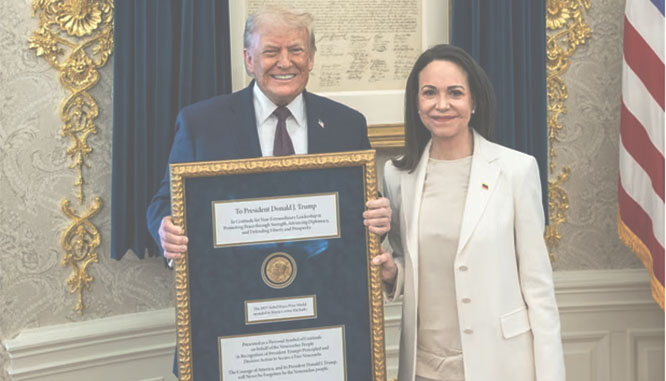
The Nobel Peace Prize is awarded by the independent Norwegian Nobel Committee, not the government. Trump had campaigned for last year’s prize, which went to Venezuelan opposition leader María Corina Machado, who dedicated her award to him.

Støre reiterated that the Nobel Prize decision rests solely with the committee.

Comments

Add new comment

  • Coastaldigest.com reserves the right to delete or block any comments.
  • Coastaldigset.com is not responsible for its readers’ comments.
  • Comments that are abusive, incendiary or irrelevant are strictly prohibited.
  • Please use a genuine email ID and provide your name to avoid reject.
News Network
February 1,2026

Bengaluru, Feb 1: For travelers landing at Kempegowda International Airport (KIA), the sleek, wood-paneled curves of Terminal 2 promise a world-class welcome. But the famed “Garden City” charm quickly withers at the curb. As India’s aviation sector swells to record numbers—handling over 43 million passengers in Bengaluru alone this past year—the “last mile” has turned into a marathon of frustration.

The Bengaluru Logjam: Rules vs Reality

While the city awaits the 2027 completion of the Namma Metro Blue Line, the interim has been chaotic. Recent “decongestion” rules at Terminal 1 have pushed app-based cab pickups to distant parking zones, forcing weary passengers into a 20-minute walk with luggage.

“I landed after ten months away and felt like a stranger in my own city,” says Ruchitha Jain, a Koramangala resident. “My driver couldn’t find me, staff couldn’t guide me, and the so-called ‘Premium’ lane is just a fancy tax on convenience.”

•    The Cost of Distance: A 40-km cab ride can now easily cross ₹1,500, driven by demand pricing and airport surcharges.

•    The Bus Gap: While Vayu Vajra remains a lifeline, its ₹300–₹400 fare is often cited as the most expensive airport bus service in the country.

A National Pattern of Disconnect

The struggle is not unique to Karnataka. From Chennai’s coast to Hyderabad’s plateau, India’s airports tell a familiar story: brilliant runways, broken exits.

City:    Primary Issue   |    Recent Development

Bengaluru:    Cab pickup restrictions & distance  |    App-based taxis shifted to far parking zones; long walks and fare spikes reported

Chennai:    Multi-Level Parking (MLCP) hike  |    Passengers report 40-minute walks to reach cab pickup points

Hyderabad:    “Taxi mafia” & touting  |    Over 440 touting cases reported; security presence intensified

Mumbai:    Fare scams  |     Tourists charged ₹18,000 for just 400 metres, triggering police action

In Hyderabad, travelers continue to battle entrenched local groups that intimidate Uber and Ola drivers, pushing passengers toward overpriced private taxis. Chennai flyers, meanwhile, complain that reaching the designated pickup zones now takes longer than short-haul flights from cities like Coimbatore.

The ‘Budget Day’ Hope

As Finance Minister Nirmala Sitharaman presents the Union Budget 2026 today, the aviation sector is watching closely. With the government’s renewed emphasis on multimodal integration, there is cautious hope for funding toward seamless airport-metro-bus hubs.

The vision is clear: a future where planes, trains, and metros speak the same language. Until then, passengers at KIA—and airports across India—will continue to discover that the hardest part of flying isn’t the thousands of kilometres in the air, but the last few on the ground.

Comments

Add new comment

  • Coastaldigest.com reserves the right to delete or block any comments.
  • Coastaldigset.com is not responsible for its readers’ comments.
  • Comments that are abusive, incendiary or irrelevant are strictly prohibited.
  • Please use a genuine email ID and provide your name to avoid reject.
News Network
January 23,2026

Mangaluru: The Karnataka Government Polytechnic (KPT), Mangaluru, has achieved autonomous status from the All India Council for Technical Education (AICTE), becoming the first government polytechnic in the country to receive such recognition in its 78-year history. The status was granted by AICTE, New Delhi, and subsequently approved by the Karnataka Board of Technical Education in October last year.

Officials said the autonomy was conferred a few months ago. Until recently, AICTE extended autonomous status only to engineering colleges, excluding diploma institutions. However, with a renewed national focus on skill development, several government polytechnics across India have now been granted autonomy.

KPT, the second-largest polytechnic in Karnataka, was established in 1946 with four branches and has since expanded to offer eight diploma programmes, including computer science and polymer technology. The institution is spread across a 19-acre campus.

Ravindra M Keni, the first dean of the institution, told The Times of India that AICTE had proposed autonomous status for polytechnic institutions that are over 25 years old. “Many colleges applied. In the first round, 100 institutions were shortlisted, which was further narrowed down to 15 in the second round. We have already completed one semester after becoming an autonomous institution,” he said. He added that nearly 500 students are admitted annually across eight three-year diploma courses.

Explaining the factors that helped KPT secure autonomy, Keni said the institution has consistently recorded 100 per cent admissions and placements for its graduates. He also noted its strong performance in sports, with the college emerging champions for 12 consecutive years, along with active student participation in NCC and NSS activities.

Autonomous status allows KPT to design industry-oriented curricula, conduct examinations, prepare question papers, and manage academic documentation independently. The institution can also directly collaborate with industries and receive priority funding from AICTE or the Ministry of Education. While academic autonomy has been granted, financial control will continue to rest with the state government.

“There will be separate committees for examinations, question paper setting, boards of studies, and boards of examiners. The institution will now have the freedom to conduct admissions without government notifications and issue its own marks cards,” Keni said, adding that new academic initiatives would be planned after a year of functioning under the autonomous framework.

Comments

Add new comment

  • Coastaldigest.com reserves the right to delete or block any comments.
  • Coastaldigset.com is not responsible for its readers’ comments.
  • Comments that are abusive, incendiary or irrelevant are strictly prohibited.
  • Please use a genuine email ID and provide your name to avoid reject.