



Nainital, Mar 29: The Uttarakhand High Court today ordered a floor test in the Assembly on March 31, giving a new turn to the political events in the state where President's Rule was imposed on Sunday.
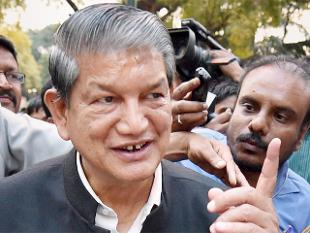
They will be taken into account subject to final outcome of the writ filed petition by Chief Minister Harish Rawat challenging the imposition of President's Rule, senior Supreme Court lawyer and Congress leader Abhishek Manu Singhvi told reporters after the second day of the hearing here.
The High Court ordered the DGP to ensure security in the Assembly when the floor test is carried out.
Rawat, whose government was sacked on Sunday on the grounds of "breakdown of Constitutional machinery", had moved the court yesterday, calling the Centre's decision as "arbitrary" and demanded its quashing.
Singhvi said the court accepted Congress position that despite the President's Rule, there is enough scope for judicial review to allow a floor test, which was sought by it.
He said Governor K K Paul too had directed holding of the floor test on March 28 and Rawat had also made the same demand twice.
"Now only the date has changed from March 28 to March 31," Singhvi said. He said mere allegations of horse-trading cannot justify the imposition of President's Rule and stop a floor test.
The Centre had imposed the President's Rule just a day ahead of the date (March 28) fixed for the floor test.
On the question of disqualification of 9 rebel Congress MLAs, Singhvi said the court did not set it aside and a final decision on it will come later. He said both the sides would consider their future legal recourse.
Singhvi said for purpose of counting, the votes of the disqualified MLAs will be kept separate and will be subjected to final outcome of the case. "The votes will not be taken as valid votes till then," the Congress lawyer said.
The political crisis in the state arose after nine Congress MLAs voted with the BJP against the Appropriation Bill on March 18 which the Speaker declared as passed, ignoring demands for Division.
Following this, Speaker Govind Singh Kunjwal issued notices to the nine rebel Congress MLAs under the anti-defection law as to why they should not be disqualified.
Even as there were reports that the rebels were disqualified, on Saturday night the Union Cabinet met and considered the Governor's report which had spoken about a breakdown in governance and expressed apprehensions of a possible pandemonium in the House during the floor test on March 28.
The Union Cabinet recommended to President Pranab Mukherjee bringing the state under President's Rule by invoking Article 356 of the Constitution, which he signed on Sunday.
After the state was brought under the central rule, the Speaker disqualified the nine rebel Congress MLAs.
Union Finance Minister Arun Jaitley, who had met the President on Sunday night and briefed him on the Cabinet decision, later justified the imposition of President's Rule, saying the Congress "plunged the State into a serious constitutional crisis by continuing a Government which should have quit after the failure of the Appropriation Bill".
To further complicate the crisis, "the Chief Minister started allurement, horse-trading and disqualification with a view to altering the composition of the House", he had said.
"After the Assembly has been put under suspended animation and the decision has been made public, the Speaker has decided to disqualify some Members. The constitutional breakdown has been compounded further by this action," he had said.


Comments
Add new comment