Hindu Samajotsav hits normal life in tension-stricken Mangaluru

[email protected] (CD Network | Photos by Suresh)
March 1, 2015

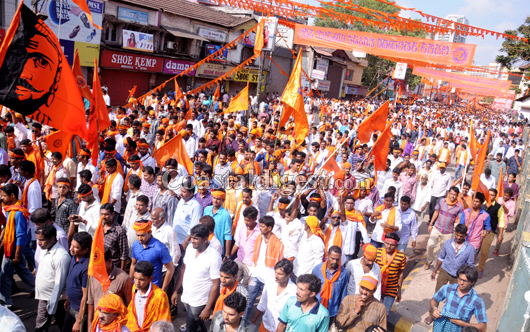
Mangaluru, Mar 1: Sunday heralded a saffron-coloured vigour on the streets of Mangaluru as intense preparations overnight had laid a cover of saffron buntings and banners across major junctions and streets leading to the venue of the Hindu Samajotsav.
Shobhayatre 2

Most of the shops remained closed owing to the weekly holiday, and the streets wore a deserted look as most people stayed inside their houses during the day owing to the traffic diversions and numerous road blocks put in place as part of security arrangements for the massive event organised by Vishwa Hindu Parishad as part of its golden jubilee celebrations.

As the day wore on, an atmosphere of slight trepidation prevailed in the city owing to high visibility of security forces appointed at every entrance and corner of Mangaluru even as hordes of saffron-clad people began arriving in the city shouting slogans alerting citizens of the exclusive religious event scheduled for the day.

Heeding instructions to close down for the day, hotels, restaurants and small eateries also began closing down after noon fearing the possibility of provocative incidents or disorder following the Samajotsav

Apart from people from the Hindu community that began arriving in droves during the latter half of the day to participate in the Samajotsav, the streets remained mostly empty since not many citizens were willing to venture out in apprehension of being stranded due to lack of public transport or being caught in the middle of a communal outlash.

The main roads in the heart of the city leading to Hampankatta circle remained closed to commuters and public transport as a grand procession was flagged off from the Ambedkar Circle (Jyothi) towards the venue of the Samajotsav. This caused sudden inconvenience to several people travelling by buses and auto rickshaws who were caught unaware of the traffic diversions. Most had to make their way towards Hampankatta and nearby areas by walking in the afternoon heat, while finding most shops closed at times of necessity.

Those who did venture out found themselves stranded at bus stops waiting for buses unaware that a majority of buses had been held back for the sake of transporting people attending the Samajothsav.

As the day progressed, few people slowly began milling out on the roads as the apprehension of possible disruption of peace grew lesser. With roads being opened up as the Samajothsav concluded and public transport plying normally after 6 p.m., people were seen on the streets again returning to their respective homes after attending the Samajothsav.

Nevertheless, several were inconvenienced by the fact that none of the shops or eateries remained open and they were unable to sate their thirst or hunger pangs. After the conclusion of the event at Nehru Maidan, service and city buses were packed with people from outside the city making their way home.

Few shops that ventured to open after 6 p.m. near Srinivas Institute in Pandeshwar and at State Bank were forcibly closed shut by the police fearing any provocative or untoward incidents. All facilities barring ATM centres, such as bakeries, recharge stores, grocery stores and other establishments remained firmly shut on Sunday, affecting normal life in the city where the atmosphere was largely and outwardly calm for the most of the day.

Also Read:

Stone ‘them’ and deport to Pakistan: Balika Saraswati

Burn your ignorance, not Bhagavad Gita: Pejawar seer’s emotional speech at Hindu Samajotsav

Grand Shobha Yatra adds vigour to Hindu Samajotsav

Comments

Add new comment

  • Coastaldigest.com reserves the right to delete or block any comments.
  • Coastaldigset.com is not responsible for its readers’ comments.
  • Comments that are abusive, incendiary or irrelevant are strictly prohibited.
  • Please use a genuine email ID and provide your name to avoid reject.
coastaldigest.com news network
January 19,2026

rizwanzameer.jpg

Bengaluru: As the dust settles on the recent legislative session, the corridors of Vidhana Soudha are buzzing with more than just policy talk. A high-stakes game of political musical chairs has begun, exposing a deepening rift within the Congress party’s Muslim leadership as a major Cabinet reshuffle looms.

With the party hierarchy signaling a "50% refresh" to gear up for the 2028 Assembly elections, the race to fill three projected Muslim ministerial berths has transformed from a strategic discussion into an all-out turf war.

The "Star Son" Spark

The internal friction turned public this week following provocative remarks by Zaid Khan, actor and son of Wakf Minister Zameer Ahmed Khan. Zaid’s claim—that his father "helped" secure a ticket for Shivajinagar MLA Rizwan Arshad in 2023—has acted as a lightning rod for resentment.

Rizwan’s camp was quick to fire back, dismissing the comment as a desperate attempt by Zameer to manufacture seniority. "Rizwan’s political pedigree was forged in the NSUI and Youth Congress long before Zameer even stepped into the party," a supporter noted, highlighting Rizwan’s tenure as an AICC secretary and his two-term presidency of the State Youth Congress.

A Tale of Two Loyalists

While both Zameer Ahmed Khan and Rizwan Arshad are staunch allies of Chief Minister Siddaramaiah and represent Bengaluru strongholds, their political DNA could not be more different:

•    Zameer Ahmed Khan: A four-time MLA who crossed over from JD(S) in 2018. Known for his "overzealous" and often polarizing outreach during communal flashpoints—from the DJ Halli riots to the recent Wakf land notice controversy—his style has frequently left the Congress high command in a state of "discomfort."

•    Rizwan Arshad: A homegrown organizational man. Seen as a "quiet performer," Arshad represents the sophisticated, moderate face of the party, preferred by those who find Zameer’s brand of politics too volatile.

The Outsiders Looking In

The bickering isn't limited to a duo. The "Beary" community, represented by leaders like N A Haris and Saleem Ahmed, is demanding its pound of flesh. Saleem Ahmed, the Chief Whip in the Legislative Council, has dropped the veil of diplomacy, openly declaring his ministerial aspirations.

"I was the only working president not included in the Cabinet last time," Saleem noted pointedly, signaling that the "loyalty quota" is no longer enough to keep the peace.

As Chief Minister Siddaramaiah prepares to finalize the list, he faces a delicate balancing act: rewarding the aggressive grassroots mobilization of Zameer’s camp without alienating the organizational stalwarts and minority sub-sects who feel increasingly sidelined by the "Chamarajpet-Shivajinagar" binary.

Comments

Add new comment

  • Coastaldigest.com reserves the right to delete or block any comments.
  • Coastaldigset.com is not responsible for its readers’ comments.
  • Comments that are abusive, incendiary or irrelevant are strictly prohibited.
  • Please use a genuine email ID and provide your name to avoid reject.
News Network
January 23,2026

Mangaluru: The Karnataka Government Polytechnic (KPT), Mangaluru, has achieved autonomous status from the All India Council for Technical Education (AICTE), becoming the first government polytechnic in the country to receive such recognition in its 78-year history. The status was granted by AICTE, New Delhi, and subsequently approved by the Karnataka Board of Technical Education in October last year.

Officials said the autonomy was conferred a few months ago. Until recently, AICTE extended autonomous status only to engineering colleges, excluding diploma institutions. However, with a renewed national focus on skill development, several government polytechnics across India have now been granted autonomy.

KPT, the second-largest polytechnic in Karnataka, was established in 1946 with four branches and has since expanded to offer eight diploma programmes, including computer science and polymer technology. The institution is spread across a 19-acre campus.

Ravindra M Keni, the first dean of the institution, told The Times of India that AICTE had proposed autonomous status for polytechnic institutions that are over 25 years old. “Many colleges applied. In the first round, 100 institutions were shortlisted, which was further narrowed down to 15 in the second round. We have already completed one semester after becoming an autonomous institution,” he said. He added that nearly 500 students are admitted annually across eight three-year diploma courses.

Explaining the factors that helped KPT secure autonomy, Keni said the institution has consistently recorded 100 per cent admissions and placements for its graduates. He also noted its strong performance in sports, with the college emerging champions for 12 consecutive years, along with active student participation in NCC and NSS activities.

Autonomous status allows KPT to design industry-oriented curricula, conduct examinations, prepare question papers, and manage academic documentation independently. The institution can also directly collaborate with industries and receive priority funding from AICTE or the Ministry of Education. While academic autonomy has been granted, financial control will continue to rest with the state government.

“There will be separate committees for examinations, question paper setting, boards of studies, and boards of examiners. The institution will now have the freedom to conduct admissions without government notifications and issue its own marks cards,” Keni said, adding that new academic initiatives would be planned after a year of functioning under the autonomous framework.

Comments

Add new comment

  • Coastaldigest.com reserves the right to delete or block any comments.
  • Coastaldigset.com is not responsible for its readers’ comments.
  • Comments that are abusive, incendiary or irrelevant are strictly prohibited.
  • Please use a genuine email ID and provide your name to avoid reject.
coastaldigest.com news network
January 19,2026

badriya.jpg

Mangaluru: The Phase I project of Badria Vision 2028 was formally launched at a ceremony held at the Badria Campus on January 17, marking an important step in the institution’s long-term development roadmap.

The programme was attended by P.B. Abdul Hameed, Secretary of the MEA, and P.C. Hasir, Correspondent of the MEA, who presided over the event and underscored the institution’s commitment to growth and academic excellence.

Office-bearers of the Badria Alumni Association were present in large numbers, including A.K. Sajid (President), Shamsuddin and S.M. Farooq (Vice-Presidents), Shaheed (General Secretary), and Khaleel (Treasurer), reflecting strong alumni engagement in the initiative.

The gathering was blessed by Sayyid Shamsuddeen Basith Thangal Kukkaje, Qateeb of Zeenat Yatheem Bakshi, who led a special dua seeking divine guidance and success for the project.

The ceremony also witnessed the participation of prominent alumnus and local corporate professional Abdul Latheef, along with alumni members Naushad, Kalandar, Safwan, members of the core committee, and several other former students.

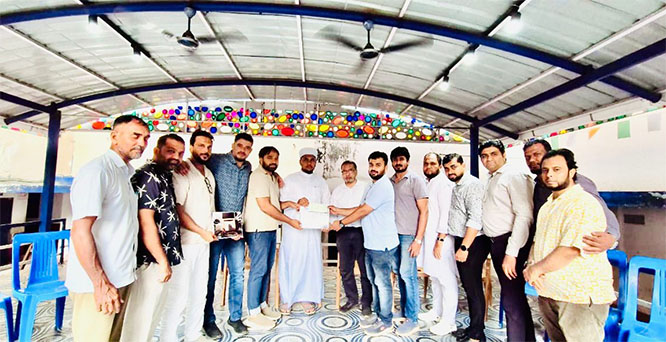
A key moment of the event was the formal handover of a cheque to Ameen Woodland Architect, signalling the immediate commencement of construction work under Phase I of the project.

Organisers said the launch of Phase I reflects a shared vision, institutional unity, and collective resolve to realise the objectives of Badria Vision 2028.

Comments

Add new comment

  • Coastaldigest.com reserves the right to delete or block any comments.
  • Coastaldigset.com is not responsible for its readers’ comments.
  • Comments that are abusive, incendiary or irrelevant are strictly prohibited.
  • Please use a genuine email ID and provide your name to avoid reject.