



Human shield row: Is dragging a person for 28 km bravery, victim asks

May 23, 2017

Srinagar, May 23: Farooq Ahmed Dar has a question. Is dragging a person for nearly 28 kilometres an act of bravery, he asks.
jammu

The poser came after the embroidery artisan heard that an army Major, on whose direction he was tied to a jeep as a "human shield" against stone pelters in Kashmir, had been awarded a commendation certificate.
Dar said he was yet to be called by the police or the Army -- which has instituted a court of inquiry into the incident of April 9 -- for his side of the story.

"It is a complete eyewash," he said about the inquiry. "They were never serious. I am a small person and why should anyone care," Dar said.

Dar was picked up by the Major after he had gone to vote in the Srinagar Parliamentary constituency election, defying calls from militant groups to boycott the bypoll.

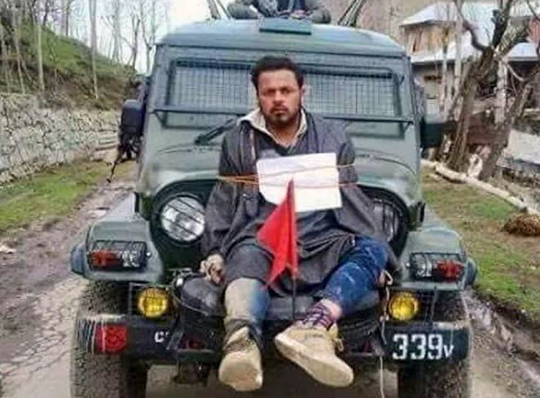
He was on his way back after casting his vote when he came across Major Leetul Gogoi, who is said to have tied him to the jeep’s bonnet as a shield against the stone pelters who had allegedly surrounded a group of armed personnel.

A video of Dar tied to the bonnet of the jeep went viral, triggering a public outcry. Some former general also said the move went against the "ethos" of the Indian Army.

The outrage prompted the Army to institute a probe into the incident.

The Jammu and Kashmir police also registered a case.

"It has been over a month since then and I am yet to hear from the local police. Even my statement has not been registered," Dar told PTI from his home in Chill in Budgam district.

The newly appointed Inspector General of Police (Kashmir range), Munir Khan, had said earlier in Sopore that the police would carry out an investigation into the matter and that the FIR had not been quashed, as many feared.

“An FIR means the beginning of an investigation. So once an FIR is lodged, the investigation begins. Whatever comes out in the investigation is a separate matter, but the investigation will take place and it will be seen what is right and what is wrong,” Khan said while replying to questions about the probe in the matter.

The incident came up again when Major Gogoi was honoured yesterday with the Army Chief’s commendation card for “his sustained efforts in counter-insurgency operations”.

"I wonder whether tying a person to a jeep are his efforts in counter-insurgency operations," Dar said, regretting having stepped out of his home to vote.

"I voted and was apparently penalised for this," he said.

His life, he said, had changed after this incident.

"People keep looking at me," the 27-year-old man who earns his living by embroidering shawls said.
He said he had received a call after April 13 when the police registered a case.

"I was told that my statement had to be recorded but that has not happened so far. Even if the Army is conducting its own inquiry, my statement is needed for I am the victim," he said.

Dar believed the state and central governments were trying "bury the truth" in the files.

The state police, which came into action after the video went viral on social networking sites, registered a case of abduction with an intent to cause grievous hurt, wrongful confinement and criminal intimidation.

"Information was received by the Beerwah Police station through reliable sources on April 9, 2017, that on the polling day of Parliament elections a news item was being telecast that a person identified as Farooq Ahmed Dar had been illegally confined by army personnel," the FIR said.

It said he had been tied with a rope to an army vehicle at Ghondipora and turned into a human shield.

"On this information, the case has been registered and investigation taken up," the FIR filed in Urdu said.

Comments

Add new comment

  • Coastaldigest.com reserves the right to delete or block any comments.
  • Coastaldigset.com is not responsible for its readers’ comments.
  • Comments that are abusive, incendiary or irrelevant are strictly prohibited.
  • Please use a genuine email ID and provide your name to avoid reject.
News Network
December 13,2025

New Delhi: School-going children are picking up drug and smoking habits and engaging in consumption of alcohol, with the average age of introduction to such harmful substances found to be around 13 years, suggesting a need for earlier interventions as early as primary school, a multi-city survey by AIIMS-Delhi said.

The findings also showed substance use increased in higher grades, with grade XI/XII students two times more likely to report use of substances when compared with grade VIII students. This emphasised the importance of continued prevention and intervention through middle and high school.

The study led by Dr Anju Dhawan of AIIMS's National Drug Dependence Treatment Centre, published in the National Medical Journal of India this month, looks at adolescent substance use across diverse regions.

The survey included 5,920 students from classes 8, 9, 11 and 12 in urban government, private and rural schools across 10 cities -- Bengaluru, Chandigarh, Delhi, Dibrugarh, Hyderabad, Imphal, Jammu, Lucknow, Mumbai, and Ranchi. The data were collected between May 2018 and June 2019.

The average age of initiation for any substance was 12.9 (2.8) years. It was lowest for inhalants (11.3 years) followed by heroin (12.3 years) and opioid pharmaceuticals (without prescription; 12.5 years).

Overall, 15.1 per cent of participants reported lifetime use, 10.3 per cent reported past year use, and 7.2 per cent reported use in the past month of any substance, the study found.

The most common substances used in the past year, after tobacco (4 per cent) and alcohol (3.8 per cent), were opioids (2.8 per cent), followed by cannabis (2 per cent) and inhalants (1.9 per cent). Use of non-prescribed pharmaceutical opioids was most common among opioid users (90.2 per cent).

On being asked, 'Do you think this substance is easily available for a person of your age' separately for each substance category, nearly half the students (46.3 per cent) endorsed that tobacco products and more than one-third of the students (36.5 per cent) agreed that a person of their age can easily procure alcohol products.

Similarly, for Bhang (21.9 per cent), ganja/charas (16.1 per cent), inhalants (15.2 per cent), sedatives (13.7 per cent), opium and heroin (10 per cent each), the students endorsed that these can be easily procured.

About 95 per cent of the children, irrespective of their grade, agreed with the statement that 'drug use is harmful'.

The rates of substance use (any) among boys were significantly higher than those of girls for substance use (ever), use in the past year and use in the past 30 days. Compared to grade VIII students, grade IX students were more likely, and grade XI/XII students were twice as likely to have used any substance (ever).

The likelihood of past-year use of any substance was also higher for grade IX students and for grade XI/XII students as compared to grade VIII students.

About 40 per cent of students mentioned that they had a family member who used tobacco or alcohol each. The use of cannabis (any product) and opioid (any product) by a family member was reported by 8.2 per cent and 3.9 per cent of students, respectively, while the use of other substances, such as inhalants/sedatives by family was 2-3 per cent, the study found.

A relatively smaller percentage of students reported use of tobacco or alcohol among peers as compared to among family members, while a higher percentage reported inhalants, sedatives, cannabis or opioid use among peers.

Children using substances (past year) compared to non-users reported significantly higher any substance use by their family members and peers.

There were 25.7 per cent students who replied 'yes' to the question 'conflicts/fights often occur in your family'. Most students also replied affirmatively to 'family members are aware of how their time is being spent' and 'damily members are aware of with whom they spend their time'.

Comments

Add new comment

  • Coastaldigest.com reserves the right to delete or block any comments.
  • Coastaldigset.com is not responsible for its readers’ comments.
  • Comments that are abusive, incendiary or irrelevant are strictly prohibited.
  • Please use a genuine email ID and provide your name to avoid reject.