India, China, Russia refrain from seeking East Jerusalem as Palestine capital

Agencies
December 12, 2017

New Delhi, Dec 12: India, Russia and China on Monday refrained from seeking East Jerusalem as the capital of Palestine after a meeting of foreign ministers from the three countries met in New Delhi.

External Affairs Minister Sushma Swaraj hosted her Russian and Chinese counterparts Sergey Lavrov and Wang Yi for the 15th annual meeting of the Russia-India-China (RIC) in New Delhi.

The joint statement issued after the meeting called for "negotiations aimed at creating an independent, viable, territorially contiguous Palestinian State living side by side in peace and security with Israel within mutually agreed and internationally recognised borders". It, however, did not have any reference to East Jerusalem.

The last RIC joint statement issued after the 14th meeting of the foreign ministers of the three nations in Moscow in April 2016 had categorically called for East Jerusalem to be the capital of the future state of Palestine.

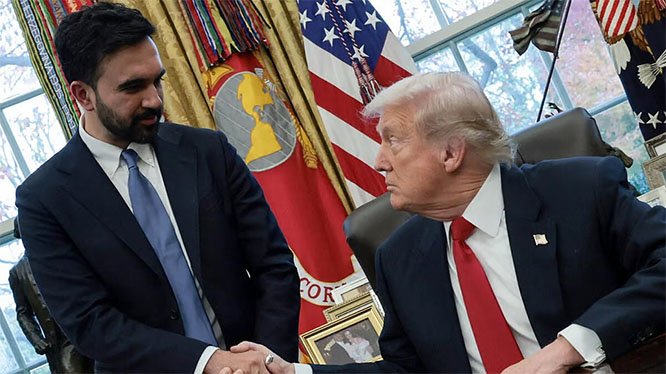
The move by Russia, India and China to drop the reference to East Jerusalem as the capital of Palestine came just days after US President Donald Trump formally recognised the ancient holy city as the capital of Israel.

The US move evoked sharp criticism not only from Arab world, but also from Europe and many other nations. Trump also set in motion a plan to shift the US Embassy from Tel Aviv to Jerusalem.

Moscow has expressed concern over the US move. Russia's ambassador to Israel, Alexander Shein, however, was quoted saying that Moscow had recognised West Jerusalem as the capital of Israel in April this year. He, however, also said that Russia could consider shifting its embassy from Tel Aviv to West Jerusalem after the "Palestinians and the Israelis agree on all issues of the final status" of the territories of Palestine.

China, however, reiterated its support to establishment of an independent sovereign Palestine with East Jerusalem as its capital as recently as last week. "The status of Jerusalem must be determined through dialogue and negotiation on the basis of UN resolutions, and the two-state solution remains a viable, fundamental solution to the Palestinian issue," Wang said in Beijing after the US recognised the ancient city as the capital of Israel.

New Delhi declined to toe the US line on recognising Jerusalem as the capital of Israel and stated that its position on Palestine was "independent and consistent" and shaped by its "views and interests, and not determined by any third country". India, however, refrained from reiterating its long-held view that eastern part of the holy city should be the capital of Palestine.

India in fact stopped calling for East Jerusalem to be the capital of Palestine this year. Hosting Palestinian President Mahmoud Abbas in New Delhi in May, Prime Minister Narendra Modi did call for "a sovereign, independent, united and viable Palestine, co-existing peacefully with Israel", but avoided supporting the demand for East Jerusalem to be the capital of Palestine. He carefully avoided referring to it during his visit to Israel in July – the first by a Prime Minister of India, although the two countries had established formal diplomatic relations in 1992. His message on the occasion of International Day of Solidarity with Palestinian People on November 25 last or India's statement to UN General Assembly on November 29 last too did not refer to the call for East Jerusalem to be the capital of Palestine.

The leaders of BRICS (Brazil, Russia, India, China and South Africa) too refrained from calling for East Jerusalem the capital of Palestine when they issued a joint statement after the summit of the five-nation bloc at Xiamen in China in September. The statement issued after the BRICS summit in Goa in October 2016 had reiterated the call for East Jerusalem to be the capital of Palestine.

Comments

Add new comment

  • Coastaldigest.com reserves the right to delete or block any comments.
  • Coastaldigset.com is not responsible for its readers’ comments.
  • Comments that are abusive, incendiary or irrelevant are strictly prohibited.
  • Please use a genuine email ID and provide your name to avoid reject.
News Network
November 26,2025

students.jpg

Bengaluru, Nov 26: Karnataka is taking its first concrete steps towards lifting a three-decade-old ban on student elections in colleges and universities. Deputy Chief Minister D.K. Shivakumar announced Wednesday that the state government will form a small committee to study the reintroduction of campus polls, a practice halted in 1989 following incidents of violence.

Speaking at a 'Constitution Day' event organised by the Karnataka Congress, Mr. Shivakumar underscored the move's aim: nurturing new political leadership from the grassroots.

"Recently, (Leader of the Opposition in Lok Sabha) Rahul Gandhi wrote a letter to me and Chief Minister (Siddaramaiah) asking us to think about restarting student elections," Shivakumar stated. "I'm announcing today that we'll form a small committee and seek a report on this."

Student elections were banned in Karnataka in 1989, largely due to concerns over violence and the infiltration of political party affiliates into campus life. The ban effectively extinguished vibrant student bodies and the pipeline of young leaders they often produced.

Mr. Shivakumar, who also serves as the Karnataka Congress president, said that former student leaders will be consulted to "study the pros and cons" of the re-introduction.

Acknowledging the history of the ban, he added, "There were many criminal activities taking place back then. We’ll see how we can conduct (student) elections by regulating such criminal activities."

The Deputy CM reminisced about his own journey, which began on campus. He recalled his political activism at Sri Jagadguru Renukacharya College leading to his first Assembly ticket in 1985 at the age of 23. "That's how student leadership was at the time. Such leadership has gone today. College elections have stopped," he lamented, adding that for many, college elections were "like a big movement" where leaders were forged.

The move, driven by the Congress high command's push to cultivate young talent, will face scrutiny from academics and university authorities who have, in the past, expressed concern that the return of polls could disrupt the peaceful academic environment and turn campuses into political battlegrounds.

Comments

Add new comment

  • Coastaldigest.com reserves the right to delete or block any comments.
  • Coastaldigset.com is not responsible for its readers’ comments.
  • Comments that are abusive, incendiary or irrelevant are strictly prohibited.
  • Please use a genuine email ID and provide your name to avoid reject.
News Network
December 4,2025

Mangaluru: Chaos erupted at Mangaluru International Airport (MIA) after IndiGo flight 6E 5150, bound for Mumbai, was repeatedly delayed and ultimately cancelled, leaving around 100 passengers stranded overnight. The incident highlights the ongoing country-wide operational disruptions affecting the airline, largely due to the implementation of new Flight Duty Time Limitations (FDTL) norms for crew.

The flight was initially scheduled for 9:25 PM on Tuesday but was first postponed to 11:40 PM, then midnight, before being cancelled around 3:00 AM. Passengers expressed frustration over last-minute communication and the lack of clarity, with elderly and ailing travellers particularly affected. “Though the airline arranged food, there was no proper communication, leaving us confused,” said one family member.

An IndiGo executive at MIA cited the FDTL rules, designed to prevent pilot fatigue by limiting crew working hours, as the cause of the cancellation. While alternative arrangements, including hotel stays, were offered, about 100 passengers chose to remain at the airport, creating tension. A replacement flight was arranged but also faced delays due to the same constraints, finally departing for Mumbai around 1:45 PM on Wednesday. Passengers either flew, requested refunds, or postponed their travel.

The Mangaluru delay is part of a broader crisis for IndiGo. The airline has been forced to make “calibrated schedule adjustments”—a euphemism for widespread cancellations and delays—after stricter FDTL norms came into effect on November 1.

While an IndiGo spokesperson acknowledged unavoidable flight disruptions due to technology issues, operational requirements, and the updated crew rostering rules, the DGCA has intervened, summoning senior airline officials to explain the chaos and outline corrective measures.

The ripple effect has been felt across the country, with major hubs like Bengaluru and Mumbai reporting numerous cancellations. The Mangaluru incident underscores the systemic operational strain currently confronting India’s largest carrier, leaving passengers nationwide grappling with uncertainty and delays.

Comments

Add new comment

  • Coastaldigest.com reserves the right to delete or block any comments.
  • Coastaldigset.com is not responsible for its readers’ comments.
  • Comments that are abusive, incendiary or irrelevant are strictly prohibited.
  • Please use a genuine email ID and provide your name to avoid reject.
Agencies
November 22,2025

indiapak.jpg

New York/Washington: US President Donald Trump has again claimed to have solved the conflict between India and Pakistan, repeating his assertion during a meeting with New York City Mayor-elect Zohran Mamdani in the Oval Office.

Mamdani flew to Washington DC for his first meeting with Trump in the White House on Friday. Trump said he “enjoyed” the meeting, which he described as “great.”

During remarks in the Oval Office, with Mamdani standing next to him, Trump repeated his claim that he solved the May conflict between India and Pakistan.

"I did eight peace deals of countries, including India and Pakistan,” he said.

On Wednesday, Trump had said he threatened to put 350 per cent tariffs on India and Pakistan if they did not end their conflict, repeating his claim that he solved the fighting between the nuclear-armed neighbours and that Prime Minister Narendra Modi had called him to say “we're not going to go to war.”

Since May 10, when Trump announced on social media that India and Pakistan had agreed to a “full and immediate” ceasefire after a “long night” of talks mediated by Washington, he has repeated his claim over 60 times that he “helped settle” the tensions between India and Pakistan.

India has consistently denied any third-party intervention. India launched Operation Sindoor on May 7, targeting terror infrastructure in Pakistan and Pakistan-occupied Kashmir in retaliation for the April 22 Pahalgam attack that killed 26 civilians. India and Pakistan reached an understanding on May 10 to end the conflict after four days of intense cross-border drone and missile strikes.

Mamdani emerged victorious in the closely-watched battle for New York City Mayor, becoming the first South Asian and Muslim to be elected to sit at the helm of the largest city in the US.

He had been the front-runner in the NYC Mayoral election for months and defeated Republican nominee Curtis Sliwa and political heavyweight former New York State Governor Andrew Cuomo, who ran as an independent candidate and was officially endorsed by Trump just hours before the elections.

Indian-descent Mamdani is the son of renowned filmmaker Mira Nair and Columbia University professor Mahmood Mamdani. He was born and raised in Kampala, Uganda and moved to New York City with his family when he was 7. Mamdani became a naturalised US citizen only recently, in 2018.

Comments

Add new comment

  • Coastaldigest.com reserves the right to delete or block any comments.
  • Coastaldigset.com is not responsible for its readers’ comments.
  • Comments that are abusive, incendiary or irrelevant are strictly prohibited.
  • Please use a genuine email ID and provide your name to avoid reject.