



India has taken a quantum jump in the wrong direction since 2014: Amartya Sen

Agencies
July 8, 2018

New Delhi, Jul 8: Eminent economist Amartya Sen said that despite being the fastest-growing economy the country has taken a "quantum jump in the wrong direction" since 2014.

He also said that due to moving backwards, the country is now second worst in the region.

"Things have gone pretty badly wrong... It has taken a quantum jump in the wrong direction since 2014. We are getting backwards in the fastest-growing economy," Sen said.

Twenty years ago, he added, of the six countries in this region -- India, Pakistan, Bangladesh, Sri Lanka, Nepal and Bhutan, India was the second best after Sri Lanka.

"Now, it is the second worst. Pakistan has managed to shield us from being the worst."

The Nobel laureate was speaking here at the launch of 'Bharat Aur Uske Virodhabhas’, the Hindi edition of his book 'An Uncertain Glory: India and its Contradiction' that he co-authored with development economist Jean Dreze.

The economist said that the government has also deflected from issues of inequalities, the caste system and the scheduled tribes have been kept out.

There were a whole group of people, those who clean lavatories or sewage with their hands, he said, whose demands and needs have been neglected.

While highlighting the recent report of a Dalit youth who was whipped for asking a salary hike from the manager of a petrol pump in Madhya Pradesh, he said they (Dalit) are going around without any kind of certainty about their next meal, healthcare or education.

Taking a dig at the BJP-led government, he added that during freedom struggle it was difficult to see that a political battle could be won by playing up the Hindu identity, but that has changed now.

"But, that has happened. Which is why, at this time, the whole issue of Opposition unity is so important," the 84-year-old economist said.

"It is not a battle of one entity against the other (or) Mr Modi against Mr Rahul Gandhi, it is an issue of what India is," Sen added

Also speaking at the event, development economist and activist Jean Dreze termed the soon-to-be-launched Ayushmann Bharat health scheme a "hoax" as it was actually not big as it was being claimed to be.

"The budget (for the scheme) for this year is 2,000 crore. Even if it is spent, it's less than 20 rupees per person," he said.

It is projected as health insurance for 50 crore people, but it is virtually nothing, said Dreze, who helped draft the first version of the Mahatma Gandhi National Rural Employment Guarantee Scheme (MGNREGA).

Comments

Add new comment

  • Coastaldigest.com reserves the right to delete or block any comments.
  • Coastaldigset.com is not responsible for its readers’ comments.
  • Comments that are abusive, incendiary or irrelevant are strictly prohibited.
  • Please use a genuine email ID and provide your name to avoid reject.
News Network
December 16,2025

bengal.jpg

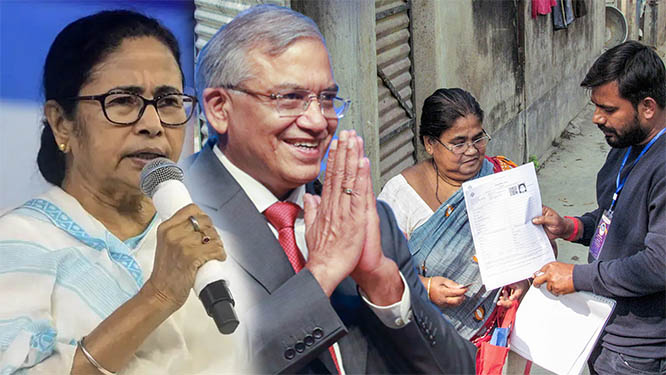
The deletion of over 58 lakh names from West Bengal’s draft electoral rolls following a Special Intensive Revision (SIR) has sparked widespread concern and is likely to deepen political tensions in the poll-bound state.

According to the Election Commission, the revision exercise has identified 24 lakh voters as deceased, 19 lakh as relocated, 12 lakh as missing, and 1.3 lakh as duplicate entries. The draft list, published after the completion of the first phase of SIR, aims to remove errors and duplication from the electoral rolls.

However, the scale of deletions has raised fears that a large number of eligible voters may have been wrongly excluded. The Election Commission has said that individuals whose names are missing can file objections and seek corrections. The final voter list is scheduled to be published in February next year, after which the Assembly election announcement is expected. Notably, the last Special Intensive Revision in Bengal was conducted in 2002.

The development has intensified the political row over the SIR process. Chief Minister Mamata Banerjee and her Trinamool Congress have strongly opposed the exercise, accusing the Centre and the Election Commission of attempting to disenfranchise lakhs of voters ahead of the elections.

Addressing a rally in Krishnanagar earlier this month, Banerjee urged people to protest if their names were removed from the voter list, alleging intimidation during elections and warning of serious consequences if voting rights were taken away.

The BJP, meanwhile, has defended the revision and accused the Trinamool Congress of politicising the issue to protect what it claims is an illegal voter base. Leader of the Opposition Suvendu Adhikari alleged that the ruling party fears losing power due to the removal of deceased, fake, and illegal voters.

The controversy comes amid earlier allegations by the Trinamool Congress that excessive work pressure during the SIR led to the deaths by suicide of some Booth Level Officers (BLOs), for which the party blamed the Election Commission. With the draft list now out, another round of political confrontation appears imminent.

As objections begin to be filed, the focus will be on whether the correction mechanism is accessible, transparent, and timely—critical factors in ensuring that no eligible voter is denied their democratic right ahead of a crucial election.

Comments

Add new comment

  • Coastaldigest.com reserves the right to delete or block any comments.
  • Coastaldigset.com is not responsible for its readers’ comments.
  • Comments that are abusive, incendiary or irrelevant are strictly prohibited.
  • Please use a genuine email ID and provide your name to avoid reject.