



India hits back at China over Arunachal Pradesh

April 21, 2017

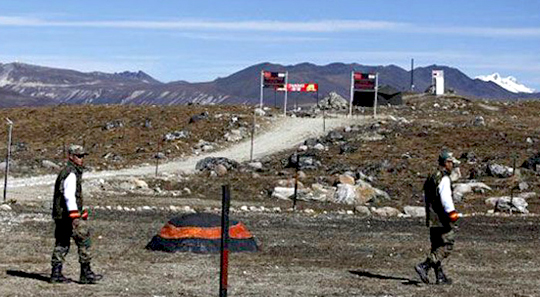
New Delhi, Apr 21: Hitting back at China over Arunachal Pradesh, India on Thursday said that assigning invented names to towns of the neighbour does not make illegal territorial claims legal.
legal

External Affairs Ministry Spokesperson Gopal Baglay also asserted that Arunachal Pradesh was an integral part of India.

"Assigning invented names to towns of your neighbour does not make illegal territorial claims legal. Arunachal Pradesh is and will always be an integral part of India," Baglay told reporters.

When asked if India has taken up the matter with China, he said the Chinese government has not communicated anything officially so far and the ministry has seen only reports on the development.

China had yesterday announced that it had 'standardised' official names for six places in Arunachal Pradesh and had termed the provocative move as a 'legitimate action'.

Their move had come days after Beijing had lodged strong protests with India over the Dalai Lama's visit to the frontier state.

The state media in Beijing had said that the move was aimed at reaffirming China's claim over Arunachal Pradesh.

China claims the state as 'South Tibet'.

"China's Ministry of Civil Affairs announced on April 14 that it had standardised in Chinese characters, Tibetan and Roman alphabet the names of six places in 'South Tibet', which India calls 'Arunachal Pradesh', in accordance with the regulations of the central government," state-run Global Times had reported.

The official names of the six places using the Roman alphabet are Wo'gyainling, Mila Ri, Qoidengarbo Ri, Mainquka, Bumo La and Namkapub Ri.

"These names reflect China's territorial claim over South Tibet (Arunachal Pradesh) is supported by clear evidence in terms of history, culture and administration," Chinese Foreign Ministry spokesman Lu Kang had told reporters.

Defending the action to standardise the names, Lu had said, "to issue these names is actually carried out in accordance with the regulations about the names of the localities and it is a legitimate action by the Chinese government".

"Let me stress that about the Indian government's indulgence of (the) Dalai Lama activities in disputed eastern section of the India-China boundary and also about his anti- China activities, this is something we are firmly against. These activities are also against the Indian government's commitments to China," Lu had added when asked about the significance of standardisation of names.

Asked why it took China so long to standardise the names and whether the sudden move was in retaliation to the Dalai Lama's recent visit to Arunachal Pradesh, he had further said that China chose this time to announce the standardisation as it was now doing a second census of names of localities and an important part of it was to standardise names in ethnic languages.

"In the next step, we will also step up our study of those names in Tibetan ethnic languages and in the next step we will announce more standardisation of these names," he had gone on to say said.

Reiterating that China's claims over the east section of India-China boundary in Arunachal Pradesh were clear and consistent, Lu had said, "these names have been passed on from generation to generation by people who have lived there for generations, the Tibetan ethnic and Monpa ethnic groups. It is also an example that shows China has clear administration over these areas and there are many activities by the Chinese people in that area."

China's move had come just days after the Dalai Lama's visit to Arunachal Pradesh, which was seventh since the 81-year-old spiritual leader fled from Tibet through Tawang and sought refuge in India.

During the Dalai Lama's Arunachal Pradesh visit, China had warned India that it will take "necessary measures" to defend its territorial sovereignty and interests.

The India-China border dispute covers the 3,488 km-long Line of Actual Control (LAC). While China claims Arunachal Pradesh as South Tibet, India asserts that the dispute covers Aksai Chin area which was occupied by China during the 1962 war.

The two sides have so far held 19 rounds of Special Representatives talks to resolve the boundary dispute.

Comments

Add new comment

  • Coastaldigest.com reserves the right to delete or block any comments.
  • Coastaldigset.com is not responsible for its readers’ comments.
  • Comments that are abusive, incendiary or irrelevant are strictly prohibited.
  • Please use a genuine email ID and provide your name to avoid reject.
News Network
December 13,2025

New Delhi: School-going children are picking up drug and smoking habits and engaging in consumption of alcohol, with the average age of introduction to such harmful substances found to be around 13 years, suggesting a need for earlier interventions as early as primary school, a multi-city survey by AIIMS-Delhi said.

The findings also showed substance use increased in higher grades, with grade XI/XII students two times more likely to report use of substances when compared with grade VIII students. This emphasised the importance of continued prevention and intervention through middle and high school.

The study led by Dr Anju Dhawan of AIIMS's National Drug Dependence Treatment Centre, published in the National Medical Journal of India this month, looks at adolescent substance use across diverse regions.

The survey included 5,920 students from classes 8, 9, 11 and 12 in urban government, private and rural schools across 10 cities -- Bengaluru, Chandigarh, Delhi, Dibrugarh, Hyderabad, Imphal, Jammu, Lucknow, Mumbai, and Ranchi. The data were collected between May 2018 and June 2019.

The average age of initiation for any substance was 12.9 (2.8) years. It was lowest for inhalants (11.3 years) followed by heroin (12.3 years) and opioid pharmaceuticals (without prescription; 12.5 years).

Overall, 15.1 per cent of participants reported lifetime use, 10.3 per cent reported past year use, and 7.2 per cent reported use in the past month of any substance, the study found.

The most common substances used in the past year, after tobacco (4 per cent) and alcohol (3.8 per cent), were opioids (2.8 per cent), followed by cannabis (2 per cent) and inhalants (1.9 per cent). Use of non-prescribed pharmaceutical opioids was most common among opioid users (90.2 per cent).

On being asked, 'Do you think this substance is easily available for a person of your age' separately for each substance category, nearly half the students (46.3 per cent) endorsed that tobacco products and more than one-third of the students (36.5 per cent) agreed that a person of their age can easily procure alcohol products.

Similarly, for Bhang (21.9 per cent), ganja/charas (16.1 per cent), inhalants (15.2 per cent), sedatives (13.7 per cent), opium and heroin (10 per cent each), the students endorsed that these can be easily procured.

About 95 per cent of the children, irrespective of their grade, agreed with the statement that 'drug use is harmful'.

The rates of substance use (any) among boys were significantly higher than those of girls for substance use (ever), use in the past year and use in the past 30 days. Compared to grade VIII students, grade IX students were more likely, and grade XI/XII students were twice as likely to have used any substance (ever).

The likelihood of past-year use of any substance was also higher for grade IX students and for grade XI/XII students as compared to grade VIII students.

About 40 per cent of students mentioned that they had a family member who used tobacco or alcohol each. The use of cannabis (any product) and opioid (any product) by a family member was reported by 8.2 per cent and 3.9 per cent of students, respectively, while the use of other substances, such as inhalants/sedatives by family was 2-3 per cent, the study found.

A relatively smaller percentage of students reported use of tobacco or alcohol among peers as compared to among family members, while a higher percentage reported inhalants, sedatives, cannabis or opioid use among peers.

Children using substances (past year) compared to non-users reported significantly higher any substance use by their family members and peers.

There were 25.7 per cent students who replied 'yes' to the question 'conflicts/fights often occur in your family'. Most students also replied affirmatively to 'family members are aware of how their time is being spent' and 'damily members are aware of with whom they spend their time'.

Comments

Add new comment

  • Coastaldigest.com reserves the right to delete or block any comments.
  • Coastaldigset.com is not responsible for its readers’ comments.
  • Comments that are abusive, incendiary or irrelevant are strictly prohibited.
  • Please use a genuine email ID and provide your name to avoid reject.