



India, Japan each seek deals during Prime Minister Narendra Modi's visit

August 30, 2014

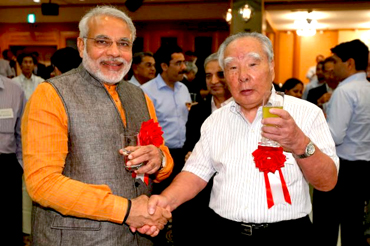
Tokyo, Aug 30: Japan and India both have much to gain from a visit by Prime Minister Narendra Modi and more than a dozen Indian steel, energy and IT tycoons that begins on Saturday in the ancient capital of Kyoto.
Narendra Modi30
The two countries have complementary economies, given Japan's wealth and technological prowess and India's natural resources and drive to modernize its economy.

So far, though, they have failed to capitalize much on those mutual interests. The two countries signed an economic cooperation agreement in 2011 that is gradually dismantling tariffs, but trade between the two despite gains remains a tiny fraction of their overall import and export flows.

That's partly because of India's restrictive policies toward foreign investment and partly because Japanese companies have been so focused on China.

Analysts expect Modi's visit with Prime Minister Shinzo Abe to yield some substantial agreements, and possibly a long-awaited deal on cooperation in nuclear power generation technology.

But in the long run, Modi must deliver on promises to improve his country's investment environment while balancing India's growing engagement with both Japan and rival China.

"I think there'll be some very big agreements, on the energy side also, not just nuclear but also renewable energy.

India has been lagging on that and needs help from Japan," said Rajiv Biswas, Asia-Pacific economist at IHS Economics.

In the run-up to their meeting, Abe and Modi have been exchanging endearments on Twitter.

"I deeply respect his leadership & enjoy a warm relationship with him from previous meetings," Modi wrote of Abe, adding that he hoped to take to take the relationship "to a new level."

"India has a special place in my heart. I am eagerly waiting for your arrival in Kyoto this weekend," tweeted back Abe, who is taking the unusually cordial step of traveling to Kyoto to escort Modi and his delegation before they fly to Tokyo late on Sunday.

Since taking office in late 2012, Abe has been trotting the globe to help clinch big contracts for Japanese industrial giants like Hitachi and Mitsubishi Heavy Industries, as part of his "Abenomics" agenda to help restore the country's economic dynamism.

India, which plans to spend USD 1 trillion on roads, railways and other infrastructure in 2012-2017, is a VIP customer.

And Modi will be trying to woo Japanese investment in three of his favorite projects, including railway modernisation, an industrial corridor between New Delhi and Mumbai, and a plan to build 100 "smart cities" with high-tech communication facilities and modern infrastructure.

"Who is a better expert in bullet train technology than Japan?" said Kunal Singh, a researcher at the Center for Policy Research, a New Delhi think tank.

The financial newspaper Nikkei reported on Thursday that the two sides may also expand cooperation on India's mining of rare earths, as Tokyo diversifies away from a longstanding reliance on China for the minerals used in many high-tech applications.


Comments

Add new comment

  • Coastaldigest.com reserves the right to delete or block any comments.
  • Coastaldigset.com is not responsible for its readers’ comments.
  • Comments that are abusive, incendiary or irrelevant are strictly prohibited.
  • Please use a genuine email ID and provide your name to avoid reject.
News Network
December 16,2025

jordan.jpg

Prime Minister Narendra Modi on Monday held talks with Jordan’s King Abdullah II in Amman, during which the two leaders discussed ways to further strengthen bilateral relations, with the Prime Minister outlining an eight-point vision covering key areas of cooperation.

Describing the meeting as “productive”, PM Modi said he shared a roadmap focused on trade and economy, fertilisers and agriculture, information technology, healthcare, infrastructure, critical and strategic minerals, civil nuclear cooperation, and people-to-people ties.

In a post on social media platform X, the Prime Minister praised King Abdullah II’s personal commitment to advancing India–Jordan relations, particularly as both countries mark the 75th anniversary of the establishment of diplomatic ties this year.

“Held productive discussions with His Majesty King Abdullah II in Amman. His personal commitment towards vibrant India-Jordan relations is noteworthy. This year, we are celebrating the 75th anniversary of our bilateral diplomatic relations,” PM Modi said.

The meeting took place at the Al Husseiniya Palace, where the two leaders also exchanged views on regional and global issues of mutual interest. According to the Ministry of External Affairs (MEA), both sides agreed to further deepen cooperation in areas including trade and investment, defence and security, counter-terrorism and de-radicalisation, fertilisers and agriculture, infrastructure, renewable energy, tourism, and heritage.

The MEA said both leaders reaffirmed their united stand against terrorism.

PM Modi arrived in Amman earlier on Monday and was received by Jordanian Prime Minister Jafar Hassan, who accorded him a formal welcome. Following the talks, King Abdullah II hosted a banquet dinner in honour of the Prime Minister, reflecting the warmth of bilateral ties.

Jordan is the first leg of PM Modi’s three-nation tour. From Amman, the Prime Minister will travel to Ethiopia at the invitation of Prime Minister Abiy Ahmed Ali, marking his first official visit to the African nation. The tour will conclude with a visit to Oman.

Comments

Add new comment

  • Coastaldigest.com reserves the right to delete or block any comments.
  • Coastaldigset.com is not responsible for its readers’ comments.
  • Comments that are abusive, incendiary or irrelevant are strictly prohibited.
  • Please use a genuine email ID and provide your name to avoid reject.