India likely to ease restrictions for foreign online retailers in July

June 5, 2014

Mumbai/New Delhi, Jun 5: India could allow global online retailers such as Amazon.com Inc to sell their own products as early as next month, removing restrictions that have held back competition in one of the world's biggest, and most price-sensitive, retail markets.

The decision, which is likely to be announced in or alongside the budget, is one of the first tangible signs of economic reform by the business-friendly government of Prime Minister Narendra Modi, who was sworn in 10 days ago.

Foreign online retailers
The move could allow the government to circumvent political opposition to opening up India's $500 billion retail sector to global retail giants such as Wal-Mart Stores Inc.

Four people privy to discussions within the government told Reuters that officials believed a more robust online retail sector would spur manufacturing and consumption, helping revive an economy that has grown at below 5 percent for two years, the longest period of sub-par expansion since the late 1980s.

"Most stakeholders support FDI (foreign direct investment)," said a senior government official, referring to e-commerce. "We have pitched for opening it up completely."

Industry surveys say e-commerce could contribute up to 4 percent to India's economy by 2020 from under one percent now.

The official, like others who spoke to Reuters on the move, declined to be named because the matter was confidential. When asked about the decision, a spokesman for India's commerce and industry ministry declined to comment.

Although New Delhi has been discussing opening up the sector since last year, the sources said a decision was imminent.

"The way the government is initiating discussion, it is very clear that they are extremely serious about it," said an executive with a global online retailer who was invited to a meeting two weeks ago between the government and foreign and domestic companies.

"They understand this will help small traders to grow their business, expand and reach out to a larger market," he said.

While Modi's Bharatiya Janata Party (BJP) has been a vocal critic of the country's multi-brand retail policy, it has remained quiet on the proposal to open up the e-commerce sector.

On the campaign trail, Modi had asked small traders not to feel intimated by big online retail chains.

"We should not worry about these things. Our children have taken IT to the world. We'll have to embrace it," he told a gathering of small traders in February.

Modi will eventually decide investment guidelines as well as the foreign ownership cap, but the sources said the rules will be clearer and better than those for foreign investment in the supermarket sector.

For example, implementation of the policy will not be left at the discretion of individual states, they said. But local sourcing and investment in the supply chain will be required.

An Amazon spokesperson said opening up the sector would be good for consumers and Indian businesses and spur infrastructure development.

"It would allow us to partner with local manufacturers to source products not carried by other sellers on the marketplace, giving Indian consumers unique and wider choices at lower prices."

Deepa Thomas, spokeswoman for eBay in India, said it was excited about the opportunity and believed in the need for a carefully calibrated approach to opening up the sector.

"I can't speculate on what might happen going forward, but I can tell you that we're very pleased about the launch of the business so far out there," Peter Faricy, Amazon's global head of marketplaces, said on Wednesday when asked about the potential impact of that change in India.

CONSUMPTION-LED GROWTH

The industry ministry that drafts FDI rules recently met officials from companies including Amazon, Google, eBay Inc, Wal-Mart and Indian e-tailer Flipkart to finalise the investment guidelines, the people said.

Global online retailers like Amazon and eBay are currently banned from selling products they have sourced themselves, and must rely on third-party suppliers. Their platforms, which they own fully, are marketplaces for these outside suppliers.

The government is likely to end this ban, paving the way for global retailers to bring their formidable supply chain, and cheaper goods, into India, potentially boosting consumption and benefiting small manufacturers and traders.

Politically influential small-scale traders have traditionally opposed any foreign direct investment in retail, fearing they would be eclipsed by larger global rivals.

The BJP is also against such investments, but the sources said the government supported the online retail expansion as global e-commerce firms would still have to rely on small traders to generate business.

Opening up the online retail business for foreign direct investment is also widely expected to eliminate middlemen, leading to lower transaction, overhead, inventory and labour costs, industry officials said.

Modi, who last month won the first outright parliamentary majority in three decades in Asia's third-largest economy, wants to kick start the sluggish economy by winning back domestic and foreign investor confidence.

Regulatory uncertainty under the previous government prevented foreign supermarket chains from setting up shop in the country. So far, only Britain's Tesco PLC has announced an investment. In its election manifesto, the ruling BJP vowed to ban foreign supermarkets.

LIFELINE TO LOCAL ONLINE RETAILERS?

E-commerce is growing at the compound annual growth rate of 34 percent in India, according to a report from Digital-Commerce, IAMAI-IMRB.

Online travel services currently account for over 70 percent of consumer e-commerce transactions. Online sales of retail goods were $1.6 billion last year, according to research firm Forrester. But they will swell to $76 billion by 2021, predicts consultancy Technopak.

By comparison, China's business and consumer e-commerce sales are projected to surpass $180 billion this year.

If approved, the policy will not only allow foreign retailers to expand in India, but will also give local online businesses access to much-needed foreign capital.

The companies vying for a bigger slice of the Indian online retail market include the country's largest e-tailer Flipkart, marketplace Snapdeal and fashion retailers Myntra and Jabong.

All retailers in the business are losing money due to high costs owing to high-voltage advertising campaigns, heavy discounts and an underdeveloped logistics network.

Only 18 of the 52 e-commerce start-ups in India - which raised $700 million in venture capital funding in the three years ending 2012 - were able to raise follow-on investments last year, investment bank Allegro Advisors said.

Most Indian e-tailers are aggressively scaling up in an effort to have the muscle to compete with Amazon, which slashed prices and improved delivery standards after entering India last year and is looking to acquire smaller retailers.


Comments

Add new comment

  • Coastaldigest.com reserves the right to delete or block any comments.
  • Coastaldigset.com is not responsible for its readers’ comments.
  • Comments that are abusive, incendiary or irrelevant are strictly prohibited.
  • Please use a genuine email ID and provide your name to avoid reject.
News Network
December 6,2025

pilot.jpg

New Delhi: IndiGo, India’s largest airline, faced major operational turbulence this week after failing to prepare for new pilot-fatigue regulations issued by the Directorate General of Civil Aviation (DGCA). The stricter rules—designed to improve flight safety—took effect in phases through 2024, with the latest implementation on November 1. IndiGo has acknowledged that inadequate roster planning led to widespread cancellations and delays.

Below are the key DGCA rules that affected IndiGo’s operations:

1. Longer Mandatory Weekly Rest

Weekly rest for pilots has been increased from 36 hours to 48 hours.

The government says the extended break is essential to curb cumulative fatigue. This rule remains in force despite the current crisis.

2. Cap on Night Landings

Pilots can now perform only two night landings per week—a steep reduction from the earlier limit of six.

Night hours, defined as midnight to early morning, are considered the least alert period for pilots.

Given the disruptions, this rule has been temporarily relaxed for IndiGo until February 10.

3. Reduced Maximum Night Flight Duty

Flight duty that stretches into the night is now capped at 10 hours.

This measure has also been kept on hold for IndiGo until February 10 to stabilize operations.

4. Weekly Rest Cannot Be Replaced With Personal Leave

Airlines can no longer count a pilot’s personal leave as part of the mandatory 48-hour rest.

Pilots say this closes a loophole that previously reduced actual rest time.

Currently, all airlines are exempt from this rule to normalise travel.

5. Mandatory Fatigue Monitoring

Airlines must submit quarterly fatigue reports along with corrective actions to DGCA.

This system aims to create a transparent fatigue-tracking framework across the industry.

The DGCA has stressed that these rules were crafted to strengthen flight safety and align India with global fatigue-management standards. The temporary relaxations are expected to remain until February 2025, giving IndiGo time to stabilise its schedules and restore normal air travel.

Comments

Add new comment

  • Coastaldigest.com reserves the right to delete or block any comments.
  • Coastaldigset.com is not responsible for its readers’ comments.
  • Comments that are abusive, incendiary or irrelevant are strictly prohibited.
  • Please use a genuine email ID and provide your name to avoid reject.
News Network
December 16,2025

bengal.jpg

The deletion of over 58 lakh names from West Bengal’s draft electoral rolls following a Special Intensive Revision (SIR) has sparked widespread concern and is likely to deepen political tensions in the poll-bound state.

According to the Election Commission, the revision exercise has identified 24 lakh voters as deceased, 19 lakh as relocated, 12 lakh as missing, and 1.3 lakh as duplicate entries. The draft list, published after the completion of the first phase of SIR, aims to remove errors and duplication from the electoral rolls.

However, the scale of deletions has raised fears that a large number of eligible voters may have been wrongly excluded. The Election Commission has said that individuals whose names are missing can file objections and seek corrections. The final voter list is scheduled to be published in February next year, after which the Assembly election announcement is expected. Notably, the last Special Intensive Revision in Bengal was conducted in 2002.

The development has intensified the political row over the SIR process. Chief Minister Mamata Banerjee and her Trinamool Congress have strongly opposed the exercise, accusing the Centre and the Election Commission of attempting to disenfranchise lakhs of voters ahead of the elections.

Addressing a rally in Krishnanagar earlier this month, Banerjee urged people to protest if their names were removed from the voter list, alleging intimidation during elections and warning of serious consequences if voting rights were taken away.

The BJP, meanwhile, has defended the revision and accused the Trinamool Congress of politicising the issue to protect what it claims is an illegal voter base. Leader of the Opposition Suvendu Adhikari alleged that the ruling party fears losing power due to the removal of deceased, fake, and illegal voters.

The controversy comes amid earlier allegations by the Trinamool Congress that excessive work pressure during the SIR led to the deaths by suicide of some Booth Level Officers (BLOs), for which the party blamed the Election Commission. With the draft list now out, another round of political confrontation appears imminent.

As objections begin to be filed, the focus will be on whether the correction mechanism is accessible, transparent, and timely—critical factors in ensuring that no eligible voter is denied their democratic right ahead of a crucial election.

Comments

Add new comment

  • Coastaldigest.com reserves the right to delete or block any comments.
  • Coastaldigset.com is not responsible for its readers’ comments.
  • Comments that are abusive, incendiary or irrelevant are strictly prohibited.
  • Please use a genuine email ID and provide your name to avoid reject.
News Network
December 6,2025

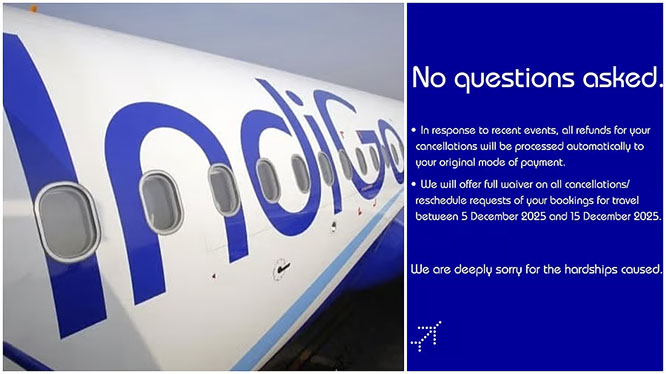
indigoticket.jpg

With IndiGo flight disruptions impacting thousands of passengers, the airline on Saturday said that it will offer full waiver on all cancellations/reschedule requests for travel bookings between December 5, 2025 and December 15, 2025.

Earlier in the day, the civil aviation ministry had directed the airline to complete the ticket refund process for the cancelled flights by Sunday evening, as well as ensure baggage separated from the travellers are delivered in the next two days.

In a post on X, titled 'No questions asked', IndiGo wrote, "In response to recent events, all refunds for your cancellations will be processed automatically to your original mode of payment."

"We are deeply sorry for the hardships caused," it further added.

Several passengers, however, complained of not getting full refund as promised by the airline.

Netizens have shared screenchots of getting charged for airline cancellation fee and convenience fee.

"Please tell me why u have did this airline cancellation charges when u say full amount will be refunded (sic)," a user wrote sharing a screenshot of the refund page.

"Well, but you have still debited the convenience charges," wrote another.

Passengers have also raised concerns about the "cancel" option being disabled on the IndiGo app. "First enable the 'Cancel' button on your App & offer full refund on tickets cancelled by customers between the said dates," wrote a user.

A day after the country's largest airline, IndiGo, cancelled more than 1,000 flights and caused disruptions for the fifth day on Saturday, the ministry said that any delay or non-compliance in refund processing will invite immediate regulatory action.

The refund process for all cancelled or disrupted flights must be completed by 8 pm on Sunday, the ministry said in a statement.

"Airlines have also been instructed not to levy any rescheduling charges for passengers whose travel plans were affected by cancellations," it said.

On Saturday, more than 400 flights were cancelled at various airports.

IndiGo has also been instructed to set up dedicated passenger support and refund facilitation cells.

Comments

Add new comment

  • Coastaldigest.com reserves the right to delete or block any comments.
  • Coastaldigset.com is not responsible for its readers’ comments.
  • Comments that are abusive, incendiary or irrelevant are strictly prohibited.
  • Please use a genuine email ID and provide your name to avoid reject.