



India, Pakistan trade gunfire in Kashmir; 4 dead

August 23, 2014

kashmir 5

Pakistani target BSF
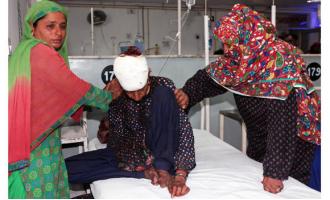
Srinagar, Aug 23: India and Pakistan traded gunfire in the disputed Kashmir region on Saturday, killing two villagers on each side and wounding several others, officials said.

Dharmendra Pareek, a top official with India’s paramilitary force, said Indian forces retaliated after Pakistani troops fired guns and mortar rounds on more than a dozen Indian border posts and at least three villages in the Ranbir Singh Pura region.

Pareek said two Indian villagers were killed, including an 8-year-old boy. One Indian border guard and three civilians were wounded, but their injuries were not life-threatening, he said.

Television images showed Indian villagers taking shelter in bunkers.

The region is about 300 kilometers (185 miles) northwest of Srinagar, the main city in the Indian portion of Kashmir.

In Pakistan, a senior army officer said two villagers were killed when the Indian border security force “resorted to unprovoked firing” along the border near the city of Sialkot in the Pakistani portion of Kashmir.

The officer spoke on condition of anonymity because he was not authorized to speak to the media on the record.

Indian Defense Minister Arun Jaitley said cease-fire violations by Pakistan had increased in the region, adding that “both the Indian army and the Border Security Force are fully vigilant and they effectively respond to each violation.”

Kashmir is divided between India and Pakistan, and the rival neighbors claim the disputed Himalayan region in its entirety. They have fought three wars since gaining independence from Britain in 1947, two of them over Kashmir.

The two sides have largely followed a 2003 cease-fire accord, but sporadic violations have occurred.

Tensions have escalated in Kashmir since India earlier in the week called off diplomatic talks with Pakistan because the Pakistani ambassador in New Delhi met with separatist leaders from the disputed region.

India said the meeting undermined efforts to thaw relations between the nuclear-armed neighbors. But India has tolerated such meetings in the past, which suggests the country’s new government is taking a hard line against Pakistan.

India accuses Pakistan of arming and training insurgent groups fighting for Kashmir’s merger with Pakistan or independence from India since 1989. Pakistan denies the charge and says it offers only moral and diplomatic support to them.

Comments

Add new comment

  • Coastaldigest.com reserves the right to delete or block any comments.
  • Coastaldigset.com is not responsible for its readers’ comments.
  • Comments that are abusive, incendiary or irrelevant are strictly prohibited.
  • Please use a genuine email ID and provide your name to avoid reject.
News Network
December 13,2025

New Delhi: School-going children are picking up drug and smoking habits and engaging in consumption of alcohol, with the average age of introduction to such harmful substances found to be around 13 years, suggesting a need for earlier interventions as early as primary school, a multi-city survey by AIIMS-Delhi said.

The findings also showed substance use increased in higher grades, with grade XI/XII students two times more likely to report use of substances when compared with grade VIII students. This emphasised the importance of continued prevention and intervention through middle and high school.

The study led by Dr Anju Dhawan of AIIMS's National Drug Dependence Treatment Centre, published in the National Medical Journal of India this month, looks at adolescent substance use across diverse regions.

The survey included 5,920 students from classes 8, 9, 11 and 12 in urban government, private and rural schools across 10 cities -- Bengaluru, Chandigarh, Delhi, Dibrugarh, Hyderabad, Imphal, Jammu, Lucknow, Mumbai, and Ranchi. The data were collected between May 2018 and June 2019.

The average age of initiation for any substance was 12.9 (2.8) years. It was lowest for inhalants (11.3 years) followed by heroin (12.3 years) and opioid pharmaceuticals (without prescription; 12.5 years).

Overall, 15.1 per cent of participants reported lifetime use, 10.3 per cent reported past year use, and 7.2 per cent reported use in the past month of any substance, the study found.

The most common substances used in the past year, after tobacco (4 per cent) and alcohol (3.8 per cent), were opioids (2.8 per cent), followed by cannabis (2 per cent) and inhalants (1.9 per cent). Use of non-prescribed pharmaceutical opioids was most common among opioid users (90.2 per cent).

On being asked, 'Do you think this substance is easily available for a person of your age' separately for each substance category, nearly half the students (46.3 per cent) endorsed that tobacco products and more than one-third of the students (36.5 per cent) agreed that a person of their age can easily procure alcohol products.

Similarly, for Bhang (21.9 per cent), ganja/charas (16.1 per cent), inhalants (15.2 per cent), sedatives (13.7 per cent), opium and heroin (10 per cent each), the students endorsed that these can be easily procured.

About 95 per cent of the children, irrespective of their grade, agreed with the statement that 'drug use is harmful'.

The rates of substance use (any) among boys were significantly higher than those of girls for substance use (ever), use in the past year and use in the past 30 days. Compared to grade VIII students, grade IX students were more likely, and grade XI/XII students were twice as likely to have used any substance (ever).

The likelihood of past-year use of any substance was also higher for grade IX students and for grade XI/XII students as compared to grade VIII students.

About 40 per cent of students mentioned that they had a family member who used tobacco or alcohol each. The use of cannabis (any product) and opioid (any product) by a family member was reported by 8.2 per cent and 3.9 per cent of students, respectively, while the use of other substances, such as inhalants/sedatives by family was 2-3 per cent, the study found.

A relatively smaller percentage of students reported use of tobacco or alcohol among peers as compared to among family members, while a higher percentage reported inhalants, sedatives, cannabis or opioid use among peers.

Children using substances (past year) compared to non-users reported significantly higher any substance use by their family members and peers.

There were 25.7 per cent students who replied 'yes' to the question 'conflicts/fights often occur in your family'. Most students also replied affirmatively to 'family members are aware of how their time is being spent' and 'damily members are aware of with whom they spend their time'.

Comments

Add new comment

  • Coastaldigest.com reserves the right to delete or block any comments.
  • Coastaldigset.com is not responsible for its readers’ comments.
  • Comments that are abusive, incendiary or irrelevant are strictly prohibited.
  • Please use a genuine email ID and provide your name to avoid reject.