



New Delhi, Jun 30: Stage is set for the launch of a nationwide goods and services tax at midnight Friday amid protests from opposition parties who see hardships to small businesses in pushing through the biggest economic reform without preparations.
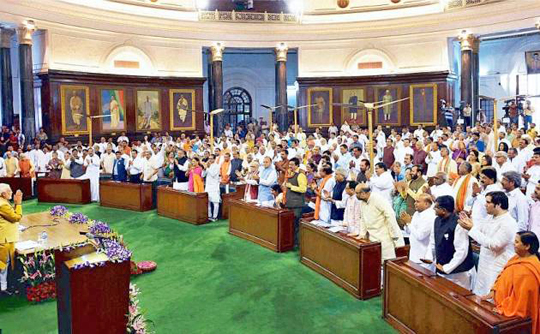
Prime Minister Narendra Modi will at midnight unveil the new tax regime replacing overnight the messy mix of more than a dozen state and central levies built up over seven decades, with a one national GST unifying the country's USD 2 trillion economy and 1.3 billion people into a common market.
President Pranab Mukherjee, who had originally moved the Constitution Amendment bill for bringing GST way back in 2011 when he was the finance minister in the previous UPA regime, will be present alongside eminent personalities at the historic Central-hall of Parliament.
Unlike the last midnight event held in 1997 on the occasion of golden jubilee of the Independence at a special session of Parliament, it will be a gala event at the circular -shaped hall that has been loaned for the launch of the historic reform.
GST to streamline taxes
The government promises that the transition to a single, nationwide tax on goods and services will streamline business and boost the economy by tearing down barriers between 31 states and union territories. It is estimated to add 0.4 per cent to 2 per cent to GDP growth.
But some businesses are still figuring out how it will work as they race against time to adopt or upgrade cash registers and computer system so they are able to file monthly tax returns that comply with the new tax regime.
Opposition to boycott
Opposition parties TMC, Congress and Left see undue haste in the implementation, causing hardships for millions of tiny neighbourhood shops that don't even use a calculator. They have decided to boycott the gala event.
Finance Minister Arun Jaitley made a last minute appeal to them to reconsider their decision saying the landmark indirect tax reform was a result of a joint decision and they cannot run away from it now.
Urging the opposition parties to "display broad shoulders", he said they should not "disassociate" from the decision they were a party to.
But opposition parties say they are not against the GST but only want small businesses, who face wrenching change, to be given more time.
Former prime ministers Manmohan Singh and H D Deva Gowda too have been invited to launch a new taxation system that is set to dramatically re-shape the over USD 2 trillion economy.
But with Congress deciding to boycott the event, Singh may not be seen on the seat reserved for him on the dais.
Jaitley acknowledged there may be "teething troubles" with many businesses as well as state governments still scrambling to get ready. But he has assured that the effort would eventually help reduce rampant tax evasion.
For some businesses, the GST is complex with four broad tax categories of 5, 12, 18 and 28 per cent, and myriad exceptions, as opposed to a simpler, flatter and broader sales taxes in other countries.
Switchover to the GST has added to the worries of businesses that are still recovering from the November 8 shock decision to overnight remove 86 per cent of currency from circulation.
One of the things that is keeping companies occupied ahead of the launch is calculation of input tax credit, which allows them to claim refunds on tax paid on inputs and pay tax on the value adds only. From soft drink makers to automobile firms, companies are busy calculating final consumer price to be charged from July 1.
The government, however, defends the decision saying enough time was given to businesses to adapt to the new regime.
Notwithstanding this, the government will take a lenient view for tax returns filed in the initial period.
Revenue Secretary Hasmukh Adhia said honest tax payers will benefit from GST and the new regime will not result in price increase of any essential or daily use commodity.
Jaitley today met industry associations and traders to nudge them to pass on the benefits of any reduction in tax incidence to consumers.
Industry's reaction
The industry on its part said it will take about 3 months to gauge the situation.
"We assured him (Jaitley) we are ready for the roll out. Even if this was rolled out after 6 months, we would have same amount of panic. Hotel industry will take it in its stride," Bharat Hotels CMD Jyotsna Suri said. Her company runs hotels under the Lalit brand.
First proposed in 2003, the idea of GST was bogged down for years in bipartisan debate, with political parties in government trying to push it and those in opposition dragging it down. Before Modi came to power three years ago, his party was not particularly in favour of the GST.
Over 1,200 items, from shampoo to tea to automobiles, have been put in four broad tax categories.
Unbranded food staples including vegetables, milk, eggs and flour will be exempt from GST, along with health and education services. Tea, edible oils, sugar, textiles and baby formula will attract a 5 per cent tax.

Comments
Add new comment