



India in talks to buy US Predator drones, has eye on China, Pakistan

April 8, 2016

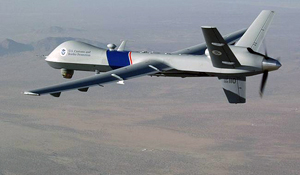
New Delhi, April 8: India is in talks with the United States to purchase 40 Predator surveillance drones, officials said, a possible first step towards acquiring the armed version of the aircraft and a development likely to annoy Pakistan.
drones

India is trying to equip the military with more unmanned technologies to gather intelligence as well as boost its firepower along the vast land borders with Pakistan and China. It also wants a closer eye on the Indian Ocean.

New Delhi has already acquired surveillance drones from Israel to monitor the mountains of Kashmir, a region disputed by the nuclear-armed South Asian rivals and the cause of two of their three wars.

As defence ties deepen with the United States, which sees India as a counterweight to China in the region, New Delhi has asked Washington for the Predator series of unmanned planes built by privately-held General Atomics, military officials said.

"We are aware of Predator interest from the Indian Navy. However, it is a government-to-government discussion," Vivek Lall, chief executive of U.S. and International Strategic Development at San Diego-based General Atomics, told Reuters.

The U.S. government late last year cleared General Atomics' proposal to market the unarmed Predator XP in India. It was not clear when the delivery of the drones would take place.

The navy wants them for surveillance in the Indian Ocean, where the pilotless aircraft can remain airborne for 35 hours at a stretch, at a time when the Chinese navy is expanding ship and submarine patrols in the region.

Moves by India to enhance its defence capabilities have in the past provoked sharp reactions from Islamabad, where the government and military are worried about falling further behind their bigger rival in the arms race.

Pakistan's foreign ministry could not be reached for comment on Friday, the start of the weekend there, while the military had no immediate comment.

India's air force has also asked Washington about acquiring around 100 armed Predator C Avenger aircraft, which the United States has used to carry out strikes against Islamist militants in Pakistan's northwest and neighbouring Afghanistan.

But it would need clearance from the Missile Technology Control Regime group of 34 nations as well as approval from U.S. Congress before any transfer of lethal Predators could happen, officials said.

The push for the drones comes as U.S. Defense Secretary Ash Carter heads to India this weekend for talks to cement military collaboration in the final months of the Obama administration.

Indian military officials said they expected the request for the armed aircraft to figure in Carter's talks with his Indian counterpart, Manohar Parrikar.

Washington wants India to sign a set of agreements including on the use of each other's military bases that would help them operate together.

Prime Minister Narendra Modi's government has signalled its willingness to move forward with the proposed pacts after the previous administration did not act for more than a decade.

Retired air vice marshal Manmohan Bahadur said the proposed acquisition of armed Predators would give the military the ability to carry out cross-border strikes, or even attack targets lying deeper inside a neighbouring country.

"But at the end of the day, it's a political decision. It's one thing to lob artillery shells, its another to use air power, that's an escalation," he said.

India has not moved against Pakistan militarily despite blaming militant groups based there for orchestrating attacks on its soil including one on Mumbai in 2008, in part out of fear it would spiral into a broader conflict.

But a drone strike might be a less risky option, experts said.

Ejaz Haider, a Pakistani security analyst, said Islamabad would object to the transfer of such drones in the region.

But he questioned their effectiveness if they entered Pakistani air space, since it would probably try to shoot them down, something it did not do with U.S. drones.

"There is obviously going to be push-back from Pakistan, because if it (the drone) does get through in some way or other it enhances Indian capability," he said.

Comments

Add new comment

  • Coastaldigest.com reserves the right to delete or block any comments.
  • Coastaldigset.com is not responsible for its readers’ comments.
  • Comments that are abusive, incendiary or irrelevant are strictly prohibited.
  • Please use a genuine email ID and provide your name to avoid reject.
News Network
December 13,2025

New Delhi: School-going children are picking up drug and smoking habits and engaging in consumption of alcohol, with the average age of introduction to such harmful substances found to be around 13 years, suggesting a need for earlier interventions as early as primary school, a multi-city survey by AIIMS-Delhi said.

The findings also showed substance use increased in higher grades, with grade XI/XII students two times more likely to report use of substances when compared with grade VIII students. This emphasised the importance of continued prevention and intervention through middle and high school.

The study led by Dr Anju Dhawan of AIIMS's National Drug Dependence Treatment Centre, published in the National Medical Journal of India this month, looks at adolescent substance use across diverse regions.

The survey included 5,920 students from classes 8, 9, 11 and 12 in urban government, private and rural schools across 10 cities -- Bengaluru, Chandigarh, Delhi, Dibrugarh, Hyderabad, Imphal, Jammu, Lucknow, Mumbai, and Ranchi. The data were collected between May 2018 and June 2019.

The average age of initiation for any substance was 12.9 (2.8) years. It was lowest for inhalants (11.3 years) followed by heroin (12.3 years) and opioid pharmaceuticals (without prescription; 12.5 years).

Overall, 15.1 per cent of participants reported lifetime use, 10.3 per cent reported past year use, and 7.2 per cent reported use in the past month of any substance, the study found.

The most common substances used in the past year, after tobacco (4 per cent) and alcohol (3.8 per cent), were opioids (2.8 per cent), followed by cannabis (2 per cent) and inhalants (1.9 per cent). Use of non-prescribed pharmaceutical opioids was most common among opioid users (90.2 per cent).

On being asked, 'Do you think this substance is easily available for a person of your age' separately for each substance category, nearly half the students (46.3 per cent) endorsed that tobacco products and more than one-third of the students (36.5 per cent) agreed that a person of their age can easily procure alcohol products.

Similarly, for Bhang (21.9 per cent), ganja/charas (16.1 per cent), inhalants (15.2 per cent), sedatives (13.7 per cent), opium and heroin (10 per cent each), the students endorsed that these can be easily procured.

About 95 per cent of the children, irrespective of their grade, agreed with the statement that 'drug use is harmful'.

The rates of substance use (any) among boys were significantly higher than those of girls for substance use (ever), use in the past year and use in the past 30 days. Compared to grade VIII students, grade IX students were more likely, and grade XI/XII students were twice as likely to have used any substance (ever).

The likelihood of past-year use of any substance was also higher for grade IX students and for grade XI/XII students as compared to grade VIII students.

About 40 per cent of students mentioned that they had a family member who used tobacco or alcohol each. The use of cannabis (any product) and opioid (any product) by a family member was reported by 8.2 per cent and 3.9 per cent of students, respectively, while the use of other substances, such as inhalants/sedatives by family was 2-3 per cent, the study found.

A relatively smaller percentage of students reported use of tobacco or alcohol among peers as compared to among family members, while a higher percentage reported inhalants, sedatives, cannabis or opioid use among peers.

Children using substances (past year) compared to non-users reported significantly higher any substance use by their family members and peers.

There were 25.7 per cent students who replied 'yes' to the question 'conflicts/fights often occur in your family'. Most students also replied affirmatively to 'family members are aware of how their time is being spent' and 'damily members are aware of with whom they spend their time'.

Comments

Add new comment

  • Coastaldigest.com reserves the right to delete or block any comments.
  • Coastaldigset.com is not responsible for its readers’ comments.
  • Comments that are abusive, incendiary or irrelevant are strictly prohibited.
  • Please use a genuine email ID and provide your name to avoid reject.