Aadhaar-electoral rolls linking rules may be issued soon; sharing details voluntary: CEC

News Network
May 14, 2022

New Delhi, May 14: Rules on linking Aadhaar with the electoral rolls may be issued by the government soon, Chief Election Commissioner Sushil Chandra has said, adding that sharing Aadhaar details will be voluntary for voters, but those not doing so will have to give "sufficient reasons".

Chandra also said that the poll panel played a key role in intensifying the vaccination drive in the five states where assembly elections concluded in March this year to ensure that voters and those involved in election duty were safe from the coronavirus.

In an interview with PTI, he said two major electoral reforms which took place in his tenure as the CEC are the provision of four dates in a year instead of one to enrol those turning 18 as voters and the linking of Aadhaar with electoral rolls to check duplicate entries in the voters' list.

"Earlier, only January 1 of every year was the cut-off date. We convinced the government that this reform is very essential and these people should be enrolled as soon as they turn 18. With this reform now, there will be four dates in a year to get these people registered when they complete 18 years of age. This reform was pending for the last 20 years," Chandra said.

The four cut-off dates for enrolment is part of a Bill passed by Parliament a few months back to allow linkage of Aadhaar with the electoral rolls.

As of now, those turning 18 on or before January 1 can be registered as voters. Those who turn 18 on January 2 or later have to wait for one year to register as a voter. But once the rules are issued, young people can get registered as voters on four different dates every year.

"The second biggest reform is the linking of Aadhaar with electoral rolls to check duplicate entries. It will make the voter list pure. It will make the electoral roll more robust," he said.

Asked when the rules will be notified by the government, Chandra said "I think very soon because we have already sent draft proposals in this regard. We have also sent the forms which are to be changed and they are with the (law) ministry. Very soon, I think they will be cleared. We will also have to tone up our IT system."

On whether sharing Aadhaar details will be voluntary, he replied in positive. "It will be voluntary. But sufficient reason will have to be given by voters for not giving their Aadhaar numbers. The reason may include not having an Aadhaar or not having applied for one or any other reason they can think of. I can not think of any other reason," the CEC said said.

Chandra was of the view that sharing Aadhaar number will help the EC purify the voter list. It will also ensure that the poll panel is able to give more services to the voters through its communication system, he added.

"If we know about the voter more clearly, then we can give more services such as when the elections will be held and booth (details) on their phone numbers... We should know clearly that he/she is the right person," Chandra said.

Asked about the biggest challenge he has faced as the CEC, he said the "toughest" one was to conduct elections in five states and various bypolls during COVID-19.

"Because when these elections were coming near, we never thought at that time that Covid will intensify. Suddenly, we came to know about the onset of Omicron. We had to prepare as nobody knew much about this variant.

"So suddenly, we had to gear up to make the voting process and the election machinery safe," he added.

During this period, the EC intensified the vaccination process and ensured booster (precaution) doses for its polling personnel, including security forces.

"We had to take the unusual step of stopping campaigning in physical form. Initially, we said only door-to-door campaigning with just five people will be allowed and there will be more emphasis on digital campaigning," Chandra recalled.

"We had regular meetings with health secretaries and chief secretaries of the states. We asked them to intensify vaccination and we kept a close watch every week. We were giving a very graded response to our campaigning methodology. We opened it gradually. By the time electioneering started, the vaccination rate was very high in all the five states, and the voters had been given the first or the second doses as per protocol," he added.

Chandra replied in positive when asked whether it was the EC which had in a way been responsible for intensifying the vaccination drive in the five states.

"Definitely. In states where it was especially less like Uttar Pradesh, Punjab and Manipur, we reviewed the situation and asked the chief sectaries and the health secretaries to boost the vaccination drive.

"Each and every person should have taken at least the first dose. If the first dose had been administered, then the second should be given. In Uttar Pradesh, the first dose coverage was 100 per cent. The percentage of vaccination in Punjab and Manipur also went up. We took each and every step possible to check the spread of Omicron during the elections in these states so that the voters and the voting process can be safe," he said. 

Comments

Add new comment

  • Coastaldigest.com reserves the right to delete or block any comments.
  • Coastaldigset.com is not responsible for its readers’ comments.
  • Comments that are abusive, incendiary or irrelevant are strictly prohibited.
  • Please use a genuine email ID and provide your name to avoid reject.
News Network
November 26,2025

students.jpg

Bengaluru, Nov 26: Karnataka is taking its first concrete steps towards lifting a three-decade-old ban on student elections in colleges and universities. Deputy Chief Minister D.K. Shivakumar announced Wednesday that the state government will form a small committee to study the reintroduction of campus polls, a practice halted in 1989 following incidents of violence.

Speaking at a 'Constitution Day' event organised by the Karnataka Congress, Mr. Shivakumar underscored the move's aim: nurturing new political leadership from the grassroots.

"Recently, (Leader of the Opposition in Lok Sabha) Rahul Gandhi wrote a letter to me and Chief Minister (Siddaramaiah) asking us to think about restarting student elections," Shivakumar stated. "I'm announcing today that we'll form a small committee and seek a report on this."

Student elections were banned in Karnataka in 1989, largely due to concerns over violence and the infiltration of political party affiliates into campus life. The ban effectively extinguished vibrant student bodies and the pipeline of young leaders they often produced.

Mr. Shivakumar, who also serves as the Karnataka Congress president, said that former student leaders will be consulted to "study the pros and cons" of the re-introduction.

Acknowledging the history of the ban, he added, "There were many criminal activities taking place back then. We’ll see how we can conduct (student) elections by regulating such criminal activities."

The Deputy CM reminisced about his own journey, which began on campus. He recalled his political activism at Sri Jagadguru Renukacharya College leading to his first Assembly ticket in 1985 at the age of 23. "That's how student leadership was at the time. Such leadership has gone today. College elections have stopped," he lamented, adding that for many, college elections were "like a big movement" where leaders were forged.

The move, driven by the Congress high command's push to cultivate young talent, will face scrutiny from academics and university authorities who have, in the past, expressed concern that the return of polls could disrupt the peaceful academic environment and turn campuses into political battlegrounds.

Comments

Add new comment

  • Coastaldigest.com reserves the right to delete or block any comments.
  • Coastaldigset.com is not responsible for its readers’ comments.
  • Comments that are abusive, incendiary or irrelevant are strictly prohibited.
  • Please use a genuine email ID and provide your name to avoid reject.
News Network
November 26,2025

Mangaluru, Nov 26: Mangaluru East police have registered a case following a sophisticated online fraud where a 57-year-old local resident was allegedly cheated out of ₹13.4 lakh after being targeted on Facebook.

The scam began in February when the complainant, while browsing Facebook reels, was contacted by a woman identifying herself as "Lillian Mary George" from London. After establishing a chat relationship, the woman claimed she would visit India in November and bring a significant sum of money.

The trap was sprung on November 15, when the victim received a call from a woman named "Sonali Gupta," who claimed Lillian had arrived at Mumbai International Airport but was detained by customs. The fraudsters convinced the man that Lillian was carrying £25,000 (about ₹26 lakh) in traveller’s cheques and 1 kg of gold (valued at around ₹30 lakh).

Under the pretense of clearing these items, the victim was asked to make numerous online transfers between November 15 and 18 for various bogus charges, including:

•    "Pounds exchange registration"
•    "Customs declaration issues"
•    "Discount charges"
•    "Money-laundering charges"

Believing the fictitious story, the complainant transferred the cumulative sum of ₹13.4 lakh to various bank accounts provided by the fraudsters. He realised he was cheated when the culprits later promised a refund within two days but stopped answering his calls. The Mangaluru East police are now investigating the case, which highlights the continuing threat of transnational cyber fraud using social engineering and promises of fictitious wealth.

Comments

Add new comment

  • Coastaldigest.com reserves the right to delete or block any comments.
  • Coastaldigset.com is not responsible for its readers’ comments.
  • Comments that are abusive, incendiary or irrelevant are strictly prohibited.
  • Please use a genuine email ID and provide your name to avoid reject.
Agencies
November 22,2025

indiapak.jpg

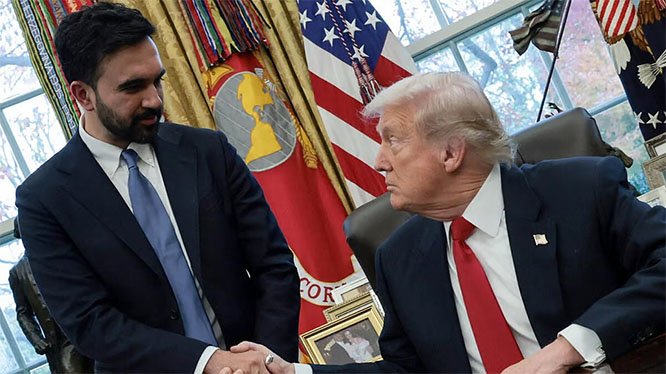
New York/Washington: US President Donald Trump has again claimed to have solved the conflict between India and Pakistan, repeating his assertion during a meeting with New York City Mayor-elect Zohran Mamdani in the Oval Office.

Mamdani flew to Washington DC for his first meeting with Trump in the White House on Friday. Trump said he “enjoyed” the meeting, which he described as “great.”

During remarks in the Oval Office, with Mamdani standing next to him, Trump repeated his claim that he solved the May conflict between India and Pakistan.

"I did eight peace deals of countries, including India and Pakistan,” he said.

On Wednesday, Trump had said he threatened to put 350 per cent tariffs on India and Pakistan if they did not end their conflict, repeating his claim that he solved the fighting between the nuclear-armed neighbours and that Prime Minister Narendra Modi had called him to say “we're not going to go to war.”

Since May 10, when Trump announced on social media that India and Pakistan had agreed to a “full and immediate” ceasefire after a “long night” of talks mediated by Washington, he has repeated his claim over 60 times that he “helped settle” the tensions between India and Pakistan.

India has consistently denied any third-party intervention. India launched Operation Sindoor on May 7, targeting terror infrastructure in Pakistan and Pakistan-occupied Kashmir in retaliation for the April 22 Pahalgam attack that killed 26 civilians. India and Pakistan reached an understanding on May 10 to end the conflict after four days of intense cross-border drone and missile strikes.

Mamdani emerged victorious in the closely-watched battle for New York City Mayor, becoming the first South Asian and Muslim to be elected to sit at the helm of the largest city in the US.

He had been the front-runner in the NYC Mayoral election for months and defeated Republican nominee Curtis Sliwa and political heavyweight former New York State Governor Andrew Cuomo, who ran as an independent candidate and was officially endorsed by Trump just hours before the elections.

Indian-descent Mamdani is the son of renowned filmmaker Mira Nair and Columbia University professor Mahmood Mamdani. He was born and raised in Kampala, Uganda and moved to New York City with his family when he was 7. Mamdani became a naturalised US citizen only recently, in 2018.

Comments

Add new comment

  • Coastaldigest.com reserves the right to delete or block any comments.
  • Coastaldigset.com is not responsible for its readers’ comments.
  • Comments that are abusive, incendiary or irrelevant are strictly prohibited.
  • Please use a genuine email ID and provide your name to avoid reject.