Aligarh Muslim University’s ex Vice-chancellor Tariq Mansoor is BJP’s new Vice President

News Network
July 29, 2023

mansoor.jpg

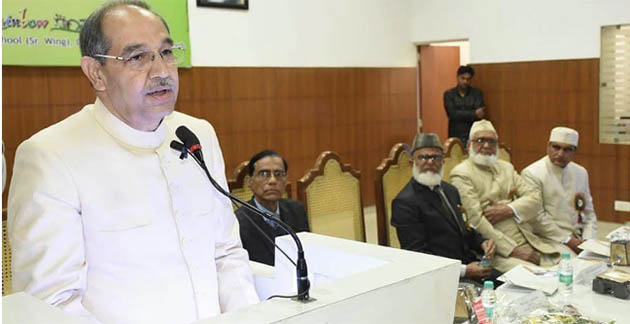
New Delhi, July 29: In an attempt to strengthen its ongoing outreach among Muslim Pasmanda communities, the BJP on Sunday appointed former Aligarh Muslim University vice-chancellor Tariq Mansoor as one of its vice presidents.

Mr Mansoor was instrumental in steering the AMU, one of the hotbeds of anti-NRC and CAA protests, on a "middle path", and later closely working with the RSS on its project to promote the teachings of Mughal prince Dara Shikoh on peaceful Hindu-Muslim coexistence that was in contradiction to his brother Mughal emperor Aurangzeb's way of working.

The appointment came on a day when Home Minister Amit Shah was in Rameshwaram in Tamil Nadu to launch a book on former president APJ Abdul Kalam, also one of the icons of the party's Pasmanda outreach.

BJP has been continuously reaching out to a section of the Muslim population through Minority Morcha meetings, mostly focused on Pasmanda Muslims, who are from Dalit and other backward class communities. Mr Mansoor was elected to the Uttar Pradesh Legislative Council, the fourth Muslim picked by the BJP for the post in the last few years.

Tariq Mansoor is from Aligarh in Uttar Pradesh, where Muslims constitute roughly 19% of the state's electorate, and have a sizeable presence in at least 30 Lok Sabha seats, out of which they play a major role in deciding the outcome in 15 to 20 constituencies. 

According to an RSS functionary, Mr Mansoor had impressed the sangh's leadership by his work on the Dara Shikoh project, by effectively using the AMU's Persian department to translate much of Shikoh's work on inter-faith dialogue and project him as an ideal for the Muslim community. He organised seminars and conferences on the same.

Mr Mansoor, a surgeon, has been associated with AMU since the 1970s when he completed his MBBS degree in surgery from the university's JN Medical College. He then went on to do his Master of Surgery (MS) degree in 1982 from the same college. Apart from the BJP's focus on the Pasmanda Muslims, which is important in terms of influence, the RSS has been specifically reaching out to Muslim academics, and people of the community from professions such as medicine, law, and bureaucracy, to make a difference in the minority discourse.

Jamal Siddiqui, head of the BJP's Minority Morcha said Mr Mansoor was a "nationalist Muslim" who has always promoted the ideal of "nation first." "His understanding of the fault lines in the Muslim community is as deep as his knowledge about the country and its history. He has led the students of AMU on the right path and prevented them from being misled. His appointment will help the party to expand better."

He was the fourth person from the Muslim community to be promoted to the Legislative Council by the party in UP since 2017, after Bukkal Nawab, Mohsin Raza, and Danish Azad Ansari.

Mr Mansoor was the AMU Vice Chancellor when it witnessed protests against the Citizenship Amendment Act (CAA) and the proposed National Register of Citizens (NRC) in 2020. He was then criticised for "not standing up for students" when policemen allegedly barged into the university, as opposed to the VC of Jamia Millia Islamia in Delhi, who stood by the students. Mr Mansoor has, however, always said he did his best, and talked about the importance of welfare and socio-economic justice over identity issues.

"Mansoor belongs to Aligarh, the hub of Muslim politics, and comes from an educated, middle class family. His family has doctors and lawyers. This is the kind of Muslims we want to work with to take the nation forward," a BJP functionary from UP said.

Khalid Anis Ansari, associate professor from Azim Premji University, who has been actively raising issues pertaining to the community for many years, has often pointed out that Indian Muslims too are victims of caste-based stratification, and are divided into three main classes, and hundreds of biradaris.

The 'Ashraf' Muslims, or native upper caste converts, for instance Syed, Sheikh, Mughal, Pathan, etc are at the top, and the Syed biradari is highly revered. The movements against the Ashraf dominance have been led by the 'lower' ones - Ajlaf (backward Muslims) and Arzal (Dalit Muslims), and these are known as Pasmandas, the community the BJP has been trying to woo. Only 15 percent of the community come from these upper caste communities, while the rest are largely Pasmanda Muslims. The BJP has planned a massive Sneh Yatra to reach out to these Pasmanda Muslims in the coming days.

Muslim intellectuals and opposition parties have, however, said this was an attempt by the BJP to create a divide among the Muslim community, and that often the Muslim victims of hate crimes or economic boycott were Pasmanda themselves.

Comments

Add new comment

  • Coastaldigest.com reserves the right to delete or block any comments.
  • Coastaldigset.com is not responsible for its readers’ comments.
  • Comments that are abusive, incendiary or irrelevant are strictly prohibited.
  • Please use a genuine email ID and provide your name to avoid reject.
News Network
December 3,2025

indigo.jpg

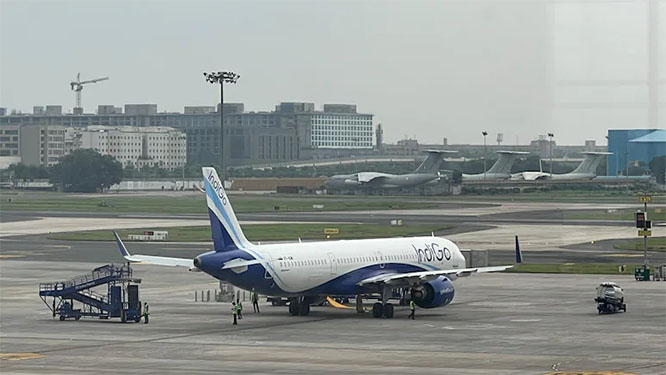
IndiGo, India’s largest airline, is battling one of its worst operational disruptions in recent years, with hundreds of delays and cancellations throwing domestic travel into chaos.

Government data on Tuesday showed its on-time performance plunging to 35%, an unusual dip for a carrier long associated with punctuality.

By Wednesday afternoon, airports in Delhi, Mumbai, Bengaluru and Hyderabad had collectively reported close to 200 cancellations, stranding travellers across the country.

Crew Shortage After New Duty Norms

A major trigger behind the meltdown is a severe crew shortage, especially among pilots, following the rollout of revised Flight Duty Time Limitation (FDTL) norms last month.

The rules mandate longer rest hours and more humane rosters — a shift IndiGo has struggled to incorporate across its vast network.

Sources said several flights were grounded due to lack of cabin crew, while some delays stretched upwards of eight hours.

With IndiGo controlling over 60% of India’s domestic aviation market, the ripple effect has impacted airports nationwide.

IndiGo Issues Apology, Lists “Compounding Factors”

In a statement, IndiGo acknowledged the large-scale disruption:

“We sincerely apologise to customers. A series of unforeseen operational challenges — technology glitches, winter schedule changes, adverse weather, system congestion and updated FDTL norms — created a compounding impact that could not have been anticipated.”

To stabilise operations, the airline has begun calibrated schedule adjustments for the next 48 hours, aiming to restore punctuality. Affected passengers are being offered refunds or alternate travel arrangements, IndiGo said.

What the FDTL Rules Require

The FDTL norms, designed to reduce pilot fatigue, cap duty and flying hours as follows:
•    Maximum 8 hours of flying per day
•    35 hours per week
•    125 hours per month
•    1,000 hours per year

Crew must also receive rest equalling twice the flight duration, with a minimum 10-hour rest period in any 24-hour window.

The DGCA introduced these limits to enhance flight safety.

Hyderabad: 33 Flights Cancelled, Long Queues Reported

Hyderabad’s Rajiv Gandhi International Airport saw heavy early-morning crowds as 33 IndiGo flights (arrivals and departures) were cancelled.

The airport clarified on X that operations were normal, advising passengers to contact IndiGo directly for latest flight status.

Cancellations included flights to and from Visakhapatnam, Goa, Ahmedabad, Delhi, Bengaluru, Chennai, Madurai, Hubli, Bhopal and Bhubaneswar.

Bengaluru: 42 Flights Disrupted

Bengaluru’s Kempegowda International Airport recorded 42 cancellations — 22 arrivals and 20 departures — affecting routes to Delhi, Mumbai, Chennai, Hyderabad, Goa, Kolkata and Lucknow.

Passengers Vent on Social Media

Irate travellers took to X to share their experiences. One passenger stranded in Hyderabad wrote: “I have been here since 3 a.m. and missed an important meeting.”

Another said: “My flight was pushed from 1:55 PM to 2:55 PM and now 4:35 PM. I was informed only three minutes before entering the airport.”

Delhi Airport Hit by Tech Glitch

At Delhi Airport, the disruption deepened due to a slowdown in the Amadeus system — used for reservations, check-ins and departure control.

The technical issue led to longer queues and sluggish processing, adding to delays already worsened by staff shortages.

Comments

Add new comment

  • Coastaldigest.com reserves the right to delete or block any comments.
  • Coastaldigset.com is not responsible for its readers’ comments.
  • Comments that are abusive, incendiary or irrelevant are strictly prohibited.
  • Please use a genuine email ID and provide your name to avoid reject.
News Network
November 21,2025

Bengaluru, Nov 21: The Karnataka government is facing pressure to overhaul its employment system after a high-level Cabinet sub-committee recommended the complete phase-out of job outsourcing in government offices, boards, and corporations by March 2028. The move is aimed at tackling a systemic issue that has led to the potential violation of constitutional reservation policies and the exploitation of workers.

The Call for Systemic Change

With over three lakh vacant posts currently being filled through private agencies on an outsource, insource, or daily wage basis, the sub-committee highlighted a significant lapse. "As a result, reservations are not being followed as per the Constitution and state laws. It’s an urgent need to take serious steps to change the system. It has been recommended to completely stop the system of outsourcing by March 2028," the panel stated in a document.

The practice of outsourcing involves private companies hiring workers to perform duties for a government agency. Critics argue this model results in lesser salaries, a lack of social security benefits (otherwise available to permanent government employees), and a failure to adhere to the provisions of Articles 14 and 15 of the Constitution, which guarantee equality before the law and prohibit discrimination.

The 'Bidar Model' as a Stop-Gap Solution

To regulate the current mode of employment and reduce worker exploitation until the 2028 deadline, the government plans to establish workers’ services multi-purpose cooperative societies across all districts, following the successful "Bidar Model."

The Bidar District Services of Labour Multi-purpose Cooperative Society Ltd., which operates under the District Commissioner, is cited as a successful example of providing a measure of social security to outsourced staff. Labour Department officials argue this society ensures workers receive their due wages and statutory facilities like ESI (Employees' State Insurance) and PF (Provident Fund), in exchange for a 1% service fee collected from the employees.

legislative push and Priority Insourcing

The recommendations, led by the sub-committee headed by Law and Parliamentary Affairs Minister H K Patil, are set to be discussed at the next Cabinet meeting. The committee has proposed the introduction of the Karnataka Outsourced Employees (Regulation, Placement and Welfare) Bill 2025.

In a move addressing immediate concerns, Labour Minister Santosh Lad, a member of the sub-committee, has reportedly assured that steps will be taken over the next 2-3 years to insource workers in "life-threatening services" on a priority basis. This includes essential personnel like pourakarmikas (sanitation workers), drivers, electrical staff in the Energy Department, and Health Department staff handling contagious diseases. The transition aims to grant these workers the long-term security and benefits they currently lack under the outsourcing system. 

Comments

Add new comment

  • Coastaldigest.com reserves the right to delete or block any comments.
  • Coastaldigset.com is not responsible for its readers’ comments.
  • Comments that are abusive, incendiary or irrelevant are strictly prohibited.
  • Please use a genuine email ID and provide your name to avoid reject.
coastaldigest.com news network
November 28,2025

roadshow.jpg

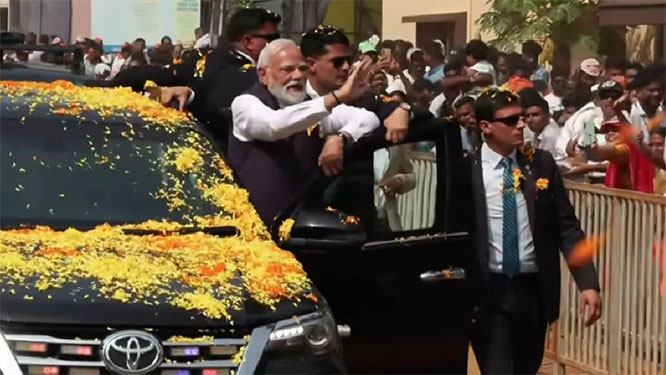
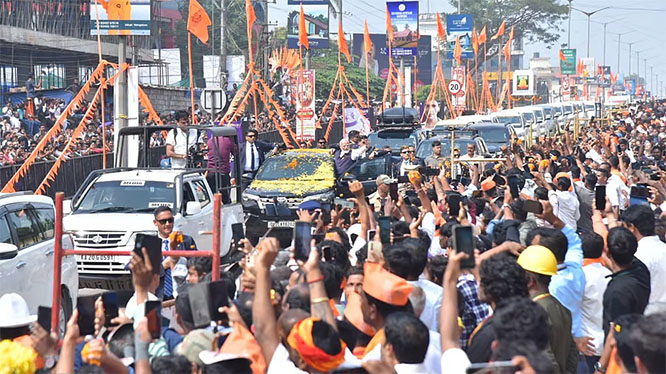
Udupi district transformed into a sea of saffron and celebration on Friday, November 28, as Prime Minister Narendra Modi’s roadshow swept through the coastal temple town. Thousands of residents lined the streets, turning the event into a vibrant public spectacle filled with cheers, flags, and festive energy.

The procession route—from the helipad to the historic Sri Krishna Math—was decked with buntings, saffron flags, and multilayered security barricades. One of the district’s largest-ever security deployments was put in place for the high-profile visit, with over 3,000 police personnel on duty. The arrangement included ten SPs, 27 DSPs, 49 inspectors, 127 sub-inspectors, 232 assistant sub-inspectors, 1,608 constables, and 39 women staff.

Six platoons of the Karnataka State Reserve Police, six Quick Response Teams, bomb detection units, and dog squads were stationed across Udupi. Enhanced surveillance covered Adi Udupi, Bannanje bus stand, and the Sri Krishna Math parking zone, with combing operations carried out along the roadshow corridor.

At the 800-year-old Sri Krishna Math, preparations reached a ceremonial peak. Paryaya Puttige Math seer Sugunendra Teertha Swamiji said the Prime Minister would take part in the Laksha Kantha Geetha Parayana, a mass chanting of the Bhagavad Gita by one lakh devotees, and inaugurate the new Suvarna Teertha Mantapa.

“He will first offer floral tributes to saint-poet Kanakadasa and then unveil the golden covering over the Kanakana Kindi,” the seer said.

The Prime Minister will also receive a Poorna Kumbha welcome and have darshan of Lord Sri Krishna, Mukhyaprana Devaru, and the Suvarna Paduke. Union Minister Pralhad Joshi, Karnataka Governor Thaawarchand Gehlot, Minister Bairathi Suresh, Dharmadhikari D. Veerendra Heggade, and seers from the Ashta Maths are expected to join the ceremony.

Ahead of his arrival, the Prime Minister posted on X that he felt “honoured” to attend the spiritually significant gathering. “This is a special occasion that brings together people from different sections of society for a recital of the Gita. This Matha has a very special significance in our cultural life,” he wrote, noting the institution’s long-standing legacy rooted in the teachings of Sri Madhvacharya.

roadshow2.jpg

Comments

Add new comment

  • Coastaldigest.com reserves the right to delete or block any comments.
  • Coastaldigset.com is not responsible for its readers’ comments.
  • Comments that are abusive, incendiary or irrelevant are strictly prohibited.
  • Please use a genuine email ID and provide your name to avoid reject.