‘Billionaire Raj’: India now more unequal than in British Raj; top 1% income, wealth shares reach historical highs

News Network
March 21, 2024

billionairs.jpg

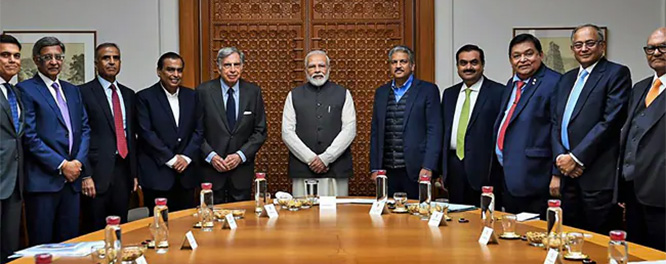
New Delhi: India has now become more unequal in terms of wealth concentration than the British colonial period as income and wealth of the top 1% of the country’s population have hit historical highs, according to a paper released by World Inequality Lab.

By 2022-23, the top 1 per cent income share in India was 22.6 per cent and the top 1 per cent wealth share rose to 40.1 per cent, with India’s top 1 per cent income share among the very highest in the world, higher than even South Africa, Brazil and the US.

Co-authored by economists Nitin Kumar Bharti, Lucas Chancel, Thomas Piketty, and Anmol Somanchi, the paper stated that the “Billionaire Raj” headed by “India’s modern bourgeoisie” is now more unequal than the British Raj headed by the colonialist forces. 

The paper said there is evidence to suggest the Indian tax system might be “regressive when viewed from the lens of net wealth”. A restructuring of the tax code is needed, the paper said, adding that a levy of a “super tax” of 2 per cent on the net wealth of 167 wealthiest families would yield 0.5 per cent of national income in revenues and create space for investments.

“A restructuring of the tax code to account for both income and wealth, and broad-based public investments in health, education and nutrition are needed to enable the average Indian, and not just the elites, to meaningfully benefit from the ongoing wave of globalisation. Besides serving as a tool to fight inequality, a “super tax” of 2% on the net wealth of the 167 wealthiest families in 2022-23 would yield 0.5% of national income in revenues and create valuable fiscal space to facilitate such investments,” the paper said. 

The paper has analysed data based on the annual tax tabulations published by the Indian income tax authorities to extract the distribution of top income earners between 1922-2020.

The share of national income going to the top 10 per cent fell from 37 per cent in 1951 to 30 per cent by 1982 after which it began steadily rising. From the early 1990s onwards, the top 10 per cent share increased substantially over the next three decades, nearly touching 60 per cent in the most recent years, the paper said. This compares with the bottom 50 per cent getting only 15 per cent of India’s national income in 2022-23.

 The top 1 per cent earn on average Rs 5.3 million, 23 times the average Indian (Rs 0.23 million). Average incomes for the bottom 50 per cent and the middle 40 per cent stood at Rs 71,000 (0.3 times national average) and Rs 1,65,000 (0.7 times national average), respectively.
The richest, nearly 10,000 individuals (of 92 million Indian adults) earn on average Rs 480 million (2,069 times the average Indian). “To get a sense of just how skewed the distribution is, one would have to be at nearly the 90th percentile to earn the average income in India,” the paper said.

In 2022, just the top 0.1 per cent in India earned nearly 10 per cent of the national income, while the top 0.01 per cent earned 4.3 per cent share of the national income and top 0.001 per cent earned 2.1 per cent of the national income.

Enlisting the probable reasons for sharp rise in top 1 per cent income shares, the paper said public and private sector wage growth could have played a part till the late 1990s, adding that there are good reasons to believe capital incomes likely played a role in subsequent years. For the shares of the bottom 50 per cent and middle 40 per cent remaining depressed, the paper said, the primary reason has been the lack of quality broad-based education, focused on the masses and not just the elites.

“One reason to be concerned with such high levels of inequality is that extreme concentration of incomes and wealth is likely to facilitate disproportionate influence on society and government. This is even more so in contexts with weak democratic institutions. After largely being a role model among post-colonial nations in this regard, the integrity of various key institutions in India appears to have been compromised in recent years. This makes the possibility of India’s slide towards plutocracy even more real. If only for this reason, income and wealth inequality in India must be closely tracked and challenged,” it said.

Comments

Add new comment

  • Coastaldigest.com reserves the right to delete or block any comments.
  • Coastaldigset.com is not responsible for its readers’ comments.
  • Comments that are abusive, incendiary or irrelevant are strictly prohibited.
  • Please use a genuine email ID and provide your name to avoid reject.
News Network
December 4,2025

indigoflight.jpg

Domestic carrier IndiGo has cancelled over 180 flights from three major airports — Mumbai, Delhi and Bengaluru — on Thursday, December 4, as the airline struggles to secure the required crew to operate its flights in the wake of new flight-duty and rest-period norms for pilots.

While the number of cancellations at Mumbai airport stands at 86 (41 arrivals and 45 departures) for the day, at Bengaluru, 73 flights have been cancelled, including 41 arrivals, according to a PTI report that quoted sources.

"IndiGo cancelled over 180 flights on Thursday at three airports-Mumbai, Delhi and Bengaluru," the source told the news agency.

Besides, it had cancelled as many as 33 flights at Delhi airport for Thursday, the source said, adding, "The number of cancellations is expected to be higher by the end of the day."

The Gurugram-based airline's On-Time Performance (OTP) nosedived to 19.7 per cent at six key airports — Delhi, Mumbai, Chennai, Kolkata, Bengaluru and Hyderabad — on December 3, as it struggled to get the required crew to operate its services, down from almost half of December 2, when it was 35 per cent.

"IndiGo has been facing acute crew shortage since the implementation of the second phase of the FDTL (Flight Duty Time Limitations) norms, leading to cancellations and huge delays in its operations across the airports," a source had told PTI on Wednesday.

Chaos continued at several major airports for the third day on Thursday because of the cancellations.

A spokesperson for the Kempegowda International Airport (KIA) in Bengaluru said that 73 IndiGo flights had been cancelled on Thursday.

At least 150 flights were cancelled and dozens of others delayed on Wednesday, airport sources said, leaving thousands of travellers stranded, according to news agency Reuters.

The Directorate General of Civil Aviation (DGCA) has said it is investigating IndiGo flight disruptions and has asked the airline to submit the reasons for the current situation, as well as its plans to reduce flight cancellations and delays.

It may be mentioned here that the pilots' body, Federation of Indian Pilots (FIP), has alleged that IndiGo, despite getting a two-year preparatory window before the full implementation of new flight duty and rest period norms for cockpit crew, "inexplicably" adopted a "hiring freeze".

The FIP said it has urged the safety regulator, the DGCA, not to approve airlines' seasonal flight schedules unless they have adequate staff to operate their services "safely and reliably" in accordance with the New Flight Duty Time Limitations (FDTL) norms.

In a letter to the DGCA late on Wednesday, the FIP urged the DGCA to consider re-evaluating and reallocating slots to other airlines, which have the capacity to operate them without disruption during the peak holiday and fog season if IndiGo continues to "fail in delivering on its commitments to passengers due to its own avoidable staffing shortages."

Comments

Add new comment

  • Coastaldigest.com reserves the right to delete or block any comments.
  • Coastaldigset.com is not responsible for its readers’ comments.
  • Comments that are abusive, incendiary or irrelevant are strictly prohibited.
  • Please use a genuine email ID and provide your name to avoid reject.
News Network
November 21,2025

Tejas.jpg

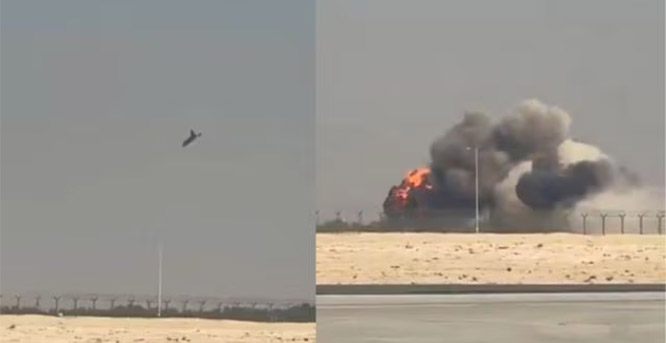
An Indian Air Force (IAF) Tejas fighter jet crashed on Friday, November 21, afternoon during its aerial demonstration at the Dubai Air Show, plunging to the ground at around 2:10 pm local time while performing a manoeuvre before thousands of spectators.

The IAF confirmed the incident, stating that a Tejas aircraft participating in the show had crashed and that further details were being gathered. An Air Force spokesperson said more information would be shared after initial assessments.

The crash sent thick black smoke billowing into the sky near the airport, causing panic among visitors, including families and children who had gathered to watch the display. Authorities have not yet confirmed whether the pilot managed to eject before the aircraft went down. Emergency response teams rushed to the scene, and officials have not released information on casualties or damage so far.

The Tejas is a 4.5-generation, multi-role fighter aircraft developed indigenously by Hindustan Aeronautics Limited (HAL). Designed for versatility, it is capable of offensive air support, close combat, ground attack missions and maritime operations. The aircraft family includes single-seat fighters and twin-seat trainers for both the Air Force and Navy.

HAL describes the latest version, the LCA Mk1A, as the most advanced in the series, featuring an AESA radar, an upgraded electronic warfare suite with radar-warning and self-protection jamming, smart multifunction displays, a digital map generator, a combined interrogator–transponder system and a modern radio altimeter. These enhancements significantly improve the aircraft’s combat capability and survivability.

Further updates from IAF and UAE authorities are awaited.

Comments

Add new comment

  • Coastaldigest.com reserves the right to delete or block any comments.
  • Coastaldigset.com is not responsible for its readers’ comments.
  • Comments that are abusive, incendiary or irrelevant are strictly prohibited.
  • Please use a genuine email ID and provide your name to avoid reject.
News Network
November 28,2025

ministerPM.jpg

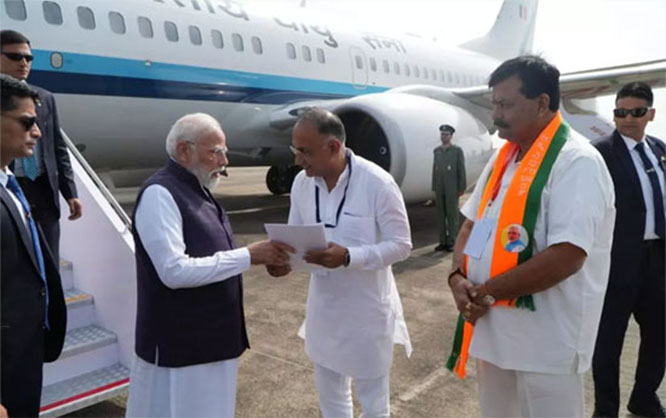
Mangaluru, Nov 28: Karnataka Health Minister and Dakshina Kannada district in-charge minister Dinesh Gundu Rao on Friday handed over Chief Minister Siddaramaiah’s letter to Prime Minister Narendra Modi, highlighting the severe distress faced by farmers due to crashing crop prices.

PM Modi arrived at the Mangaluru International Airport en route to Udupi, where Gundu Rao welcomed him and submitted the letter. The chief minister’s message stressed that farmers are suffering heavy losses because maize and green gram are being bought far below the Minimum Support Price (MSP). The state urged the Centre to immediately begin procurement at MSP.

According to the letter, Karnataka has a bumper harvest this year—over 54.74 lakh metric tons of maize and 1.98 lakh metric tons of green gram—yet farmers are unable to secure fair prices. Against the MSP of ₹2,400/MT for maize and ₹8,768/MT for green gram, market rates have plunged to ₹1,600–₹1,800 and ₹5,400 respectively.

The chief minister has requested the Centre to:

• Direct NAFED, FCI and NCCF to start MSP procurement immediately.
• Ensure ethanol units purchase maize directly from farmers or FPOs.
• Increase Karnataka’s ethanol allocation, citing high production capacity.
• Stop maize imports, which have depressed domestic prices.
• Relax quality norms for green gram, allowing up to 10% discoloration due to rains.

The letter stresses that MSP is crucial for farmer dignity and income stability and calls for swift central intervention to prevent a deepening crisis.

Comments

Add new comment

  • Coastaldigest.com reserves the right to delete or block any comments.
  • Coastaldigset.com is not responsible for its readers’ comments.
  • Comments that are abusive, incendiary or irrelevant are strictly prohibited.
  • Please use a genuine email ID and provide your name to avoid reject.