



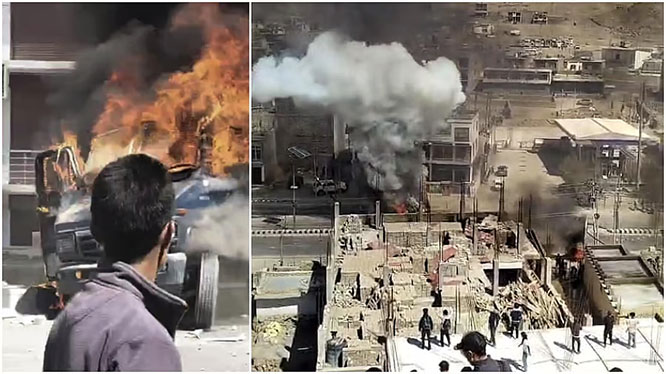
Srinagar: Violent protests erupted in Leh, Ladakh on Wednesday after the health of two supporters of Sonam Wangchuk deteriorated during his ongoing hunger strike demanding full statehood for the Union Territory and constitutional safeguards.
Wangchuk, the renowned climate activist and educator, has been on a 35-day fast pressing for full-fledged statehood for Ladakh and its inclusion under the Sixth Schedule of the Constitution to protect land, jobs, and cultural identity. His protest has reignited long-standing concerns over Ladakh’s political future.
Videos circulating on social media showed hundreds of youths taking to the streets in Leh, accusing the Central government of “denying Ladakh its rights.” Several clips shared on X (formerly Twitter) showed protesters attempting to storm the Ladakh Autonomous Hill Development Council (LAHDC) office while police tried to contain the crowd.
Tensions escalated as demonstrators pelted stones at the LAHDC building and security personnel. Several vehicles were set on fire, and the local office of the Bharatiya Janata Party (BJP) was vandalised amid accusations that the party had failed to fulfil promises made when Ladakh was carved out as a Union Territory in August 2019. Police responded with baton charges and tear gas to disperse the crowd.
Earlier, on September 20, the Union Ministry of Home Affairs (MHA) announced the resumption of talks with Ladakh leadership, with the next round scheduled for October 6. A high-powered committee was formed on January 2, 2023, after repeated protests in Ladakh, with the Leh Apex Body (LAB) and Kargil Democratic Alliance (KDA) demanding statehood and Sixth Schedule status.
Reacting to Wednesday’s unrest, KDA leader Sajad Kargili said on X: “Whatever is happening in Leh is unfortunate. Ladakh, once peaceful, is now gripped by frustration and insecurity due to the government’s failed UT experiment. The onus lies on the government—resume dialogue, act sensibly, and fulfil Ladakh’s demand for statehood and Sixth Schedule without delay. I also appeal to people to remain peaceful and steadfast.”
The push for protections dates back to the aftermath of Article 370’s abrogation, when Ladakh was separated from Jammu and Kashmir and downgraded to a Union Territory without a legislature. Since then, political groups and civil society have repeatedly warned of threats to land, job rights, and Ladakh’s cultural identity.
This is not the first instance of unrest in the region. In 2019, large-scale protests erupted in Kargil against UT status. Joint demonstrations by LAB and KDA in 2021 and 2022 mobilised thousands across Leh and Kargil for constitutional safeguards. Last year, a major rally brought together Buddhist and Muslim leaders warning that Ladakh’s distinct identity was at risk without legislative protections.
In solidarity with the Leh protesters, the KDA has called for a complete shutdown on Thursday. Authorities have increased police deployment across both Leh and Kargil districts, though the situation in Leh remained tense at the time of filing this report.

Comments
Add new comment