



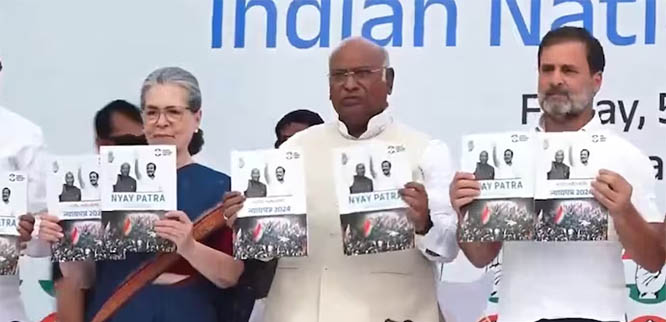
Congress Manifesto 2024 focuses on jobs, reservation, healthcare; promises Caste Census; silent on CAA

News Network
April 5, 2024

manifesto.jpg

New Delhi: The Congress has released its manifesto for the 2024 Lok Sabha election, with jobs creation, development of infrastructure, and a national caste census among the major highlights.

The manifesto was released in Delhi by party boss Mallikarjun Kharge, who was flanked by senior leaders Sonia Gandhi and Rahul Gandhi. Former Union Finance Minister P Chidambaram - who led the committee that drafted the document - was also present.

"This manifesto will be 'nyay ka dastavez' (a document for justice) in the political history of the country. From the five pillars of the 'Bharat Jodo Nyaya Yatra' - yuva (youth), kisan (farmers), naari (women), shramik (workers), and hissedari (equity), 25 guarantees will emerge... ," Mr Kharge said.

The overall theme of the manifesto is based on 'work', 'wealth', and 'welfare', the party said.

"'Work' means you must provide jobs. 'Wealth' must be created before it is distributed. 'Welfare' means taking care of the poorer sections," the Congress said.

Silent on CAA

While the manifesto is silent on the controversial Citizenship (Amendment) Act and restoration of Article 370, the party promises immediate restoration of statehood to Jammu and Kashmir.

Caste Census

One of the biggest talking points is the caste census - a political hot topic that has been in the headlines since the Bihar government's statewide survey was released in November.

The 48-page document promises to amend the Constitution to raise the 50 per cent cap on reservations for SCs, STs and OBCs, with Caste Census providing the latest data to go ahead with the affirmative action. Addressing land issues, the party also pledges to establish an authority to monitor the distribution of government land and surplus land under the land ceiling Acts to the poor.

MSP for Farmers

The party has also promised to implement MSP, or minimum support price, for farmer growing cash crops. The MSP issue has been at the heart of protests by farmers since 2020, when lakhs from across the country went on a months-long agitation against the centre's (now-scrapped) three farm laws.

The Congress has said it will give a permanent legal guarantee for MSP - a core demand for protesting farmers - based on the formula recommended by the Swaminathan Commission.

"Congress has been the only party that has lent its ear to the distress of the farmers and farm labourers, and we are determined to do everything possible to alleviate their pain and make agriculture a desirable livelihood," the party said, attacking the BJP's response to the farmers protest as "callous and brutal".

Poverty

The party also vowed to eliminate poverty by improving the fortunes of 23 crore people over the next decade. Mr Chidambaram attacked the BJP as a "government of the rich, by the rich, and for the rich", and said it is "driven by the interests of the top 1 per cent".

"... but we will look at the bottom 50 per cent. The bottom 50 per cent is as important. It has been estimated 23 crore people are still poor in this country. The UPA lifted 24 crore people out of poverty and we promise, if the Congress-led government comes to power in 2024, we will lift 23 crore in 10 years."

As part of this promise - and to empower women - the Congress said it would launch a 'Mahalakshmi' scheme to provide an unconditional cash transfer of Rs 1 lakh per year to the oldest female member of every poor family.  Beneficiaries will be identified as those from the bottom level of the income pyramid.

Inequality of income and opportunity remain India's ugliest truth. It is the moral and political responsibility of any government to ensure that every family is assured of a basic income every month, the party said.

National Security, China

The Congress said it "recognises that national security is not enhanced by chest-thumping or exaggerated claims, but by quiet attention to borders and resolute defence preparedness".

The party said it would work to restore status quo on the country's borders with China and "ensure areas where both armies patrolled in the past are again accessible to our soldiers".

This has been seen as a direct jab at the BJP over the military stand-off with China in parts of eastern Ladakh following violence in June 2020 that, the opposition has repeatedly claimed, led to New Delhi surrendering territory to Beijing.

On diplomatic tension with Maldives, the Congress said it work to "repair relations".

Healthcare

Universal free healthcare, including cost of diagnosis, surgery, and medication, will be made available, the party said. This will come with cashless insurance up to ₹ 25 lakh, like the model implemented in Rajasthan, when the Congress was in power.

"We promise that healthcare will be universal and free in public health centres, such as hospitals, clinics, PHCs, MHCs, and dispensaries, as well as health camps. Free healthcare will include examination, diagnosis, treatment, surgery, medicines, rehabilitation, and palliative care."

The Congress said it would also establish Assisted Living and Care Centres for disabled people and provide representation for them in local bodies.

Other Major Points

In a move likely to resonate strongly among unemployed youth struggling with massive loan debts, the party said it would "as a one-time measure of relief" write off all student educational loans, including unpaid interest. This amount will be calculated as on March 15.

Banks will be compensated by the government, the Congress said.

The party said it would also introduce a law to "recognise civil unions between couples belonging to the LGBTQIA+ community".

The Congress said it would amend laws to "combine the efficiency of EVM and transparency of ballot papers". "Voting will be through the EVM but the voter will be able to hold and deposit the machine-generated voting slip into the voter-verifiable paper audit trail (VVPAT) unit," the party said.

2024 Lok Sabha Election

The election will be spread over seven phases beginning April 19. Votes will be declared June 4.

Prime Minister Narendra Modi and the ruling BJP - which is yet to release its manifesto - are bidding for a third consecutive term.  They face a combined challenge from the opposition, which has united (for the most part) under the INDIA banner led by the Congress. 

Comments

Add new comment

  • Coastaldigest.com reserves the right to delete or block any comments.
  • Coastaldigset.com is not responsible for its readers’ comments.
  • Comments that are abusive, incendiary or irrelevant are strictly prohibited.
  • Please use a genuine email ID and provide your name to avoid reject.
News Network
January 23,2026

Karnataka Governor Thaawarchand Gehlot read only three lines from the 122-paragraph address prepared by the Congress-led state government while addressing the joint session of the Legislature on Thursday, effectively bypassing large sections critical of the BJP-led Union government.

The omitted portions of the customary Governor’s address outlined what the state government described as a “suppressive situation in economic and policy matters” under India’s federal framework. The speech also sharply criticised the Centre’s move to replace the Mahatma Gandhi National Rural Employment Guarantee Act (MGNREGA) with the Viksit Bharat–Guarantee for Rozgar and Ajeevika Mission (Gramin) Act, commonly referred to as the VB-GRAM (G) Act.

Governor Gehlot had earlier conveyed his objection to several paragraphs that were explicitly critical of the Union government. On Thursday, he confined himself to the opening lines — “I extend a warm welcome to all of you to the joint session of the State legislature. I am extremely pleased to address this august House” — before jumping directly to the concluding sentence of the final paragraph.

He ended the address by reading the last line of paragraph 122: “Overall, my government is firmly committed to doubling the pace of the State’s economic, social and physical development. Jai Hind — Jai Karnataka.”

According to the prepared speech, the Karnataka government demanded the scrapping of the VB-GRAM (G) Act, describing it as “contractor-centric” and detrimental to rural livelihoods, and called for the full restoration of MGNREGA. The state government argued that the new law undermines decentralisation, weakens labour protections, and centralises decision-making in violation of constitutional norms.

Key points from the unread sections of the speech:

•    Karnataka facing a “suppressive” economic and policy environment within the federal system

•    Repeal of MGNREGA described as a blow to rural livelihoods

•    VB-GRAM (G) Act accused of protecting corporate and contractor interests

•    New law alleged to weaken decentralised governance

•    Decision-making said to be imposed by the Centre without consulting states

•    Rights of Adivasis, women, backward classes and agrarian communities curtailed

•    Labourers allegedly placed under contractor control

•    States facing mounting fiscal stress due to central policies

•    VB-GRAM (G) Act accused of enabling large-scale corruption

Comments

Add new comment

  • Coastaldigest.com reserves the right to delete or block any comments.
  • Coastaldigset.com is not responsible for its readers’ comments.
  • Comments that are abusive, incendiary or irrelevant are strictly prohibited.
  • Please use a genuine email ID and provide your name to avoid reject.
News Network
January 23,2026

modIKERALA.jpg

Prime Minister Narendra Modi, during his visit to Thiruvananthapuram on Friday, January 23, indicated that the Bharatiya Janata Party (BJP) is aiming to expand its political footprint in Kerala ahead of the Assembly elections scheduled in the coming months.

Speaking at a BJP-organised public meeting, Modi drew parallels between the party’s early electoral gains in Gujarat and its recent victory in the Thiruvananthapuram Municipal Corporation. The civic body win, which ended decades of Left control, was cited by the Prime Minister as a possible starting point for the party’s broader ambitions in the state.

Recalling BJP’s political trajectory in Gujarat, Modi said the party was largely insignificant before 1987 and received little media attention. He pointed out that the BJP’s first major breakthrough came with its victory in the Ahmedabad Municipal Corporation that year.

“Just as our journey in Gujarat began with one city, Kerala’s journey has also started with a single city,” Modi said, suggesting that the party’s municipal-level success could translate into wider electoral acceptance.

The Prime Minister alleged that successive governments led by the Left Democratic Front (LDF) and the United Democratic Front (UDF) had failed to adequately develop Thiruvananthapuram. He accused both fronts of corruption and neglect, claiming that basic infrastructure and facilities were denied to the capital city for decades.

According to Modi, the BJP’s control of the civic body represents a shift driven by public dissatisfaction with the existing political alternatives. He asserted that the BJP administration in Thiruvananthapuram had begun working towards development, though no specific details or timelines were outlined.

Addressing the gathering at Putharikandam Maidan, Modi said the BJP intended to project Thiruvananthapuram as a “model city,” reiterating his party’s commitment to governance-led change.

The Prime Minister’s visit to Kerala also included the inauguration of several development projects and the flagging off of new train services, as the BJP intensifies its political outreach in the poll-bound state.

Comments

Add new comment

  • Coastaldigest.com reserves the right to delete or block any comments.
  • Coastaldigset.com is not responsible for its readers’ comments.
  • Comments that are abusive, incendiary or irrelevant are strictly prohibited.
  • Please use a genuine email ID and provide your name to avoid reject.
News Network
February 1,2026

Bengaluru, Feb 1: For travelers landing at Kempegowda International Airport (KIA), the sleek, wood-paneled curves of Terminal 2 promise a world-class welcome. But the famed “Garden City” charm quickly withers at the curb. As India’s aviation sector swells to record numbers—handling over 43 million passengers in Bengaluru alone this past year—the “last mile” has turned into a marathon of frustration.

The Bengaluru Logjam: Rules vs Reality

While the city awaits the 2027 completion of the Namma Metro Blue Line, the interim has been chaotic. Recent “decongestion” rules at Terminal 1 have pushed app-based cab pickups to distant parking zones, forcing weary passengers into a 20-minute walk with luggage.

“I landed after ten months away and felt like a stranger in my own city,” says Ruchitha Jain, a Koramangala resident. “My driver couldn’t find me, staff couldn’t guide me, and the so-called ‘Premium’ lane is just a fancy tax on convenience.”

•    The Cost of Distance: A 40-km cab ride can now easily cross ₹1,500, driven by demand pricing and airport surcharges.

•    The Bus Gap: While Vayu Vajra remains a lifeline, its ₹300–₹400 fare is often cited as the most expensive airport bus service in the country.

A National Pattern of Disconnect

The struggle is not unique to Karnataka. From Chennai’s coast to Hyderabad’s plateau, India’s airports tell a familiar story: brilliant runways, broken exits.

City:    Primary Issue   |    Recent Development

Bengaluru:    Cab pickup restrictions & distance  |    App-based taxis shifted to far parking zones; long walks and fare spikes reported

Chennai:    Multi-Level Parking (MLCP) hike  |    Passengers report 40-minute walks to reach cab pickup points

Hyderabad:    “Taxi mafia” & touting  |    Over 440 touting cases reported; security presence intensified

Mumbai:    Fare scams  |     Tourists charged ₹18,000 for just 400 metres, triggering police action

In Hyderabad, travelers continue to battle entrenched local groups that intimidate Uber and Ola drivers, pushing passengers toward overpriced private taxis. Chennai flyers, meanwhile, complain that reaching the designated pickup zones now takes longer than short-haul flights from cities like Coimbatore.

The ‘Budget Day’ Hope

As Finance Minister Nirmala Sitharaman presents the Union Budget 2026 today, the aviation sector is watching closely. With the government’s renewed emphasis on multimodal integration, there is cautious hope for funding toward seamless airport-metro-bus hubs.

The vision is clear: a future where planes, trains, and metros speak the same language. Until then, passengers at KIA—and airports across India—will continue to discover that the hardest part of flying isn’t the thousands of kilometres in the air, but the last few on the ground.

Comments

Add new comment

  • Coastaldigest.com reserves the right to delete or block any comments.
  • Coastaldigset.com is not responsible for its readers’ comments.
  • Comments that are abusive, incendiary or irrelevant are strictly prohibited.
  • Please use a genuine email ID and provide your name to avoid reject.
