'Courts can’t direct the President': Vice President’s remark sparks alarm over threat to judicial independence

News Network
April 17, 2025

VPcourt.jpg

In a controversial statement that has sparked alarm among legal experts and constitutional scholars, Vice-President Jagdeep Dhankhar criticized the judiciary for allegedly overstepping its bounds, particularly targeting the Supreme Court’s recent verdict that set deadlines for the President and Governors to act on Bills.

“We cannot have a situation where courts direct the President,” Mr. Dhankhar said, suggesting that the judiciary is interfering with the powers of the executive. He further described Article 142 of the Constitution — which empowers the Supreme Court to pass orders necessary to do "complete justice" — as a “nuclear missile against democratic forces, available to the judiciary 24x7.”

This incendiary metaphor has drawn backlash for implying that judicial independence — a cornerstone of democracy — is somehow hostile or dangerous. Critics argue that such rhetoric undermines public trust in the judiciary and risks damaging the careful separation of powers between branches of government.

While addressing the sixth batch of Rajya Sabha interns, the Vice President also referred to a serious incident involving a Delhi High Court judge, Yashwant Varma, from whose residence a large amount of cash was allegedly recovered in March. He questioned the delayed disclosure of the incident and criticized the absence of an FIR against the judge.

“An FIR in this country can be registered against anyone, any constitutional functionary, including the one before you... But if it is Judges, FIR cannot be straightaway registered. It has to be approved by the concerned in the Judiciary, but that is not given in the Constitution,” he argued.

He went on to question why judges, unlike the President and Governors, appear to enjoy immunity not explicitly provided in the Constitution.

“If the event had taken place at his house, the speed would have been an electronic rocket. Now it is not even a cattle cart,” he remarked, criticizing the pace of response and investigation.

Why These Remarks Are Dangerous

While scrutiny of public institutions is necessary in a democracy, the Vice President’s remarks are concerning for several reasons:

1.    Undermining Judicial Authority: By calling Article 142 a "nuclear missile," the Vice President risks portraying the judiciary as a threat rather than a guardian of constitutional rights.

2.    Challenging Separation of Powers: The suggestion that courts should not “direct” the President could erode judicial checks on executive inaction or overreach, especially when constitutional responsibilities are being delayed or ignored.

3.    Eroding Public Confidence: As the Vice President of India — also the Chairperson of the Rajya Sabha — such statements carry institutional weight. Attacks on judicial legitimacy can embolden other political actors to disregard court rulings, weakening the rule of law.

4.    Threatening Judicial Independence: Implying that judges should be more easily prosecuted, without proper due process and internal accountability, could be seen as an attempt to intimidate the judiciary.

5.    Fueling Distrust During Sensitive Times: At a moment when public trust in institutions is essential, these remarks may sow unnecessary suspicion and politicize judicial matters that require careful and independent handling.

The Vice President’s speech has ignited a vital conversation about accountability and judicial conduct. However, framing the judiciary as a rogue institution and questioning its constitutional powers without nuance is fraught with danger. Safeguarding democracy requires mutual respect and balance among all pillars of governance — executive, legislature, and judiciary. When this balance is disturbed through political rhetoric, it threatens not just institutions, but the very foundation of constitutional democracy.

Comments

Add new comment

  • Coastaldigest.com reserves the right to delete or block any comments.
  • Coastaldigset.com is not responsible for its readers’ comments.
  • Comments that are abusive, incendiary or irrelevant are strictly prohibited.
  • Please use a genuine email ID and provide your name to avoid reject.
News Network
November 21,2025

Tejas.jpg

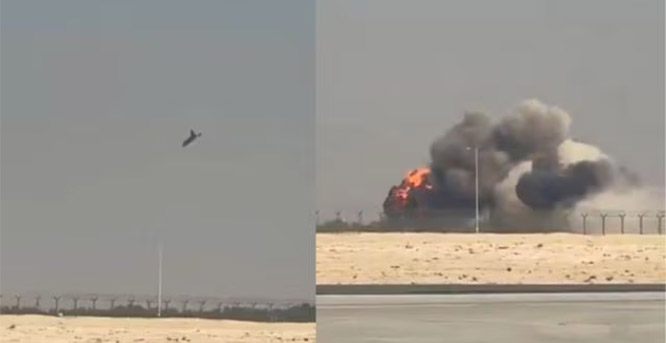
An Indian Air Force (IAF) Tejas fighter jet crashed on Friday, November 21, afternoon during its aerial demonstration at the Dubai Air Show, plunging to the ground at around 2:10 pm local time while performing a manoeuvre before thousands of spectators.

The IAF confirmed the incident, stating that a Tejas aircraft participating in the show had crashed and that further details were being gathered. An Air Force spokesperson said more information would be shared after initial assessments.

The crash sent thick black smoke billowing into the sky near the airport, causing panic among visitors, including families and children who had gathered to watch the display. Authorities have not yet confirmed whether the pilot managed to eject before the aircraft went down. Emergency response teams rushed to the scene, and officials have not released information on casualties or damage so far.

The Tejas is a 4.5-generation, multi-role fighter aircraft developed indigenously by Hindustan Aeronautics Limited (HAL). Designed for versatility, it is capable of offensive air support, close combat, ground attack missions and maritime operations. The aircraft family includes single-seat fighters and twin-seat trainers for both the Air Force and Navy.

HAL describes the latest version, the LCA Mk1A, as the most advanced in the series, featuring an AESA radar, an upgraded electronic warfare suite with radar-warning and self-protection jamming, smart multifunction displays, a digital map generator, a combined interrogator–transponder system and a modern radio altimeter. These enhancements significantly improve the aircraft’s combat capability and survivability.

Further updates from IAF and UAE authorities are awaited.

Comments

Add new comment

  • Coastaldigest.com reserves the right to delete or block any comments.
  • Coastaldigset.com is not responsible for its readers’ comments.
  • Comments that are abusive, incendiary or irrelevant are strictly prohibited.
  • Please use a genuine email ID and provide your name to avoid reject.
News Network
November 26,2025

students.jpg

Bengaluru, Nov 26: Karnataka is taking its first concrete steps towards lifting a three-decade-old ban on student elections in colleges and universities. Deputy Chief Minister D.K. Shivakumar announced Wednesday that the state government will form a small committee to study the reintroduction of campus polls, a practice halted in 1989 following incidents of violence.

Speaking at a 'Constitution Day' event organised by the Karnataka Congress, Mr. Shivakumar underscored the move's aim: nurturing new political leadership from the grassroots.

"Recently, (Leader of the Opposition in Lok Sabha) Rahul Gandhi wrote a letter to me and Chief Minister (Siddaramaiah) asking us to think about restarting student elections," Shivakumar stated. "I'm announcing today that we'll form a small committee and seek a report on this."

Student elections were banned in Karnataka in 1989, largely due to concerns over violence and the infiltration of political party affiliates into campus life. The ban effectively extinguished vibrant student bodies and the pipeline of young leaders they often produced.

Mr. Shivakumar, who also serves as the Karnataka Congress president, said that former student leaders will be consulted to "study the pros and cons" of the re-introduction.

Acknowledging the history of the ban, he added, "There were many criminal activities taking place back then. We’ll see how we can conduct (student) elections by regulating such criminal activities."

The Deputy CM reminisced about his own journey, which began on campus. He recalled his political activism at Sri Jagadguru Renukacharya College leading to his first Assembly ticket in 1985 at the age of 23. "That's how student leadership was at the time. Such leadership has gone today. College elections have stopped," he lamented, adding that for many, college elections were "like a big movement" where leaders were forged.

The move, driven by the Congress high command's push to cultivate young talent, will face scrutiny from academics and university authorities who have, in the past, expressed concern that the return of polls could disrupt the peaceful academic environment and turn campuses into political battlegrounds.

Comments

Add new comment

  • Coastaldigest.com reserves the right to delete or block any comments.
  • Coastaldigset.com is not responsible for its readers’ comments.
  • Comments that are abusive, incendiary or irrelevant are strictly prohibited.
  • Please use a genuine email ID and provide your name to avoid reject.
News Network
November 28,2025

ministerPM.jpg

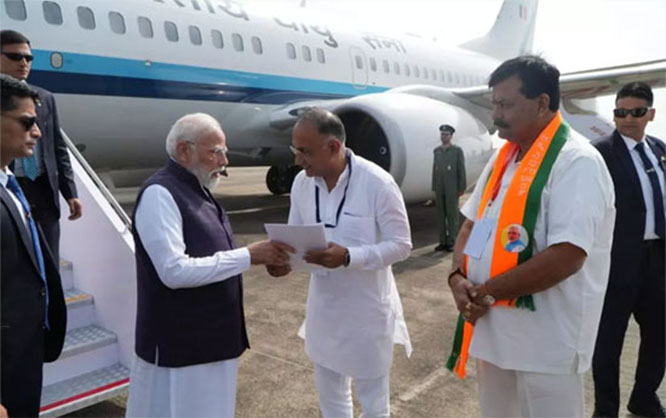
Mangaluru, Nov 28: Karnataka Health Minister and Dakshina Kannada district in-charge minister Dinesh Gundu Rao on Friday handed over Chief Minister Siddaramaiah’s letter to Prime Minister Narendra Modi, highlighting the severe distress faced by farmers due to crashing crop prices.

PM Modi arrived at the Mangaluru International Airport en route to Udupi, where Gundu Rao welcomed him and submitted the letter. The chief minister’s message stressed that farmers are suffering heavy losses because maize and green gram are being bought far below the Minimum Support Price (MSP). The state urged the Centre to immediately begin procurement at MSP.

According to the letter, Karnataka has a bumper harvest this year—over 54.74 lakh metric tons of maize and 1.98 lakh metric tons of green gram—yet farmers are unable to secure fair prices. Against the MSP of ₹2,400/MT for maize and ₹8,768/MT for green gram, market rates have plunged to ₹1,600–₹1,800 and ₹5,400 respectively.

The chief minister has requested the Centre to:

• Direct NAFED, FCI and NCCF to start MSP procurement immediately.
• Ensure ethanol units purchase maize directly from farmers or FPOs.
• Increase Karnataka’s ethanol allocation, citing high production capacity.
• Stop maize imports, which have depressed domestic prices.
• Relax quality norms for green gram, allowing up to 10% discoloration due to rains.

The letter stresses that MSP is crucial for farmer dignity and income stability and calls for swift central intervention to prevent a deepening crisis.

Comments

Add new comment

  • Coastaldigest.com reserves the right to delete or block any comments.
  • Coastaldigset.com is not responsible for its readers’ comments.
  • Comments that are abusive, incendiary or irrelevant are strictly prohibited.
  • Please use a genuine email ID and provide your name to avoid reject.