Before covid, society became victim of two pandemics -- religiosity, strident nationalism: Hamid Ansari

Agencies
November 21, 2020

kdsal.jpg

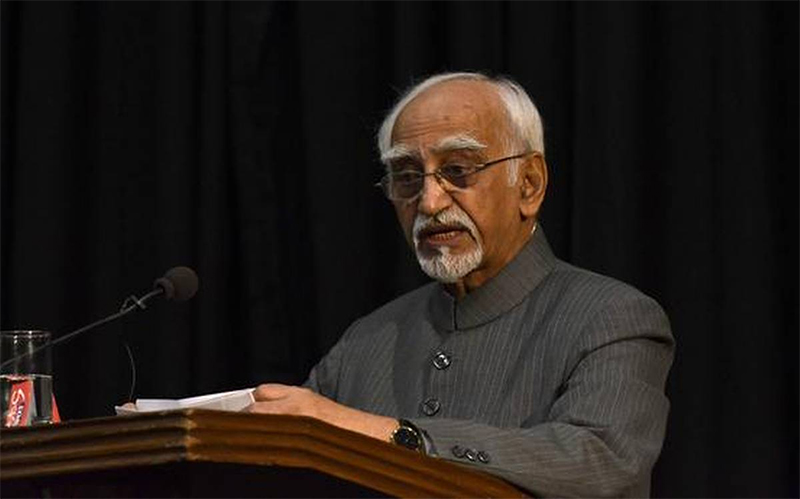
New Delhi, Nov 21: Overt and covert ideologies are seeking to segment India on an imagined criteria of "us and them", former vice president Hamid Ansari said on Friday, asserting that even before COVID-19, society became a victim of two other pandemics -- religiosity and strident nationalism.

Ansari said that as against religiosity and strident nationalism, patriotism is a more positive concept as it is defensive both militarily and culturally.

Speaking at the virtual launch of senior Congress leader Shashi Tharoor's book 'The Battle of Belonging', Ansari said that in a short space of four years, India has made a long journey from its founding vision of civic nationalism to a new political imagery of cultural nationalism that appears to be firmly embedded in the public realm.

The former vice president said that "there is a passionate plea for an ideal of India (in the book), an India that was taken for granted by our generation" and now is seemingly endangered by "overt and covert ideas and ideologies that seek to segment it on imagined criteria of us and them".

"Hitherto, our core values were summed up as an existential reality of a plural society, a democratic polity and a secular state structure. These were accepted in the freedom movement, they were incorporated in the Constitution and encapsulated in the preamble of the Constitution," said Ansari, who was vice president from 2007-2017.

The plurality of Indian society is evident from the sociological evidence of 4,635 communities, he said, adding that every fifth Indian belongs to a recognised religious minority.

It is this diverse mass that a new ideology is seeking to homogenise supposedly on the basis of a faith premised on an "imaginary history", he said.

"The COVID-19 as a pandemic is bad enough, but before it our society became a victim of two other pandemics -- religiosity and strident nationalism. Religiosity is defined as extreme religious ardour, denoting exaggerated embodiment, involvement or zeal for certain aspects of religious activity enforced through social and even governmental pressure," he said.

Much has also been written about the perils of strident nationalism and it has been called an "ideological poison" that has no hesitation in transcending and transgressing individual rights, Ansari said.

"Records world over show that it at times takes the form of hatred as a tonic that inspires vengeance as a mass ideology. Some of it can be witnessed in our own land," he said.

Ansari asserted that patriotism is a more positive concept as it is defensive both militarily and culturally and inspires nobel sentiments, but must not be allowed to run amok.

In the book published by Aleph Book Company, Tharoor makes a stinging critique of the Hindutva doctrine and the Citizenship (Amendment) Act, which he says is a challenge to, arguably, the most fundamental aspect of Indianness.

He has asserted that Hindutva is a political doctrine and not a religious one.

Speaking at the event, Tharoor said that the BJP has spent its last six years in government contesting the idea of India by arguing that there can be an alternative idea of India.

During the discussion on the book, former Jammu and Kashmir chief minister Farooq Abdullah said,"We had the opportunity of joining Pakistan in 1947, it was my father and the others who felt that the two nation theory is not for us."

Hindus, Muslims, Sikhs or Christians are not different as they are all human beings and thus "we chose (Mahatma) Gandhi's India, (Jawaharlal) Nehru's India, an India that belong to everyone", Abdullah said.

"That's how I felt till this government came in. They think that only a Hindu can be an Indian and all the others who are there cannot be Indians, they are second class citizens. This I am never going to accept till my dying day," he said.

"My belief is that this is for all of us, this is our motherland, we grew in it, we were educated in it, we have developed in it, our families live here, our ancestors are buried here, this is as good for me as it is for any Hindu. Today we are being divided, divided on religion, on caste on creed on language," the National Conference leader said.

"Tyrants come and tyrants go, nations continue to survive and I am confident that his nation will survive, these dividers will go," he said.

Also part of the discussion, Professor Makarand R Paranjape argued that there was not one idea of India, but many that were being hotly contested.

Comments

Add new comment

  • Coastaldigest.com reserves the right to delete or block any comments.
  • Coastaldigset.com is not responsible for its readers’ comments.
  • Comments that are abusive, incendiary or irrelevant are strictly prohibited.
  • Please use a genuine email ID and provide your name to avoid reject.
News Network
November 29,2025

DKSsiddu.jpg

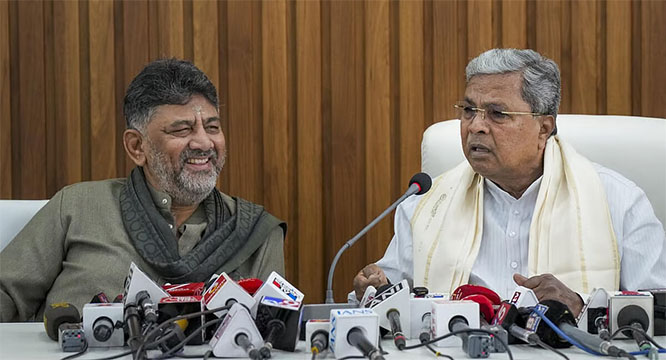
New Delhi: Karnataka chief minister Siddaramaiah and deputy CM DK Shivakumar on Saturday put up a dramatic display of unity at a closely watched joint press briefing, firmly dismissing weeks of speculation about a power-sharing tussle within the Congress. With the high command nudging both leaders to sit together and settle the dust, the meeting became a political spectacle, ending with the duo declaring that there was “no confusion, no differences.”

Calling the reports of a rift “manufactured confusion,” Siddaramaiah said the talks had gone smoothly, even joking about their breakfast. “Breakfast was very good. All three of us enjoyed it,” he said. “We want to end this confusion once and for all. For local elections and for 2028, our mission is clear — Congress must return to power. There is no difference between me and DKS, not now, not before.”

He blamed the media for fuelling rumours and reiterated absolute adherence to the party leadership. “From tomorrow, let there be no confusion. What the high command says, we will follow.”

Siddaramaiah also assured that the Assembly session starting December 8 would run smoothly and vowed that Congress would take on the BJP and JD(S) “together.”

Shivakumar echoed the chief minister word for word, stressing loyalty and discipline. “People have given us a massive mandate. It is our duty to deliver,” he said. “This government was formed under Siddaramaiah’s leadership. We both have complete trust in the high command. If they tell me to wait, I will wait.”

He added that the two leaders had discussed strategy for the 2028 Assembly elections. “Whatever the CM says, I agree. We are loyal soldiers of the party. The party may be facing challenges nationally, but we will keep it strong in Karnataka.”

Shivakumar also said Siddaramaiah would soon visit his home for lunch or dinner — another symbolic gesture meant to underline their unity.

Both leaders later posted on social media describing the breakfast meeting as “productive” and focused on “Karnataka’s priorities.”

The BJP, however, rejected the show of camaraderie as “pure bunkum,” accusing Congress of trying to paper over an internal power struggle. But Siddaramaiah and Shivakumar insisted their united front would continue — and that there was “no confusion” within the state leadership.

Comments

Add new comment

  • Coastaldigest.com reserves the right to delete or block any comments.
  • Coastaldigset.com is not responsible for its readers’ comments.
  • Comments that are abusive, incendiary or irrelevant are strictly prohibited.
  • Please use a genuine email ID and provide your name to avoid reject.
News Network
November 26,2025

students.jpg

Bengaluru, Nov 26: Karnataka is taking its first concrete steps towards lifting a three-decade-old ban on student elections in colleges and universities. Deputy Chief Minister D.K. Shivakumar announced Wednesday that the state government will form a small committee to study the reintroduction of campus polls, a practice halted in 1989 following incidents of violence.

Speaking at a 'Constitution Day' event organised by the Karnataka Congress, Mr. Shivakumar underscored the move's aim: nurturing new political leadership from the grassroots.

"Recently, (Leader of the Opposition in Lok Sabha) Rahul Gandhi wrote a letter to me and Chief Minister (Siddaramaiah) asking us to think about restarting student elections," Shivakumar stated. "I'm announcing today that we'll form a small committee and seek a report on this."

Student elections were banned in Karnataka in 1989, largely due to concerns over violence and the infiltration of political party affiliates into campus life. The ban effectively extinguished vibrant student bodies and the pipeline of young leaders they often produced.

Mr. Shivakumar, who also serves as the Karnataka Congress president, said that former student leaders will be consulted to "study the pros and cons" of the re-introduction.

Acknowledging the history of the ban, he added, "There were many criminal activities taking place back then. We’ll see how we can conduct (student) elections by regulating such criminal activities."

The Deputy CM reminisced about his own journey, which began on campus. He recalled his political activism at Sri Jagadguru Renukacharya College leading to his first Assembly ticket in 1985 at the age of 23. "That's how student leadership was at the time. Such leadership has gone today. College elections have stopped," he lamented, adding that for many, college elections were "like a big movement" where leaders were forged.

The move, driven by the Congress high command's push to cultivate young talent, will face scrutiny from academics and university authorities who have, in the past, expressed concern that the return of polls could disrupt the peaceful academic environment and turn campuses into political battlegrounds.

Comments

Add new comment

  • Coastaldigest.com reserves the right to delete or block any comments.
  • Coastaldigset.com is not responsible for its readers’ comments.
  • Comments that are abusive, incendiary or irrelevant are strictly prohibited.
  • Please use a genuine email ID and provide your name to avoid reject.
coastaldigest.com news network
November 28,2025

roadshow.jpg

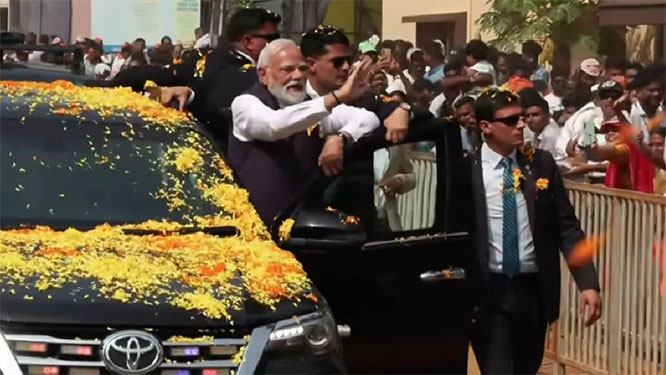
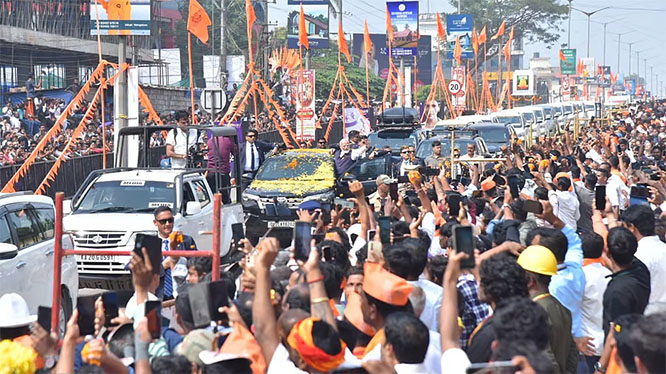
Udupi district transformed into a sea of saffron and celebration on Friday, November 28, as Prime Minister Narendra Modi’s roadshow swept through the coastal temple town. Thousands of residents lined the streets, turning the event into a vibrant public spectacle filled with cheers, flags, and festive energy.

The procession route—from the helipad to the historic Sri Krishna Math—was decked with buntings, saffron flags, and multilayered security barricades. One of the district’s largest-ever security deployments was put in place for the high-profile visit, with over 3,000 police personnel on duty. The arrangement included ten SPs, 27 DSPs, 49 inspectors, 127 sub-inspectors, 232 assistant sub-inspectors, 1,608 constables, and 39 women staff.

Six platoons of the Karnataka State Reserve Police, six Quick Response Teams, bomb detection units, and dog squads were stationed across Udupi. Enhanced surveillance covered Adi Udupi, Bannanje bus stand, and the Sri Krishna Math parking zone, with combing operations carried out along the roadshow corridor.

At the 800-year-old Sri Krishna Math, preparations reached a ceremonial peak. Paryaya Puttige Math seer Sugunendra Teertha Swamiji said the Prime Minister would take part in the Laksha Kantha Geetha Parayana, a mass chanting of the Bhagavad Gita by one lakh devotees, and inaugurate the new Suvarna Teertha Mantapa.

“He will first offer floral tributes to saint-poet Kanakadasa and then unveil the golden covering over the Kanakana Kindi,” the seer said.

The Prime Minister will also receive a Poorna Kumbha welcome and have darshan of Lord Sri Krishna, Mukhyaprana Devaru, and the Suvarna Paduke. Union Minister Pralhad Joshi, Karnataka Governor Thaawarchand Gehlot, Minister Bairathi Suresh, Dharmadhikari D. Veerendra Heggade, and seers from the Ashta Maths are expected to join the ceremony.

Ahead of his arrival, the Prime Minister posted on X that he felt “honoured” to attend the spiritually significant gathering. “This is a special occasion that brings together people from different sections of society for a recital of the Gita. This Matha has a very special significance in our cultural life,” he wrote, noting the institution’s long-standing legacy rooted in the teachings of Sri Madhvacharya.

roadshow2.jpg

Comments

Add new comment

  • Coastaldigest.com reserves the right to delete or block any comments.
  • Coastaldigset.com is not responsible for its readers’ comments.
  • Comments that are abusive, incendiary or irrelevant are strictly prohibited.
  • Please use a genuine email ID and provide your name to avoid reject.