



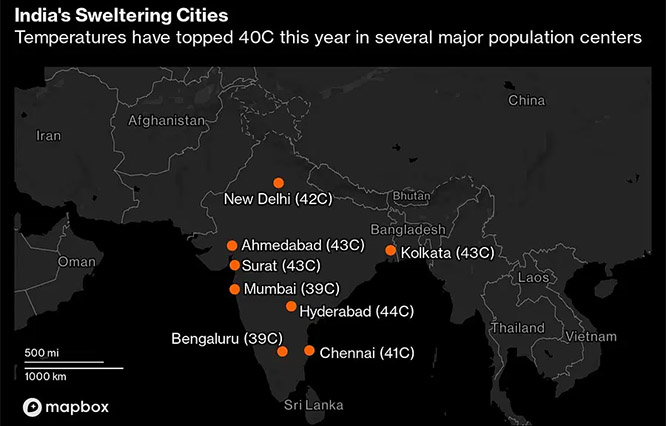
In scorching heat on a busy Kolkata street last month, commuters sought refuge inside a glass-walled bus shelter where two air conditioners churned around stifling air. Those inside were visibly sweating, dabbing at their foreheads in sauna-like temperatures that were scarcely cooler than out in the open.
Local authorities initially had plans to install as many as 300 of the cooled cabins under efforts to improve protections from a heat season that typically runs from April until the monsoon hits the subcontinent in June. There are currently only a handful in operation, and some have been stripped of their AC units, leaving any users sweltering.
“It doesn’t work,” Firhad Hakim, mayor of the city of 1.5 crore, said on a searing afternoon when temperatures topped 40C. “You feel suffocated.”
Attempts in Kolkata and across India to improve resilience to extreme heat have often been equally ill-conceived, despite a death toll estimated at more than 24,000 since 1992. Inconsistent or incomplete planning, a lack of funding, and the failure to make timely preparations to shield a population of 140 crore are leaving communities vulnerable as periods of extreme temperatures become more frequent, longer in duration and affect a wider sweep of the country.
Kolkata, with its hot, humid climate and proximity to the Bay of Bengal, is particularly vulnerable to temperature and rainfall extremes, and ranked by the Intergovernmental Panel on Climate Change as among the global locations that are most at risk.
An increase in average global temperatures of 2C could mean the city would experience the equivalent of its record 2015 heat waves every year, according to the IPCC. High humidity can compound the impacts, as it limits the human body’s ability to regulate its temperature.
Even so, the city — one of India's largest urban centres — still lacks a formal strategy to handle heat waves.
Several regions across India will see as many as 11 heat wave days this month compared to 3 in a typical year, while maximum temperatures in recent weeks have already touched 47.2C in the nation’s east, according to the Indian Meteorological Department. Those extremes come amid the Lok Sabha election during which high temperatures are being cited as among the factors for lower voter turnout.
At SSKM Hospital, one of Kolkata’s busiest, a waiting area teemed last month with people sheltering under colorful umbrellas and thronging a coin-operated water dispenser to refill empty bottles. A weary line snaked back from a government-run kiosk selling a subsidized lunch of rice, lentils, boiled potato and eggs served on foil plates.
“High temperatures can cause heat stroke, skin rashes, cramps and dehydration,” said Niladri Sarkar, professor of medicine at the hospital. “Some of these can turn fatal if not attended to on time, especially for people that have pre-existing conditions.” Extreme heat has an outsized impact on poorer residents, who are often malnourished, lack access to clean drinking water and have jobs that require outdoor work, he said.
Elsewhere in the city, tea sellers sweltered by simmering coal-fired ovens, construction workers toiled under a blistering midday sun, and voters attending rallies for the ongoing national elections draped handkerchiefs across their faces in an effort to stay cool. The state government in April advised some schools to shutter for an early summer vacation to avoid the heat.
Since 2013, states, districts and cities are estimated to have drafted more than 100 heat action plans, intended to improve their ability to mitigate the effects of extreme temperatures. The Centre set out guidelines eight years ago to accelerate adoption of the policies, and a January meeting of the National Disaster Management Authority pledged to do more to strengthen preparedness.
The absence of such planning in Kolkata has also meant a failure to intervene in trends that have made the city more susceptible.
Almost a third of the city’s green cover was lost during the decade through 2021, according to an Indian government survey. Other cities including Mumbai and Bengaluru have experienced similar issues. That’s combined with a decline in local water bodies and a construction boom to deliver an urban heat island effect, according to Saira Shah Halim, a parliamentary candidate in the Kolkata Dakshin electoral district in the city’s south. “What we’re seeing today is a result of this destruction,” she said.
Hakim, the city’s mayor, disputes the idea that Kolkata’s preparations have lagged, arguing recent extreme weather has confounded local authorities. “Such a kind of heat wave is new to us, we’re not used to it,” he said. “We’re locked with elections right now. Once the elections are over, we’ll sit with experts to work on a heat action plan.”
Local authorities are currently ensuring adequate water supplies, and have put paramedics on stand-by to handle heat-induced illnesses, Hakim said.
Focusing on crisis management, rather than on better preparedness, is at the root of the country’s failings, according to Nairwita Bandyopadhyay, a Kolkata-based climatologist and geographer. “Sadly the approach is to wait and watch until the hazard turns into a disaster,” she said.
Even cities and states that already have heat action plans have struggled to make progress in implementing recommendations, the New Delhi-based think tank Centre for Policy Research said in a report last year reviewing 37 of the documents.
Most policies don’t adequately reflect local conditions, they often lack detail on how action should be funded and typically don’t set out a source of legal authority, according to the report.
As many as 9 people have already died as a result of heat extremes this year, according to the meteorological department, though the figure is likely to significantly underestimate the actual total. That follows about 110 fatalities during severe heat waves during April and June last year, the World Meteorological Organization said last month.
Even so, the handling of extreme heat has failed to become a “political lightning rod that can stir governments into action,” said Aditya Valiathan Pillai, among authors of the CPR study and now a fellow at New Delhi-based Sustainable Futures Collaborative.
Modi's government has often moved to contain criticism of its policies, and there is also the question of unreliable data. “When deaths occur, one is not sure whether it was directly caused by heat, or whether heat exacerbated an existing condition,” Pillai said.
In 2022, health ministry data showed 33 people died as a result of heat waves, while the National Crime Records Bureau – another agency that tracks mortality statistics – reported 730 fatalities from heat stroke.
Those discrepancies raise questions about a claim by the Centre that its policies helped cut heat-related deaths from 2,040 in 2015 to 4 in 2020, after national bureaucrats took on more responsibility for disaster risk management.
Local officials in Kolkata are now examining potential solutions and considering the addition of more trees, vertical gardens on building walls and the use of porous concrete, all of which can help combat urban heat.
India’s election is also an opportunity to raise issues around poor preparations, according to Halim, a candidate for the Communist Party of India (Marxist), whose supporters carry bright red flags at campaign events scheduled for the early morning and after sundown to escape extreme temperatures.
“I’m mentioning it,” she said. “It’s become a very, very challenging campaign. The heat is just insufferable.”

Comments
Add new comment