



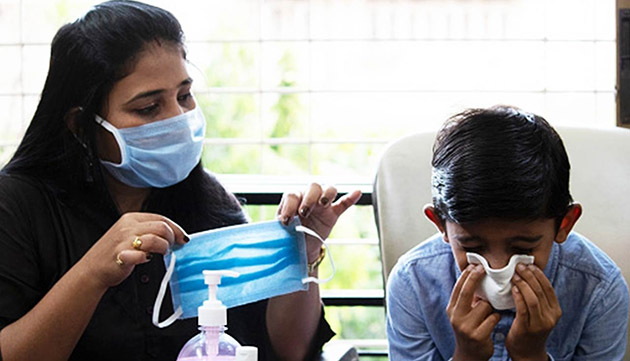
Increase precaution, no need to panic, say experts as H3N2 claims lives in India

News Network
March 11, 2023

cold.jpg

There is a need for increased monitoring and precautionary measures to ward off H3N2 but no cause for panic yet, say experts as India confirms its first two deaths due to the influenza virus.

In Karnataka, 78-year-old Hiregowda. a diabetic who suffered from hypertension died due to the H3N2 seasonal influenza subtype on March 1. Another death, that of a 56-year-old lung cancer patient, was reported from Haryana.

From January 2 to March 5, 451 cases of the H3N2 have been reported in the country, according to data shared by the ministry on Friday. It also said it is keeping a close watch on the situation and cases are expected to decline from month end.

H3N2 is a non-human influenza virus that normally circulates in pigs and has infected humans, according to the US Centre for Disease Control and Prevention (CDC). Symptoms are similar to those of seasonal flu viruses and can include fever and respiratory symptoms such as cough and runny nose, and possibly other symptoms, including body ache, nausea, vomiting or diarrhoea.

As concerns mounted and some people wondered whether this could possibly turn out to be another Covid, pulmonologist Anurag Agrawal said he doesn’t expect to see a massive wave.

"Admission to hospital has not been very common and only about 5 per cent cases have been reported to be hospitalised," added Tarun Sahani, senior consultant, internal medicine, Apollo Hospitals.

While there is no need to panic yet, Sahani said it is advisable to take precautions similar to those taken during Covid times.

"... if most of the infected people recover albeit slow, it should be fine," virologist Upasana Ray, an alumni member of the Indian National Young Academy of Science (INYAS) and member of Global Young Academy (GYA), told PTI.

She noted that lockdowns and extensive use of masks for extended periods of time helped control transmission of more virulent versions of the virus, but also prevented good exposure of regular seasonal respiratory viruses.

"Due to at least two years of elaborate, expansive use of masks, we might have lost part of our immunity against the versions of these other respiratory viruses that are now getting transmitted," Ray argued.

According to Agrawal, H3N2 outbreaks can "indeed cause death" and are more severe than regular flu.

"Since there is general immunity to flu and vaccines exist, I wouldn’t expect to see a massive wave but yes, all outbreaks and deaths are of some concern," Agrawal, the dean of the Trivedi School of Biosciences at Ashoka University, told PTI.

Sahani noted that India is witnessing a huge spike in H3N2 cases since the start of 2023.

"The incidence is two to three times higher than usually seen at this time of the year. This virus is known to be a subtype of Influenza A virus which is common at this time of the year," Sahani told PTI.

Though the Covid pandemic seems to be ending, the spate of respiratory illnesses continues among adults with a significant number being infected with influenza viruses such as H3N2, adenovirus and H1N1.

According to the latest data available on IDSP-IHIP (Integrated Health Information Platform), a total of 3,038 laboratory-confirmed cases of various subtypes of Influenza including H3N2 have been reported till March 9 by the states.

This includes 1,245 cases in January, 1,307 in February and 486 cases in March till 9th, it said.

The Union Health Ministry is keeping a close watch on the seasonal influenza situation in various states/UTs through the Integrated Disease Surveillance Programme (IDSP) network on a real-time basis.

Agrawal said flu surveillance is an important part of public health.

"In coming times we will have better combined respiratory virus surveillance," Agrawal, the former director of the CSIR-Institute of Genomics and Integrative Biology noted.

Ray agreed, saying disease monitoring is urgently needed to address the situation. 

Comments

Add new comment

  • Coastaldigest.com reserves the right to delete or block any comments.
  • Coastaldigset.com is not responsible for its readers’ comments.
  • Comments that are abusive, incendiary or irrelevant are strictly prohibited.
  • Please use a genuine email ID and provide your name to avoid reject.
News Network
November 26,2025

students.jpg

Bengaluru, Nov 26: Karnataka is taking its first concrete steps towards lifting a three-decade-old ban on student elections in colleges and universities. Deputy Chief Minister D.K. Shivakumar announced Wednesday that the state government will form a small committee to study the reintroduction of campus polls, a practice halted in 1989 following incidents of violence.

Speaking at a 'Constitution Day' event organised by the Karnataka Congress, Mr. Shivakumar underscored the move's aim: nurturing new political leadership from the grassroots.

"Recently, (Leader of the Opposition in Lok Sabha) Rahul Gandhi wrote a letter to me and Chief Minister (Siddaramaiah) asking us to think about restarting student elections," Shivakumar stated. "I'm announcing today that we'll form a small committee and seek a report on this."

Student elections were banned in Karnataka in 1989, largely due to concerns over violence and the infiltration of political party affiliates into campus life. The ban effectively extinguished vibrant student bodies and the pipeline of young leaders they often produced.

Mr. Shivakumar, who also serves as the Karnataka Congress president, said that former student leaders will be consulted to "study the pros and cons" of the re-introduction.

Acknowledging the history of the ban, he added, "There were many criminal activities taking place back then. We’ll see how we can conduct (student) elections by regulating such criminal activities."

The Deputy CM reminisced about his own journey, which began on campus. He recalled his political activism at Sri Jagadguru Renukacharya College leading to his first Assembly ticket in 1985 at the age of 23. "That's how student leadership was at the time. Such leadership has gone today. College elections have stopped," he lamented, adding that for many, college elections were "like a big movement" where leaders were forged.

The move, driven by the Congress high command's push to cultivate young talent, will face scrutiny from academics and university authorities who have, in the past, expressed concern that the return of polls could disrupt the peaceful academic environment and turn campuses into political battlegrounds.

Comments

Add new comment

  • Coastaldigest.com reserves the right to delete or block any comments.
  • Coastaldigset.com is not responsible for its readers’ comments.
  • Comments that are abusive, incendiary or irrelevant are strictly prohibited.
  • Please use a genuine email ID and provide your name to avoid reject.
News Network
November 21,2025

Bengaluru, Nov 21: The Karnataka government is facing pressure to overhaul its employment system after a high-level Cabinet sub-committee recommended the complete phase-out of job outsourcing in government offices, boards, and corporations by March 2028. The move is aimed at tackling a systemic issue that has led to the potential violation of constitutional reservation policies and the exploitation of workers.

The Call for Systemic Change

With over three lakh vacant posts currently being filled through private agencies on an outsource, insource, or daily wage basis, the sub-committee highlighted a significant lapse. "As a result, reservations are not being followed as per the Constitution and state laws. It’s an urgent need to take serious steps to change the system. It has been recommended to completely stop the system of outsourcing by March 2028," the panel stated in a document.

The practice of outsourcing involves private companies hiring workers to perform duties for a government agency. Critics argue this model results in lesser salaries, a lack of social security benefits (otherwise available to permanent government employees), and a failure to adhere to the provisions of Articles 14 and 15 of the Constitution, which guarantee equality before the law and prohibit discrimination.

The 'Bidar Model' as a Stop-Gap Solution

To regulate the current mode of employment and reduce worker exploitation until the 2028 deadline, the government plans to establish workers’ services multi-purpose cooperative societies across all districts, following the successful "Bidar Model."

The Bidar District Services of Labour Multi-purpose Cooperative Society Ltd., which operates under the District Commissioner, is cited as a successful example of providing a measure of social security to outsourced staff. Labour Department officials argue this society ensures workers receive their due wages and statutory facilities like ESI (Employees' State Insurance) and PF (Provident Fund), in exchange for a 1% service fee collected from the employees.

legislative push and Priority Insourcing

The recommendations, led by the sub-committee headed by Law and Parliamentary Affairs Minister H K Patil, are set to be discussed at the next Cabinet meeting. The committee has proposed the introduction of the Karnataka Outsourced Employees (Regulation, Placement and Welfare) Bill 2025.

In a move addressing immediate concerns, Labour Minister Santosh Lad, a member of the sub-committee, has reportedly assured that steps will be taken over the next 2-3 years to insource workers in "life-threatening services" on a priority basis. This includes essential personnel like pourakarmikas (sanitation workers), drivers, electrical staff in the Energy Department, and Health Department staff handling contagious diseases. The transition aims to grant these workers the long-term security and benefits they currently lack under the outsourcing system. 

Comments

Add new comment

  • Coastaldigest.com reserves the right to delete or block any comments.
  • Coastaldigset.com is not responsible for its readers’ comments.
  • Comments that are abusive, incendiary or irrelevant are strictly prohibited.
  • Please use a genuine email ID and provide your name to avoid reject.
News Network
December 2,2025

A major upgrade in safety and monitoring is planned for Haj 2026, with every Indian pilgrim set to receive a Haj Suvidha smart wristband linked to the official Haj Suvidha mobile app. The initiative aims to support pilgrims—especially senior citizens—who may struggle with smartphones during the 45-day journey.

What the Smart Wristband Will Do

Officials said the device will come with:
•    Location tracking
•    Pedometer
•    SOS emergency button
•    Qibla compass
•    Prayer timings
•    Basic health monitoring

SP Tiwari, secretary of the UP State Haj Committee, said the goal is to make the pilgrimage safer and more comfortable.

“Most Hajis are elderly and not comfortable with mobile apps,” he said. “The smartwatch will help locate pilgrims who forget their way or cannot communicate their location.”

The wristbands will be monitored by the Consulate General of India in Saudi Arabia, similar to mobile tracking via the Haj Suvidha App.

Free Distribution and Training

•    Smart wristbands will be given free of cost.
•    Training for pilgrims will be conducted between January and February 2026.
•    Sample units will reach state Haj committees soon.
•    Final devices will be distributed as pilgrims begin their journey.

New Rules for Accommodation

Two major decisions have also been finalised for Haj 2026:
1.    Separate rooms for men and women – including married couples. They may stay on the same floor but must occupy different rooms, following stricter Saudi guidelines.
2.    Cooking banned – gas cylinders will not be allowed; all meals will be provided through official catering services arranged by the Haj Committee of India.

These decisions were finalised during a meeting of the Haj Committee of India and state representatives in Mumbai.

Haj Suvidha App Launched Earlier

The government launched the Haj Suvidha App in 2024, offering:

•    Training modules
•    Accommodation and flight details
•    Baggage information
•    SOS and translation tools
•    Grievance redressal

Haj 2026 Quota and Key States

•    India’s total Haj quota for 2026: 1,75,025 pilgrims
•    70% (1,25,000) allotted to the Haj Committee of India
•    30% (around 50,000) reserved for Haj Group Organisers

Uttar Pradesh has the largest allocation (around 30,000 seats), though approximately 18,000 pilgrims are expected to go this year. States with high pilgrim numbers include Kerala, Maharashtra and Gujarat.

Dates of Haj 2026

The pilgrimage is scheduled to take place from 24 May to 29 May, 2026 (tentative).
Haj is one of the five pillars of Islam and is mandatory for Muslims who meet the required conditions.

Comments

Add new comment

  • Coastaldigest.com reserves the right to delete or block any comments.
  • Coastaldigset.com is not responsible for its readers’ comments.
  • Comments that are abusive, incendiary or irrelevant are strictly prohibited.
  • Please use a genuine email ID and provide your name to avoid reject.