



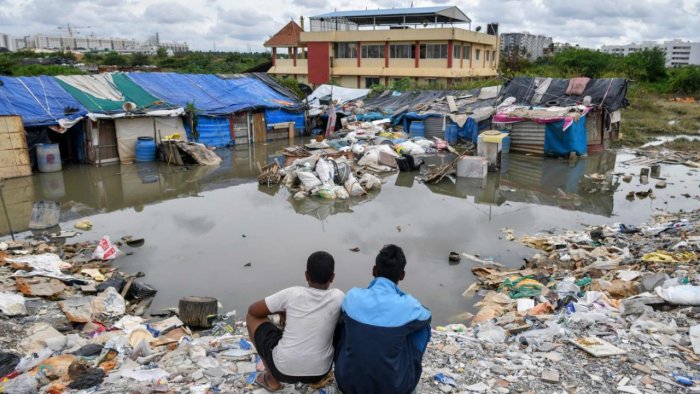
India ranks 132 out of 191 in UNDP's human development index; Bangladesh better

News Network
September 8, 2022

india.jpg

India ranked 132 out of 191 countries in the 2021 human development index, according to a report released by the United Nations Development Programme (UNDP).

India's HDI value of 0.633 places the country in the medium human development category, lower than its value of 0.645 in the 2020 report. India ranked 131 among 189 countries in the 2020 human development index.

"Like global trends, in India's case, the drop in HDI from 0.645 in 2019 to 0.633 in 2021 can be attributed to falling life expectancy - 69.7 to 67.2 years. India's expected years of schooling stand at 11.9 years, and the mean years of schooling are at 6.7 years," the report said.

Human Development - a measure of a nation's health, education, and average income - has declined for two years in a row - 2020 and 2021, reversing five years of progress, the report said.

This is in line with the global decline, indicating that human development across the world has stalled for the first time in 32 years, the report said.

The report said a large contributor to the Human Development Index's recent decline is a global drop in life expectancy, down from 72.8 years in 2019 to 71.4 years in 2021.

The latest Human Development Report - Uncertain Times, Unsettled Lives: Shaping our Future in a Transforming World - launched by UNDP - argues that layers of uncertainty are stacking up and interacting to unsettle life in unprecedented ways.

"The world is scrambling to respond to back-to-back crises. We have seen with the cost of living and energy crises that, while it is tempting to focus on quick fixes like subsidizing fossil fuels, immediate relief tactics are delaying the long-term systemic changes we must make," said Achim Steiner, administrator, UNDP.

"We are collectively paralyzed in making these changes. In a world defined by uncertainty, we need a renewed sense of global solidarity to tackle our interconnected, common challenges," Steiner said.

These intersecting crises have impacted India's development trajectory just as they have in much of the world.

The HDI measures progress on 3 key dimensions of human development - a long and healthy life, access to education, and a decent standard of living. It is calculated using four indicators – life expectancy at birth, mean years of schooling, expected years of schooling, and the Gross National Income (GNI) per capita.

"The Human Development Report shows that progress globally is in reverse. India's decline in human development mirrors this trend – impacted by intersecting crises. But there is good news. Compared to 2019, the impact of inequality on human development is lower," said Shoko Noda, UNDP Resident Representative in India.

"India is bridging the human development gap between men and women faster than the world. This development has come at a smaller cost to the environment. India's growth story reflects the country's investments in inclusive growth, social protection, gender-responsive policies, and push towards renewables to ensure no one is left behind," said Noda.

While some countries are beginning to get back on their feet, recovery is uneven and partial, further widening inequalities in human development. Despite a significant economic recovery in 2021, the health crisis intensified, with two-thirds of countries recording even further reductions in life expectancy at birth, the report said.

India's HDI value continues to exceed South Asia's average human development. India's HDI value has been steadily catching up to the world average since 1990 - indicating a faster than the global rate of progress in human development. This is a result of policy choices made by the country over time, including investments made in health and education.

South Asian economies like Bangladesh (129) and Bhutan bucked the trend and registered an improvement, the report pointed out.

The report also suggested that stress, sadness, anger, and worry have been increasing over the last decade, now reaching record levels.

On average, countries spend less than two per cent of their healthcare budgets on mental health, which limits access to mental health services for citizens globally.

Uncertainty, inequality, and insecurity go hand in hand with polarization and lack of trust. Polarization and mistrust shrink our capacity for social dialogue and stifle collective action, it said.

The report recommends implementing policies that focus on 3 Is - investment - from renewable energy to preparedness for pandemics and insurance - including social protection - to prepare our societies for the ups and downs of an uncertain world. While innovation in its many forms - technological, economic, cultural - can also build capacities to respond to whatever challenges come next.

"Policies that focus on the 3Is will enable people to thrive in the face of uncertainty. India is already a frontrunner in these areas with its push towards renewable energy, boosting social security for the most vulnerable and driving the world's largest vaccination drive through Co-WIN, supported by UNDP," added Noda.

Over the last decade, India has lifted a staggering 271 million out of multidimensional poverty.

The country is improving access to clean water, sanitation, and affordable clean energy. India has also boosted access to social protection for vulnerable sections of society, especially during and after the pandemic, with a 9.8 per cent increase in the budgetary allocation to the Social Services sector in 2021-22 over 2020-21, the report said.

Comments

Add new comment

  • Coastaldigest.com reserves the right to delete or block any comments.
  • Coastaldigset.com is not responsible for its readers’ comments.
  • Comments that are abusive, incendiary or irrelevant are strictly prohibited.
  • Please use a genuine email ID and provide your name to avoid reject.
News Network
December 2,2025

A major upgrade in safety and monitoring is planned for Haj 2026, with every Indian pilgrim set to receive a Haj Suvidha smart wristband linked to the official Haj Suvidha mobile app. The initiative aims to support pilgrims—especially senior citizens—who may struggle with smartphones during the 45-day journey.

What the Smart Wristband Will Do

Officials said the device will come with:
•    Location tracking
•    Pedometer
•    SOS emergency button
•    Qibla compass
•    Prayer timings
•    Basic health monitoring

SP Tiwari, secretary of the UP State Haj Committee, said the goal is to make the pilgrimage safer and more comfortable.

“Most Hajis are elderly and not comfortable with mobile apps,” he said. “The smartwatch will help locate pilgrims who forget their way or cannot communicate their location.”

The wristbands will be monitored by the Consulate General of India in Saudi Arabia, similar to mobile tracking via the Haj Suvidha App.

Free Distribution and Training

•    Smart wristbands will be given free of cost.
•    Training for pilgrims will be conducted between January and February 2026.
•    Sample units will reach state Haj committees soon.
•    Final devices will be distributed as pilgrims begin their journey.

New Rules for Accommodation

Two major decisions have also been finalised for Haj 2026:
1.    Separate rooms for men and women – including married couples. They may stay on the same floor but must occupy different rooms, following stricter Saudi guidelines.
2.    Cooking banned – gas cylinders will not be allowed; all meals will be provided through official catering services arranged by the Haj Committee of India.

These decisions were finalised during a meeting of the Haj Committee of India and state representatives in Mumbai.

Haj Suvidha App Launched Earlier

The government launched the Haj Suvidha App in 2024, offering:

•    Training modules
•    Accommodation and flight details
•    Baggage information
•    SOS and translation tools
•    Grievance redressal

Haj 2026 Quota and Key States

•    India’s total Haj quota for 2026: 1,75,025 pilgrims
•    70% (1,25,000) allotted to the Haj Committee of India
•    30% (around 50,000) reserved for Haj Group Organisers

Uttar Pradesh has the largest allocation (around 30,000 seats), though approximately 18,000 pilgrims are expected to go this year. States with high pilgrim numbers include Kerala, Maharashtra and Gujarat.

Dates of Haj 2026

The pilgrimage is scheduled to take place from 24 May to 29 May, 2026 (tentative).
Haj is one of the five pillars of Islam and is mandatory for Muslims who meet the required conditions.

Comments

Add new comment

  • Coastaldigest.com reserves the right to delete or block any comments.
  • Coastaldigset.com is not responsible for its readers’ comments.
  • Comments that are abusive, incendiary or irrelevant are strictly prohibited.
  • Please use a genuine email ID and provide your name to avoid reject.
News Network
December 2,2025

A major upgrade in safety and monitoring is planned for Haj 2026, with every Indian pilgrim set to receive a Haj Suvidha smart wristband linked to the official Haj Suvidha mobile app. The initiative aims to support pilgrims—especially senior citizens—who may struggle with smartphones during the 45-day journey.

What the Smart Wristband Will Do

Officials said the device will come with:
•    Location tracking
•    Pedometer
•    SOS emergency button
•    Qibla compass
•    Prayer timings
•    Basic health monitoring

SP Tiwari, secretary of the UP State Haj Committee, said the goal is to make the pilgrimage safer and more comfortable.

“Most Hajis are elderly and not comfortable with mobile apps,” he said. “The smartwatch will help locate pilgrims who forget their way or cannot communicate their location.”

The wristbands will be monitored by the Consulate General of India in Saudi Arabia, similar to mobile tracking via the Haj Suvidha App.

Free Distribution and Training

•    Smart wristbands will be given free of cost.
•    Training for pilgrims will be conducted between January and February 2026.
•    Sample units will reach state Haj committees soon.
•    Final devices will be distributed as pilgrims begin their journey.

New Rules for Accommodation

Two major decisions have also been finalised for Haj 2026:
1.    Separate rooms for men and women – including married couples. They may stay on the same floor but must occupy different rooms, following stricter Saudi guidelines.
2.    Cooking banned – gas cylinders will not be allowed; all meals will be provided through official catering services arranged by the Haj Committee of India.

These decisions were finalised during a meeting of the Haj Committee of India and state representatives in Mumbai.

Haj Suvidha App Launched Earlier

The government launched the Haj Suvidha App in 2024, offering:

•    Training modules
•    Accommodation and flight details
•    Baggage information
•    SOS and translation tools
•    Grievance redressal

Haj 2026 Quota and Key States

•    India’s total Haj quota for 2026: 1,75,025 pilgrims
•    70% (1,25,000) allotted to the Haj Committee of India
•    30% (around 50,000) reserved for Haj Group Organisers

Uttar Pradesh has the largest allocation (around 30,000 seats), though approximately 18,000 pilgrims are expected to go this year. States with high pilgrim numbers include Kerala, Maharashtra and Gujarat.

Dates of Haj 2026

The pilgrimage is scheduled to take place from 24 May to 29 May, 2026 (tentative).
Haj is one of the five pillars of Islam and is mandatory for Muslims who meet the required conditions.

Comments

Add new comment

  • Coastaldigest.com reserves the right to delete or block any comments.
  • Coastaldigset.com is not responsible for its readers’ comments.
  • Comments that are abusive, incendiary or irrelevant are strictly prohibited.
  • Please use a genuine email ID and provide your name to avoid reject.
coastaldigest.com news network
December 2,2025

karkala.jpg

Udupi, Dec 2: A wave of regional pride is sweeping through Udupi district as Shagun S Verma Hegde, a talented Class 9 student from Christ King English Medium High School, Karkala, has been named the captain of the Indian National Team for the Under-15 Girls’ Volleyball Championship.

Shagun holds the unique distinction of being the sole player from Karnataka selected to represent the country in the prestigious international tournament. The championship, organized by the School Games Federation, is scheduled to take place in Shangluo, China, from December 3 to 13, where Shagun will lead the national squad.

A Remarkable Journey to the Top

Shagun’s selection is a testament to her dedication and exceptional skill on the court. Her journey included several rigorous rounds of selection:

•    She was the only player from Udupi district to qualify for the state-level selection camp.

•    Out of eight players from Karnataka who advanced to the national selection camp in Pune, Maharashtra, Shagun was the only one to secure a place in the final national squad.

•    The national camp saw participation from approximately 200 players, which was shortlisted to 23. Shagun not only made the final cut but was also ranked as the second-best player overall, solidifying her leadership role.

Shagun, who is the daughter of Sandesh Verma and Shruthiraj of Kallotte, Karkala, has trained under experienced coaches Santosh D’Souza, Jeevan D’Silva, Jairaj Poojary, and Ramesh. Her selection as the team captain has brought profound honour to her family, school, the Udupi district, and the entire state of Karnataka.

Comments

Add new comment

  • Coastaldigest.com reserves the right to delete or block any comments.
  • Coastaldigset.com is not responsible for its readers’ comments.
  • Comments that are abusive, incendiary or irrelevant are strictly prohibited.
  • Please use a genuine email ID and provide your name to avoid reject.