



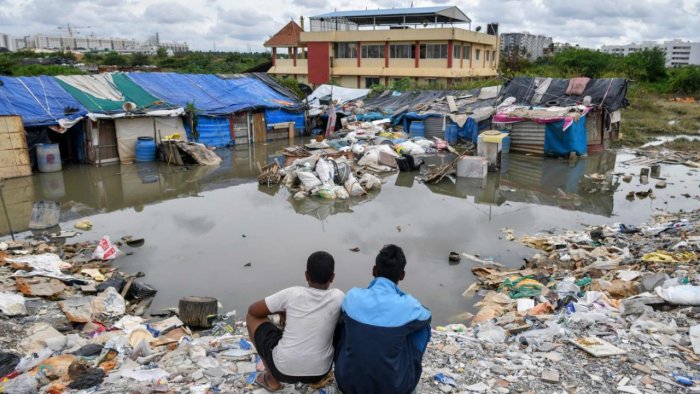
India ranks 132 out of 191 in UNDP's human development index; Bangladesh better

News Network
September 8, 2022

india.jpg

India ranked 132 out of 191 countries in the 2021 human development index, according to a report released by the United Nations Development Programme (UNDP).

India's HDI value of 0.633 places the country in the medium human development category, lower than its value of 0.645 in the 2020 report. India ranked 131 among 189 countries in the 2020 human development index.

"Like global trends, in India's case, the drop in HDI from 0.645 in 2019 to 0.633 in 2021 can be attributed to falling life expectancy - 69.7 to 67.2 years. India's expected years of schooling stand at 11.9 years, and the mean years of schooling are at 6.7 years," the report said.

Human Development - a measure of a nation's health, education, and average income - has declined for two years in a row - 2020 and 2021, reversing five years of progress, the report said.

This is in line with the global decline, indicating that human development across the world has stalled for the first time in 32 years, the report said.

The report said a large contributor to the Human Development Index's recent decline is a global drop in life expectancy, down from 72.8 years in 2019 to 71.4 years in 2021.

The latest Human Development Report - Uncertain Times, Unsettled Lives: Shaping our Future in a Transforming World - launched by UNDP - argues that layers of uncertainty are stacking up and interacting to unsettle life in unprecedented ways.

"The world is scrambling to respond to back-to-back crises. We have seen with the cost of living and energy crises that, while it is tempting to focus on quick fixes like subsidizing fossil fuels, immediate relief tactics are delaying the long-term systemic changes we must make," said Achim Steiner, administrator, UNDP.

"We are collectively paralyzed in making these changes. In a world defined by uncertainty, we need a renewed sense of global solidarity to tackle our interconnected, common challenges," Steiner said.

These intersecting crises have impacted India's development trajectory just as they have in much of the world.

The HDI measures progress on 3 key dimensions of human development - a long and healthy life, access to education, and a decent standard of living. It is calculated using four indicators – life expectancy at birth, mean years of schooling, expected years of schooling, and the Gross National Income (GNI) per capita.

"The Human Development Report shows that progress globally is in reverse. India's decline in human development mirrors this trend – impacted by intersecting crises. But there is good news. Compared to 2019, the impact of inequality on human development is lower," said Shoko Noda, UNDP Resident Representative in India.

"India is bridging the human development gap between men and women faster than the world. This development has come at a smaller cost to the environment. India's growth story reflects the country's investments in inclusive growth, social protection, gender-responsive policies, and push towards renewables to ensure no one is left behind," said Noda.

While some countries are beginning to get back on their feet, recovery is uneven and partial, further widening inequalities in human development. Despite a significant economic recovery in 2021, the health crisis intensified, with two-thirds of countries recording even further reductions in life expectancy at birth, the report said.

India's HDI value continues to exceed South Asia's average human development. India's HDI value has been steadily catching up to the world average since 1990 - indicating a faster than the global rate of progress in human development. This is a result of policy choices made by the country over time, including investments made in health and education.

South Asian economies like Bangladesh (129) and Bhutan bucked the trend and registered an improvement, the report pointed out.

The report also suggested that stress, sadness, anger, and worry have been increasing over the last decade, now reaching record levels.

On average, countries spend less than two per cent of their healthcare budgets on mental health, which limits access to mental health services for citizens globally.

Uncertainty, inequality, and insecurity go hand in hand with polarization and lack of trust. Polarization and mistrust shrink our capacity for social dialogue and stifle collective action, it said.

The report recommends implementing policies that focus on 3 Is - investment - from renewable energy to preparedness for pandemics and insurance - including social protection - to prepare our societies for the ups and downs of an uncertain world. While innovation in its many forms - technological, economic, cultural - can also build capacities to respond to whatever challenges come next.

"Policies that focus on the 3Is will enable people to thrive in the face of uncertainty. India is already a frontrunner in these areas with its push towards renewable energy, boosting social security for the most vulnerable and driving the world's largest vaccination drive through Co-WIN, supported by UNDP," added Noda.

Over the last decade, India has lifted a staggering 271 million out of multidimensional poverty.

The country is improving access to clean water, sanitation, and affordable clean energy. India has also boosted access to social protection for vulnerable sections of society, especially during and after the pandemic, with a 9.8 per cent increase in the budgetary allocation to the Social Services sector in 2021-22 over 2020-21, the report said.


Comments

Add new comment

  • Coastaldigest.com reserves the right to delete or block any comments.
  • Coastaldigset.com is not responsible for its readers’ comments.
  • Comments that are abusive, incendiary or irrelevant are strictly prohibited.
  • Please use a genuine email ID and provide your name to avoid reject.
News Network
February 4,2026

gaming.jpg

Ghaziabad: In a tragic incident, three sisters aged 12, 14 and 16 died after jumping from the ninth floor of their apartment in Uttar Pradesh’s Ghaziabad in the early hours of Wednesday. The girls allegedly took the extreme step after becoming deeply obsessed with an online Korean task-based game.

The incident occurred around 2.15 am at a high-rise apartment complex in Bharat City. Before jumping, the sisters — Pakhi (12), Prachi (14) and Vishika (16) — left behind a handwritten note that read, “Sorry, Papa.”

According to police, the girls went to the balcony, bolted the door from inside and jumped one after another. Their screams and the sound alerted their parents, neighbours and security guards. By the time the parents broke open the balcony door, all three had died.

“When we reached the spot, we confirmed that three minor girls, daughters of Chetan Kumar, had died after jumping from the building,” said Assistant Commissioner of Police Atul Kumar Singh.

Visuals from the scene on Wednesday morning showed the bodies lying on the ground, their mother wailing in grief, and stunned neighbours gathering at the complex.

Police said the sisters were heavily influenced by Korean culture and were addicted to an online “Korean love game”, though no specific game has been identified so far. Investigators are examining an eight-page suicide note written in a pocket diary, detailing the girls’ mobile and gaming activities.

“Read everything written in this diary because all of it is true. I’m really sorry. Sorry, Papa,” the note said, accompanied by a hand-drawn crying emoji.

Their father, Chetan Kumar, told police that the girls had even adopted Korean names and had gradually withdrawn from school and daily activities. “They used to say, ‘Korea is our life, Korea is our biggest love. We cannot give it up,’” he said, breaking down.

Police said the parents had recently restricted the girls’ mobile phone usage, which may have triggered distress. “The investigation has not revealed the name of any particular game, but it is evident that the girls were deeply influenced by Korean culture, as mentioned in the suicide note,” said senior police officer Nimish Patel.

The sisters reportedly did everything together, including eating and bathing. Their gaming addiction is believed to have begun during the COVID-19 pandemic, after which they became irregular at school and eventually stopped attending altogether.

Police also revealed that Chetan Kumar is married to two sisters and lives with both wives and their children, all daughters. Two of the deceased girls were daughters of one wife, while the third was their half-sister.

Further investigation is underway.

Comments

Add new comment

  • Coastaldigest.com reserves the right to delete or block any comments.
  • Coastaldigset.com is not responsible for its readers’ comments.
  • Comments that are abusive, incendiary or irrelevant are strictly prohibited.
  • Please use a genuine email ID and provide your name to avoid reject.
News Network
January 31,2026

Roy.jpg

Bengaluru: The shooting incident involving CJ Roy, founder of the Confident Group, has once again put the spotlight on a businessman whose life has swung between flamboyant global success and persistent controversy at home.

Though Roy’s business interests extended across continents, his roots lay firmly in Karnataka. An alumnus of Christ School in Bengaluru, he later moved to Tumakuru to pursue an engineering degree. Those familiar with his early years describe him as intensely ambitious, beginning his career as a salesman at a small electronics firm dealing in computers.

Roy’s entry into large-scale real estate came through the Crystal Group, where he worked closely with Latha Namboothiri and rose from manager to director. However, the launch of the Confident Group in 2005 was clouded by industry speculation. Insiders speak of a fallout involving alleged “benami” properties and claims of deception that ultimately led to his independent venture—an episode Roy spent years trying to distance himself from, according to associates.

A tale of two cities

Roy’s professional trajectory diverged sharply across geographies.

In Dubai, he built a reputation as a bold and efficient developer, completing massive luxury residential projects in record time—some reportedly within 11 months. His rapid project delivery and lavish lifestyle in the Emirates earned him admiration and visibility in the real estate sector.

In Bengaluru, however, his image remained far more fractured. Sources say Roy stayed away from the city for several years amid disputes over unpaid dues to vendors and suppliers. Several projects were allegedly stalled, with accusations of unfulfilled commitments to cement and steel suppliers continuing to follow him.

Roy’s return to Bengaluru’s business and social circles began around 2018, marked by a conscious attempt at rebranding. His appointment as Honorary Consul of the Slovak Republic added diplomatic legitimacy, which he complemented with visible CSR initiatives, including ambulance donations and high-profile charity events.

Heavy police presence in Langford Town

Following the incident, police personnel from the Central division were deployed outside the Confident Group building in Langford Town, which also houses the Slovak Honorary Consulate in Bengaluru.

The otherwise busy premises near Hosur Road wore a deserted look on Friday, reflecting the shock and uncertainty that followed the tragedy.

Comments

Add new comment

  • Coastaldigest.com reserves the right to delete or block any comments.
  • Coastaldigset.com is not responsible for its readers’ comments.
  • Comments that are abusive, incendiary or irrelevant are strictly prohibited.
  • Please use a genuine email ID and provide your name to avoid reject.
News Network
February 1,2026

Bengaluru: Karnataka Deputy Chief Minister D K Shivakumar on Sunday criticised the Union Budget presented by Finance Minister Nirmala Sitharaman, claiming it offered no tangible benefit to the state.

Though he said he was yet to study the budget in detail, Shivakumar asserted that Karnataka had gained little from it. “There is no benefit for our state from the central budget. I was observing it. They have now named a programme after Mahatma Gandhi, after repealing the MGNREGA Act that was named after him,” he said.

Speaking to reporters here, the Deputy Chief Minister demanded the restoration of MGNREGA, and made it clear that the newly enacted rural employment scheme — VB-G RAM G — which proposes a 60:40 fund-sharing formula between the Centre and the states, would not be implemented in Karnataka.

“I don’t see any major share for our state in this budget,” he added.

Shivakumar, who also holds charge of Bengaluru development, said there were high expectations for the city from the Union Budget. “The Prime Minister calls Bengaluru a ‘global city’, but what has the Centre done for it?” he asked.

He also drew attention to the problems faced by sugar factories, particularly those in the cooperative sector, alleging a lack of timely decisions and support from the central government.

Noting that the Centre has the authority to fix the minimum support price (MSP) for agricultural produce, Shivakumar said the Union government must take concrete steps to protect farmers’ interests.

Comments

Add new comment

  • Coastaldigest.com reserves the right to delete or block any comments.
  • Coastaldigset.com is not responsible for its readers’ comments.
  • Comments that are abusive, incendiary or irrelevant are strictly prohibited.
  • Please use a genuine email ID and provide your name to avoid reject.
