



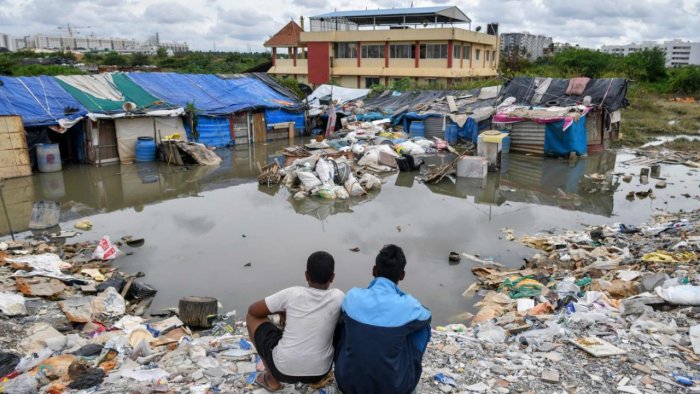
India ranks 132 out of 191 in UNDP's human development index; Bangladesh better

News Network
September 8, 2022

india.jpg

India ranked 132 out of 191 countries in the 2021 human development index, according to a report released by the United Nations Development Programme (UNDP).

India's HDI value of 0.633 places the country in the medium human development category, lower than its value of 0.645 in the 2020 report. India ranked 131 among 189 countries in the 2020 human development index.

"Like global trends, in India's case, the drop in HDI from 0.645 in 2019 to 0.633 in 2021 can be attributed to falling life expectancy - 69.7 to 67.2 years. India's expected years of schooling stand at 11.9 years, and the mean years of schooling are at 6.7 years," the report said.

Human Development - a measure of a nation's health, education, and average income - has declined for two years in a row - 2020 and 2021, reversing five years of progress, the report said.

This is in line with the global decline, indicating that human development across the world has stalled for the first time in 32 years, the report said.

The report said a large contributor to the Human Development Index's recent decline is a global drop in life expectancy, down from 72.8 years in 2019 to 71.4 years in 2021.

The latest Human Development Report - Uncertain Times, Unsettled Lives: Shaping our Future in a Transforming World - launched by UNDP - argues that layers of uncertainty are stacking up and interacting to unsettle life in unprecedented ways.

"The world is scrambling to respond to back-to-back crises. We have seen with the cost of living and energy crises that, while it is tempting to focus on quick fixes like subsidizing fossil fuels, immediate relief tactics are delaying the long-term systemic changes we must make," said Achim Steiner, administrator, UNDP.

"We are collectively paralyzed in making these changes. In a world defined by uncertainty, we need a renewed sense of global solidarity to tackle our interconnected, common challenges," Steiner said.

These intersecting crises have impacted India's development trajectory just as they have in much of the world.

The HDI measures progress on 3 key dimensions of human development - a long and healthy life, access to education, and a decent standard of living. It is calculated using four indicators – life expectancy at birth, mean years of schooling, expected years of schooling, and the Gross National Income (GNI) per capita.

"The Human Development Report shows that progress globally is in reverse. India's decline in human development mirrors this trend – impacted by intersecting crises. But there is good news. Compared to 2019, the impact of inequality on human development is lower," said Shoko Noda, UNDP Resident Representative in India.

"India is bridging the human development gap between men and women faster than the world. This development has come at a smaller cost to the environment. India's growth story reflects the country's investments in inclusive growth, social protection, gender-responsive policies, and push towards renewables to ensure no one is left behind," said Noda.

While some countries are beginning to get back on their feet, recovery is uneven and partial, further widening inequalities in human development. Despite a significant economic recovery in 2021, the health crisis intensified, with two-thirds of countries recording even further reductions in life expectancy at birth, the report said.

India's HDI value continues to exceed South Asia's average human development. India's HDI value has been steadily catching up to the world average since 1990 - indicating a faster than the global rate of progress in human development. This is a result of policy choices made by the country over time, including investments made in health and education.

South Asian economies like Bangladesh (129) and Bhutan bucked the trend and registered an improvement, the report pointed out.

The report also suggested that stress, sadness, anger, and worry have been increasing over the last decade, now reaching record levels.

On average, countries spend less than two per cent of their healthcare budgets on mental health, which limits access to mental health services for citizens globally.

Uncertainty, inequality, and insecurity go hand in hand with polarization and lack of trust. Polarization and mistrust shrink our capacity for social dialogue and stifle collective action, it said.

The report recommends implementing policies that focus on 3 Is - investment - from renewable energy to preparedness for pandemics and insurance - including social protection - to prepare our societies for the ups and downs of an uncertain world. While innovation in its many forms - technological, economic, cultural - can also build capacities to respond to whatever challenges come next.

"Policies that focus on the 3Is will enable people to thrive in the face of uncertainty. India is already a frontrunner in these areas with its push towards renewable energy, boosting social security for the most vulnerable and driving the world's largest vaccination drive through Co-WIN, supported by UNDP," added Noda.

Over the last decade, India has lifted a staggering 271 million out of multidimensional poverty.

The country is improving access to clean water, sanitation, and affordable clean energy. India has also boosted access to social protection for vulnerable sections of society, especially during and after the pandemic, with a 9.8 per cent increase in the budgetary allocation to the Social Services sector in 2021-22 over 2020-21, the report said.


Comments

Add new comment

  • Coastaldigest.com reserves the right to delete or block any comments.
  • Coastaldigset.com is not responsible for its readers’ comments.
  • Comments that are abusive, incendiary or irrelevant are strictly prohibited.
  • Please use a genuine email ID and provide your name to avoid reject.
News Network
December 3,2025

indigo.jpg

IndiGo, India’s largest airline, is battling one of its worst operational disruptions in recent years, with hundreds of delays and cancellations throwing domestic travel into chaos.

Government data on Tuesday showed its on-time performance plunging to 35%, an unusual dip for a carrier long associated with punctuality.

By Wednesday afternoon, airports in Delhi, Mumbai, Bengaluru and Hyderabad had collectively reported close to 200 cancellations, stranding travellers across the country.

Crew Shortage After New Duty Norms

A major trigger behind the meltdown is a severe crew shortage, especially among pilots, following the rollout of revised Flight Duty Time Limitation (FDTL) norms last month.

The rules mandate longer rest hours and more humane rosters — a shift IndiGo has struggled to incorporate across its vast network.

Sources said several flights were grounded due to lack of cabin crew, while some delays stretched upwards of eight hours.

With IndiGo controlling over 60% of India’s domestic aviation market, the ripple effect has impacted airports nationwide.

IndiGo Issues Apology, Lists “Compounding Factors”

In a statement, IndiGo acknowledged the large-scale disruption:

“We sincerely apologise to customers. A series of unforeseen operational challenges — technology glitches, winter schedule changes, adverse weather, system congestion and updated FDTL norms — created a compounding impact that could not have been anticipated.”

To stabilise operations, the airline has begun calibrated schedule adjustments for the next 48 hours, aiming to restore punctuality. Affected passengers are being offered refunds or alternate travel arrangements, IndiGo said.

What the FDTL Rules Require

The FDTL norms, designed to reduce pilot fatigue, cap duty and flying hours as follows:
•    Maximum 8 hours of flying per day
•    35 hours per week
•    125 hours per month
•    1,000 hours per year

Crew must also receive rest equalling twice the flight duration, with a minimum 10-hour rest period in any 24-hour window.

The DGCA introduced these limits to enhance flight safety.

Hyderabad: 33 Flights Cancelled, Long Queues Reported

Hyderabad’s Rajiv Gandhi International Airport saw heavy early-morning crowds as 33 IndiGo flights (arrivals and departures) were cancelled.

The airport clarified on X that operations were normal, advising passengers to contact IndiGo directly for latest flight status.

Cancellations included flights to and from Visakhapatnam, Goa, Ahmedabad, Delhi, Bengaluru, Chennai, Madurai, Hubli, Bhopal and Bhubaneswar.

Bengaluru: 42 Flights Disrupted

Bengaluru’s Kempegowda International Airport recorded 42 cancellations — 22 arrivals and 20 departures — affecting routes to Delhi, Mumbai, Chennai, Hyderabad, Goa, Kolkata and Lucknow.

Passengers Vent on Social Media

Irate travellers took to X to share their experiences. One passenger stranded in Hyderabad wrote: “I have been here since 3 a.m. and missed an important meeting.”

Another said: “My flight was pushed from 1:55 PM to 2:55 PM and now 4:35 PM. I was informed only three minutes before entering the airport.”

Delhi Airport Hit by Tech Glitch

At Delhi Airport, the disruption deepened due to a slowdown in the Amadeus system — used for reservations, check-ins and departure control.

The technical issue led to longer queues and sluggish processing, adding to delays already worsened by staff shortages.

Comments

Add new comment

  • Coastaldigest.com reserves the right to delete or block any comments.
  • Coastaldigset.com is not responsible for its readers’ comments.
  • Comments that are abusive, incendiary or irrelevant are strictly prohibited.
  • Please use a genuine email ID and provide your name to avoid reject.
News Network
December 1,2025

hindutvaboy.jpg

Udupi, Dec 1: A horrific case of alleged rape has unfolded in Udupi, where a worker from a Hindutva organisation, previously arrested and released on bail for harassing a young woman, is now accused of waylaying and sexually assaulting her.

The arrested individual has been identified as Pradeep Poojary (26), a member of the Hindu Jagarana Vedike's Nairkode unit in Perdur.

Poojary had allegedly been relentlessly harassing the young woman, pressuring her to marry him. When she bravely stood up to him and refused his demands, she filed a formal complaint at the Hiriyadka police station. He was subsequently arrested in that initial harassment case but was later granted bail.

According to police reports, driven by the same malicious grudge, Poojary allegedly intercepted the woman again on November 29. While she was walking through a deserted area, the accused is claimed to have threatened her by grabbing her neck. When she again refused to marry him, he allegedly proceeded to rape her.

The survivor immediately informed her family about the traumatic assault. Following this, her parents lodged a complaint at the Udupi women’s police station.

Police arrested Poojary again and produced him before the court. He has since been remanded to judicial custody.

Comments

Add new comment

  • Coastaldigest.com reserves the right to delete or block any comments.
  • Coastaldigset.com is not responsible for its readers’ comments.
  • Comments that are abusive, incendiary or irrelevant are strictly prohibited.
  • Please use a genuine email ID and provide your name to avoid reject.
News Network
November 29,2025

DKSsiddu.jpg

New Delhi: Karnataka chief minister Siddaramaiah and deputy CM DK Shivakumar on Saturday put up a dramatic display of unity at a closely watched joint press briefing, firmly dismissing weeks of speculation about a power-sharing tussle within the Congress. With the high command nudging both leaders to sit together and settle the dust, the meeting became a political spectacle, ending with the duo declaring that there was “no confusion, no differences.”

Calling the reports of a rift “manufactured confusion,” Siddaramaiah said the talks had gone smoothly, even joking about their breakfast. “Breakfast was very good. All three of us enjoyed it,” he said. “We want to end this confusion once and for all. For local elections and for 2028, our mission is clear — Congress must return to power. There is no difference between me and DKS, not now, not before.”

He blamed the media for fuelling rumours and reiterated absolute adherence to the party leadership. “From tomorrow, let there be no confusion. What the high command says, we will follow.”

Siddaramaiah also assured that the Assembly session starting December 8 would run smoothly and vowed that Congress would take on the BJP and JD(S) “together.”

Shivakumar echoed the chief minister word for word, stressing loyalty and discipline. “People have given us a massive mandate. It is our duty to deliver,” he said. “This government was formed under Siddaramaiah’s leadership. We both have complete trust in the high command. If they tell me to wait, I will wait.”

He added that the two leaders had discussed strategy for the 2028 Assembly elections. “Whatever the CM says, I agree. We are loyal soldiers of the party. The party may be facing challenges nationally, but we will keep it strong in Karnataka.”

Shivakumar also said Siddaramaiah would soon visit his home for lunch or dinner — another symbolic gesture meant to underline their unity.

Both leaders later posted on social media describing the breakfast meeting as “productive” and focused on “Karnataka’s priorities.”

The BJP, however, rejected the show of camaraderie as “pure bunkum,” accusing Congress of trying to paper over an internal power struggle. But Siddaramaiah and Shivakumar insisted their united front would continue — and that there was “no confusion” within the state leadership.

Comments

Add new comment

  • Coastaldigest.com reserves the right to delete or block any comments.
  • Coastaldigset.com is not responsible for its readers’ comments.
  • Comments that are abusive, incendiary or irrelevant are strictly prohibited.
  • Please use a genuine email ID and provide your name to avoid reject.