Key takeaways from Supreme Court verdict on Article 370 abrogation

News Network
December 11, 2023

court.jpg

The Supreme Court issued its decision on a slew of petitions challenging the abrogation of the Article 370 provisions on Monday (December 11, 2024).

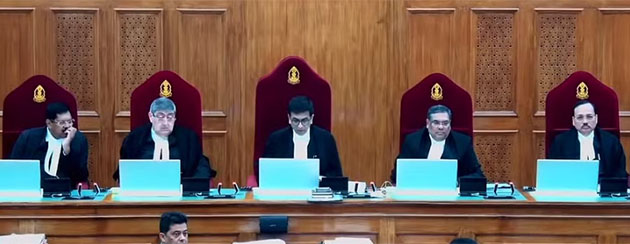
The Supreme Court upheld the Centre's decision to abrogate Article 370, saying it lacked "mala fide" intent. Chief Justice of India D Y Chandrachud announced the decision on behalf of Justices Gavai and Surya Kant as well, stating that Article 370 of the Constitution is a provision that is temporary and that the president has the authority to revoke it.

Chief Justice D Y Chandrachud led a five-judge Constitution bench that rendered the decision. Sanjay Kishan Kaul, Sanjiv Khanna, B R Gavai, and Surya Kant were the other members of the bench.

Following a 16-day hearing, the Supreme Court reserved its decision in the case on September 5.

Here are the major takeaways from the Supreme Court’s verdict:

- CJI D Y Chandrachud said that the five-judge bench made three judgements in the matter, and all were unanimous.

- Every decision taken by Union on behalf of the State is not subject to challenge, as this would eventually lead to chaos and uncertainty and would bring the administration of the State to a standstill, CJI said.

- The Supreme Court said the argument of petitioners that the Union government cannot take actions of irreversible consequences in the State during Presidential rule is not acceptable.

- The Supreme Court says it holds that Jammu and Kashmir did not retain an element of internal sovereignty after it acceded to India.

- SC held that Jammu and Kashmir became an integral part of India as evident from Articles 1 and 370 of the Constitution of India.

- Reading out the judgment CJI said, SC holds Article 370 was an interim arrangement due to war conditions in the State. Textual reading also indicates that Article 370 is a temporary provision.

- The Supreme Court held that the power of the President to issue a notification that Article 370 ceases to exist subsists even after the dissolution of the J&K Constituent Assembly.

- The Supreme Court said Article 370 was meant for the constitutional integration of Jammu and Kashmir with the Union and it was not for disintegration.

- J&K does not have internal sovereignty different from other states of the country, the CJI said.

- The Constituent Assembly of J&K was never intended to be a permanent body, the CJI also said.

- The Supreme Court said the concurrence of the State government was not required to apply all provisions of the Constitution using Article 370(1)(d). So, the President of India taking the concurrence of the Union government was not mala fide.

- The SC also said that the recommendation of Constituent Assembly of J&K was not binding on the President of India.

- The SC held the president seeking concurrence of union and not state as valid, and all provisions of the Indian constitution can be applied to J&K.

- The restoration of statehood in Union Territory of J&K shall be done at the earliest, said the CJI.

- The Supreme Court upheld the reorganisation of Ladakh as a Union Territory.

Comments

Add new comment

  • Coastaldigest.com reserves the right to delete or block any comments.
  • Coastaldigset.com is not responsible for its readers’ comments.
  • Comments that are abusive, incendiary or irrelevant are strictly prohibited.
  • Please use a genuine email ID and provide your name to avoid reject.
News Network
December 5,2025

indigoCEO.jpg

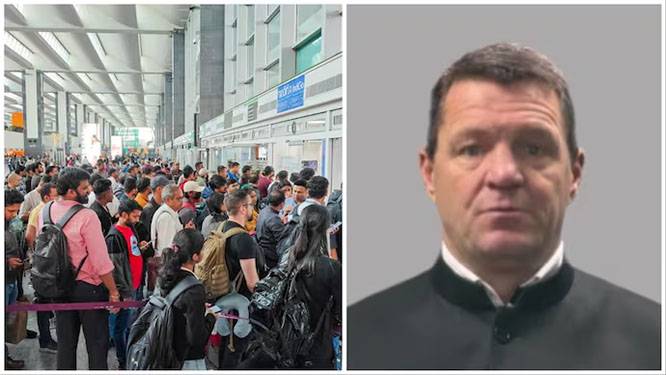
New Delhi, Dec 5: IndiGo CEO Pieter Elbers issued a public apology this evening after more than a thousand flights were cancelled today, making it the "most severely impacted day" in terms of cancellations. The biggest airline of the country cancelled "more than half" of its daily number of flights on Friday, said Elbers. He also said that even though the crisis will persist on Saturday, the airline anticipates fewer than 1,000 flight cancellations.

"Full normalisation is expected between December 10 and 15, though IndiGo cautions that recovery will take time due to the scale of operations," the IndiGo CEO said. 

IndiGo operates around 2,300 domestic and international flights daily.

Pieter Elbers, while apologising for the major inconvenience due to delays and cancellations, said the situation is a result of various causes.

The crisis at IndiGo stems from new regulations that boost pilots' weekly rest requirements by 12 hours to 48 and allow only two night-time landings per week, down from six. IndiGo has attributed the mass cancellations to "misjudgment and planning gaps".

Elbers also listed three lines of action that the airline will adopt to address the issue.

"Firstly, customer communication and addressing your needs, for this, messages have been sent on social media. And just now, a more detailed communication with information, refunds, cancellations and other customer support measures was sent," he said.

The airline has also stepped up its call centre capacity.

"Secondly, due to yesterday's situation, we had customers stranded mostly at the nation's largest airports. Our focus was for all of them to be able to travel today itself, which will be achieved. For this, we also ask customers whose flights are cancelled not to come to the airports as notifications are sent," the CEO said.

"Thirdly, cancellations were made for today to align our crew and planes to be where they need to start tomorrow morning afresh. Earlier measures of the last few days, regrettable, have proven not to be enough, but we have decided today to reboot all our systems and schedules, resulting in the highest numbers of cancellations so far, but imperative for progressive improvements starting from tomorrow," he added.

As airports witnessed chaotic scenes, the Directorate General of Civil Aviation (DGCA) stepped in to grant IndiGo a temporary exemption from stricter night duty rules for pilots. It also allowed substitution of leaves with a weekly rest period. 

Civil Aviation Minister Ram Mohan Naidu has said a high-level inquiry will be ordered and accountability will be fixed.

Comments

Add new comment

  • Coastaldigest.com reserves the right to delete or block any comments.
  • Coastaldigset.com is not responsible for its readers’ comments.
  • Comments that are abusive, incendiary or irrelevant are strictly prohibited.
  • Please use a genuine email ID and provide your name to avoid reject.
News Network
November 21,2025

Tejas.jpg

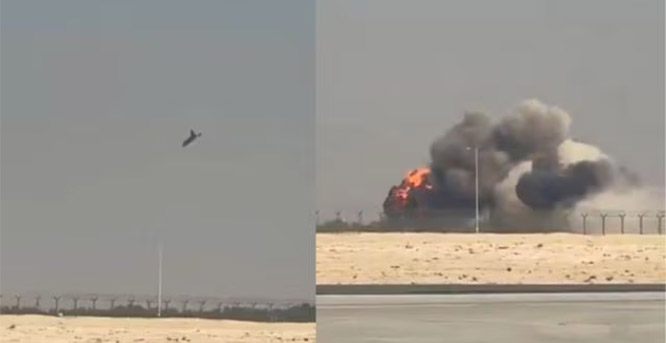
An Indian Air Force (IAF) Tejas fighter jet crashed on Friday, November 21, afternoon during its aerial demonstration at the Dubai Air Show, plunging to the ground at around 2:10 pm local time while performing a manoeuvre before thousands of spectators.

The IAF confirmed the incident, stating that a Tejas aircraft participating in the show had crashed and that further details were being gathered. An Air Force spokesperson said more information would be shared after initial assessments.

The crash sent thick black smoke billowing into the sky near the airport, causing panic among visitors, including families and children who had gathered to watch the display. Authorities have not yet confirmed whether the pilot managed to eject before the aircraft went down. Emergency response teams rushed to the scene, and officials have not released information on casualties or damage so far.

The Tejas is a 4.5-generation, multi-role fighter aircraft developed indigenously by Hindustan Aeronautics Limited (HAL). Designed for versatility, it is capable of offensive air support, close combat, ground attack missions and maritime operations. The aircraft family includes single-seat fighters and twin-seat trainers for both the Air Force and Navy.

HAL describes the latest version, the LCA Mk1A, as the most advanced in the series, featuring an AESA radar, an upgraded electronic warfare suite with radar-warning and self-protection jamming, smart multifunction displays, a digital map generator, a combined interrogator–transponder system and a modern radio altimeter. These enhancements significantly improve the aircraft’s combat capability and survivability.

Further updates from IAF and UAE authorities are awaited.

Comments

Add new comment

  • Coastaldigest.com reserves the right to delete or block any comments.
  • Coastaldigset.com is not responsible for its readers’ comments.
  • Comments that are abusive, incendiary or irrelevant are strictly prohibited.
  • Please use a genuine email ID and provide your name to avoid reject.
News Network
November 22,2025

The Karnataka government has announced a 50% rebate on pending traffic and transport fines. The discount is available from November 21 to December 12.

The rebate applies to all traffic e-challans and violation cases booked by the RTO between 1991–92 and 2019–20. Officials clarified that the offer is not applicable to pending tax dues and is restricted only to traffic-violation fines.

Across Karnataka, more than 4 lakh RTO cases remain pending, including those involving transport vehicles. While thousands of vehicle owners have already cleared their dues, the department expects to generate substantial revenue through this limited-period rebate.

How to Pay and Avail the Discount

There are three ways to check and pay your pending fines:

1. Through Mobile Apps
Available on both Play Store and App Store:
•    Karnataka State Police (KSP) app
•    KarnatakaOne app
•    ASTraM app

Steps:
•    Enter your vehicle number in any of the above apps
•    Verify the photo/details of your vehicle
•    Pay the fine with the 50% discount applied

2. Visit a Traffic Police Station

You can pay your pending fine at any nearby traffic police station.

3. Visit the Traffic Management Centre (TMC)

•    Location: First Floor, Infantry Road, near Indian Express, Bengaluru

Transport Commissioner Yogeesh A M said, “We don't issue e-challans, so there's no online payment system.”

The department estimates ₹52 crore in pending RTO fines up to March 2020. “With the 50% rebate, we expect to collect around ₹25 crore if all dues are cleared,” he added.

Comments

Add new comment

  • Coastaldigest.com reserves the right to delete or block any comments.
  • Coastaldigset.com is not responsible for its readers’ comments.
  • Comments that are abusive, incendiary or irrelevant are strictly prohibited.
  • Please use a genuine email ID and provide your name to avoid reject.